


Saturday, March 6, 2010
Lotus has presented Evora 414E Hybrid


In Lotus especially are proud of the special system, capable to reproduce sounding of the powerful petrol engine. Growl of the motor which reaches from the audiocolumns placed in forward and back parts Lotus Evora 414E Hybrid, is audible not only outside, but also in the car. Lotus in the future is intended to use the given system on serial electromobiles and hybrids, that, by the way, it will positively be reflected in safety of visually impaired pedestrians.
Renault Clio RS by Gordini

New hatchback Renault Twingo
After hatchback Renault Twingo studio Gordini tuners have finished model Clio which will go on sale under name Clio Gordini 200. The car differs from donor Clio RS only dark blue colour of a body and white "racing" stickers. Leather salon Renault Clio Gordini 200 diversified with the metal and varnished inserts.

Interior hatchback Renault Twingo
In sale Renault Clio Gordini 200 will arrive in the summer of current year.
Related Posts: Renault
On a motor show in Geneva debuted concept car Hyundai

Hyundai i-Flow <-> Hyundai Sonata
It is necessary to notice also, that at length of 4780 mm, to width of 1850 mm, to height of 1420 mm and wheel base of 2800 mm i-Flow it is practically identical on dimensions of last Sonata so, to sell both cars simultaneously to Koreans it is not meaningful.So smooth, flowing lines can be found out and in interior registration. Short strokes are not present — long wavy bends last through all salon, from a control panel to doors and further to a luggage compartment. Furnish materials — the most hi-tech, allowing essentially to lower weight.
Concept car Hyundai i-Flow
Under a cowl the first is concealed hybrid a diesel engine-electric installation Hyundai consisting of the new 1,7-litre motor and system of a two-phasic turbo-supercharging, receiving a food from lithium-polymeric of storage batteries.Occurrence of serial model is expected in 2011.
Related Posts: Hyundai
New "charged" Ford Focus will appear in two years

«Start/Stop» for new Focus RS
Besides, journalists Auto Express knew, that new "RS" will be completed with system "Start/Stop", and also the robotised transmission with two couplings. It is expected, that from 0 to 100 km/h this car will be dispersed approximately for five seconds.Light version RS
Concern Ford does not cease to work and over Focus RS current generation. Earlier it was informed, that the motor-car manufacturer plans to make the limited series facilitated "RS" at which the 2,5-l engine will be forced to 350HP. This version will receive name Clubsport. In total it will be collected such 500 cars.Related Posts: Ford
Kia has shown hybrid Ray and electric concept car Venga

It is a compact sedan in length of 4,4 m, created on a platform of model Forte it urged to show prospects of the hybrid car with possibility of additional charge from the electric socket.
LiPoly for KIA Ray
Thanks to modern li-ionic accumulators created with use of technology LiPoly, KIA Ray is capable to overcome on electrodraught more than 80 km without additional charge. On assurance of a motor-car manufacturer, at use of a hybrid power-plant, the car consumes only 1,398 l of fuel on 100 km, and the maximum run without refuelling and additional charge makes record 1200 km.The concept car body is covered by sun-protection materials and the special paint limiting penetration of solar heat inside. This technology allows to lower essentially loading on a central air and, as consequence, to reduce energy consumption.
The Concept car is equipped by the 1,4-l petrol engine power of 115HP with system of direct injection of fuel (GDI). Besides, the hybrid power-plant includes the electric motor power of 106HP, located between the engine and transmission.

Concept car KIA Venga EV
Concept car KIA Venga EV — the car with completely electric drive became one more novelty at stand KIA in Geneva. The sizes of the concept car, presented under brand EcoDynamic, are identical to the sizes usual KIA Venga — a class minivan «B» which already is on sale in Europe.The car is equipped by the electromotor power of 109HP c the maximum twisting moment equal 280Nm. A motor food is carried out from a dual accumulator room of the battery. In a mode of fast gymnastics for 20 minutes the accumulator is charged on 80%.
Venga EV has a forward drive. The car electromotor is located in a forward part, there, where the internal combustion engine usually settles down, and storage batteries are placed under a trunk floor. To 100 km/h the car is dispersed for 10.8 sec, and the maximum speed makes 140 km/h.
Related Posts: KIA
Friday, March 5, 2010
New Volkswagen Sharan with the shifted doors

Minivan VW Sharan
The family car at length reaches 4,85 m, at width — 1,9 m, in height — 1,72 m, and the wheel base of a minivan is equal almost 3 m. Appearance Volkswagen Sharan is executed in a new corporate style of German concern. In a forward part of a minivan there was a lattice of a radiator and head headlights in style of hatchback Golf, and also chromeplated emblem Volkswagen.


New interior Volkswagen Sharan
To issue the order on new Volkswagen Sharan it will be possible this month.
Related Posts: Volkswagen
Thursday, March 4, 2010
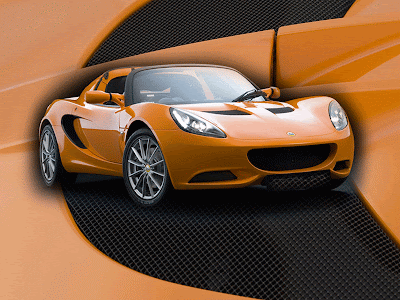
2011 Lotus Sport Cars Elise With Valvematic System Plus Combined dual VVT-i
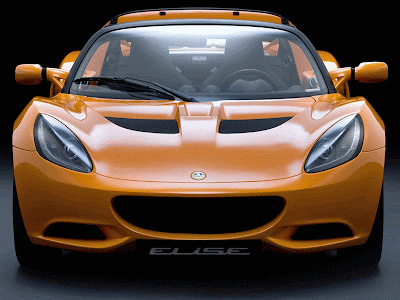
Making its debut at the 80th International Geneva Motorshow, the 2011 model year Lotus Elise introduces a number of changes and improvements to maintain its class leading position. The Lotus Elise revolutionised the sportscar market 14 years ago when the small lightweight agile 2-seat mid engine sportscar was introduced. By ensuring that the Lotus Elise stuck rigidly to Lotus' core values of performance through light weight, the Lotus Elise was able to produce supercar performance with city car economy.
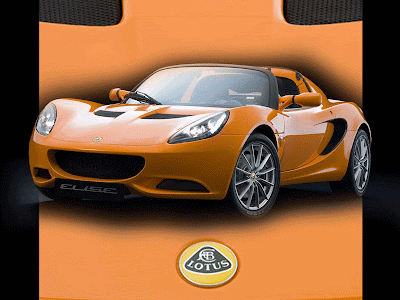
2011 Lotus Sport Cars Elise
The body of the new 2011 Lotus Elise is an evolution of the iconic Elise design, retaining the character and style, while offering a more planted, purposeful stance and a pure, contemporary look that links it to the Evora. As with all Lotus product the design is an exciting blend of dramatic style and functional efficiency. At the rear of the car the new engine has been encased by a distinctive "twin-spine" engine cover whilst lower down a more aggressive diffuser is tightly wrapped by an elegant new bumper design that now includes the rear licence plate.
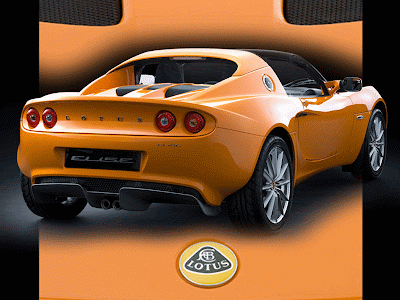
2011 Lotus Sport Cars Elise
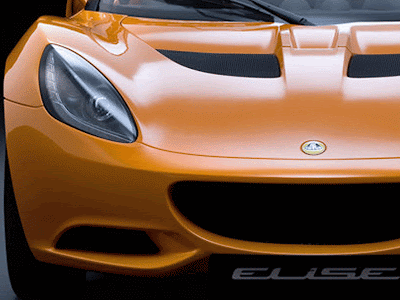
New headlamp units with distinctively sculptured LED lighting guides (incorporating daytime running lamps and direction indicators) give a contemporary twist to this classic design. Elsewhere, the signature, Lotus "mouth" and familiar sculptured forms have been sensitively refined to give a crisper, more dynamic look.
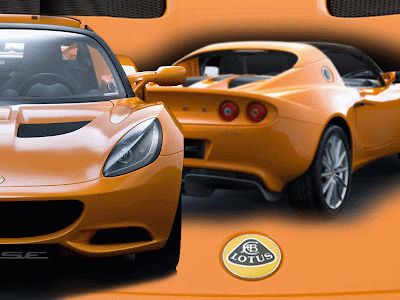
2011 Lotus Sport Cars Elise
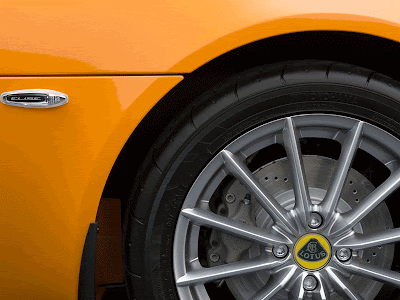
The rear boot is now opened from the cockpit rather than via a separate key operation. The high quality feel of the Lotus Elise is continued throughout the car with the Lotus Elise graphic incorporated into the new side LED direction indicators, like those on the Evora. The driving position, from the perfectly positioned pedals and steering wheel, to the comfortable and supportive seats with ProBax technology means that, like all Lotus cars, the driver becomes part of the car rather than being just a passenger. With the sleek new body the aerodynamics have improved giving a reduction in the coefficient of drag of 4%.
2011 Lotus Sport Cars Elise
The Lotus Elise introduces the new 1598 cm3, 1ZR-FAE engine, provided by Toyota. The key to this engine's performance and efficiency is the Valvematic system (a variable valve lift mechanism), which is combined with the dual VVT-i (Variable Valve Timing-intelligent). The engine continuously controls intake valve opening/closing timing and the intake valve lift to vary the volume of the intake airflow, giving significant improvements in efficiency and fuel economy. This ensures optimal performance based on the engines operational condition, thus helping the Lotus Elise achieve both high fuel efficiency and high performance.
2011 Lotus Sport Cars Elise
First of all, the maximum power output is achieved at near maximum revs (engine speed) of 6800 rpm and maximum torque (a respectable 160 Nm, 118 lb.ft) is reached at 4400 rpm. This gives a good combination of mid range pull but also encourages the driver to rev the engine to the maximum permitted engine speed of 7000 rpm (transient rev limit). Like all Lotus Elise sportscars, there are three shift up lights, on the binnacle cumulatively lighting when the driver is getting closer to the rev limiter and when all three are illuminated, they flash to indicate that the driver is almost on the rev limiter so time to change up a gear! New cast wheels have been designed specifically for the Lotus Elise and the new optional forged wheels weigh just 29.26 kg per set, 2.14 kg lighter than a set of lightweight cast versions. Both are available in silver or black colour.
Andreas Prillmann, Chief Commercial Officer for Lotus Cars said, "In its 14 years of production the Lotus Elise has accounted for 32% of all the 61 years of Lotus production, illustrating how significant to the brand and well loved it is. The 2011 Lotus Elise is greener, purer and more desirable, making it even more relevant to today's marketplace. The new Elise underlines Lotus' reputation as one of the most innovative sports car manufacturers in the world."
2011 Lotus Sport Cars Elise
The height of the engine cover has been raised by 34mm to accommodate the taller 1ZR engine compared to the previous 1ZZ engine from the outgoing model due, in part, to the additional Valvematic technology included on the new engine. This has given Lotus engineers an opportunity to subtly redesign the rear engine cover to match the design theme from the front and rear of the car.
The legendary Lotus ride and handling gives a superb high performance, sporty drive, combined with a compliant ride and progressive on limit handling, it makes the Lotus Elise a car that demands to be driven.
The entry level Lotus Elise weighs 876 kg, making it one of the lightest fully homologated sportscars in the world. This low weight translates into efficient performance with minimal environmental impact in terms of emissions and fuel consumption. The efficiency of the Lotus Elise structure means that the 136 PS (100 kW, 134 hp) delivers phenomenal performance.
2011 Opel Vauxhall Ampera Plug-in Hybrid
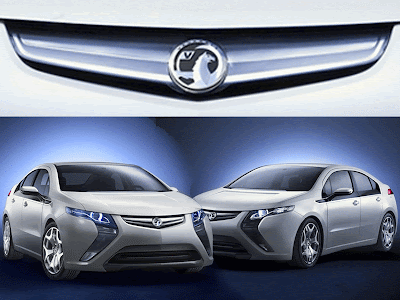
The most enlightening spy photos of the production version of the 2011 Opel Ampera plopped in our inbox today. At first we thought it was just the concept model out testing, but a closer look at the completely undisguised Ampera with the German license plates revealed that this is the actual production model that's due to go on sale in Europe and the UK (as a Vauxhall) in late 2011.

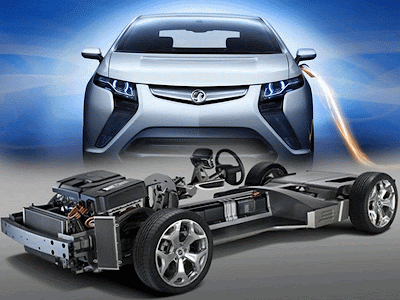
2011 Opel Vauxhall Ampera Plug-in Hybrid
Vauxhall Ampera will be unveiled along with Vauxhall Meriva compact MPV at the Geneva Motor Show 2010. Vauxhall Ampera, schedule for production late next year, is a five-door four-seater with same design DNA as Astra and the Car of the year-winning Insignia. Ampera uses extended-range electric vehicle (E-REV) technology. E-REV uses electricity as its primary power source, supplemented by a small engine to generate electricity for its motors when electric power runs low. This helps the Ampera overcome the ‘range anxiety’ issues associated with pure electric cars.
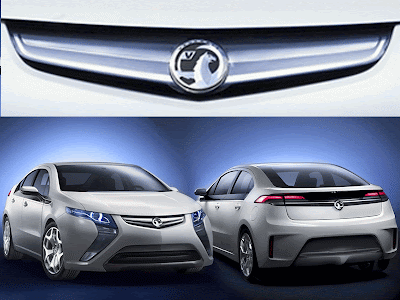
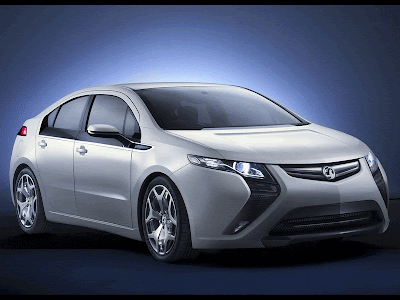
2011 Opel Vauxhall Ampera Plug-in Hybrid
Unlike other conventional propulsion systems, E-REV uses electricity as its primary power source, supplemented by a small engine to generate electricity for its motors when electric power runs low. This helps the Ampera overcome the ‘range anxiety’ issues associated with pure electric cars. Vauxhall will unveil not one, but two cars at this year’s Geneva Motor Show on March 2, with world premieres of the all-new Meriva compact MPV and a futuristic concept car, which is set to boost the company’s credentials as a leader in environmental vehicles.
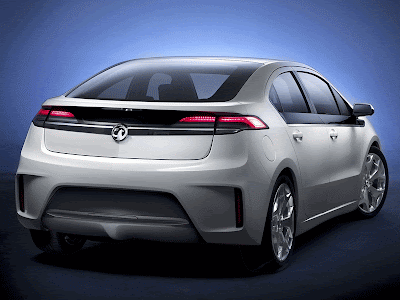
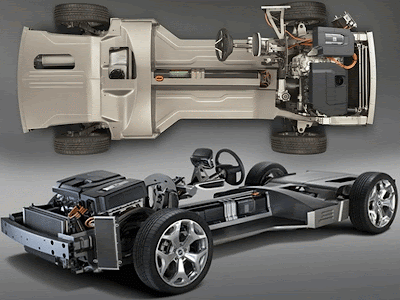
2011 Opel Vauxhall Ampera Plug-in Hybrid
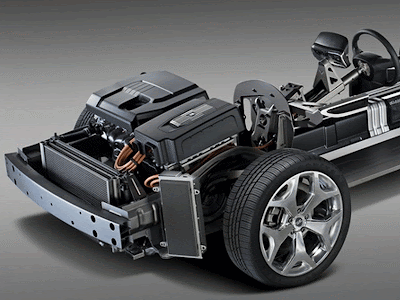
A quick recap of the details we already know, the Ampera will use the same plug-in hybrid gasoline-electric drivetrain as the Volt. It mates a powerful electric motor and a 16-kWh, lithium-ion battery pack to a 75HP 1.4-liter gasoline engine. But unlike conventional hybrids that use gasoline engines to power the wheels when the battery is depleted, the Ampera uses the petrol unit to generate electricity for the electric motor that always drives the (front) wheels. Owners will be able to charge the battery pack with a home outlet and drive for about 64km or 40 miles before the gasoline engine-generator kicks in to extend the Ampera's range to more than to more than 300 miles or 480 kilometers.
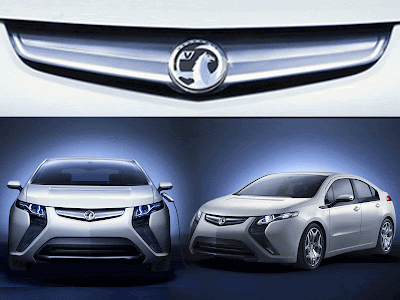
2011 Opel Vauxhall Ampera Plug-in Hybrid
Bolstering this message still further at the show will be the groundbreaking Ampera extended-range electric vehicle and Vauxhall’s most economical production car to date, the latest Corsa ecoFLEX.
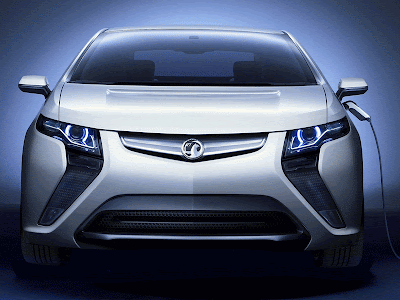
2011 Opel Vauxhall Ampera Plug-in Hybrid
‘Vauxhall is covering all bases at Geneva,’ said Duncan Aldred, Vauxhall’s Managing Director. ‘With the Meriva, we have a unique and innovative take on family motoring, but the concept car and Ampera prove that we are truly at the forefront of environmental technology. These vehicles also show that their versatility and efficiency doesn’t come at the expense of stunning design.’
2011 Redesigned Toyota Avalon Third Generation
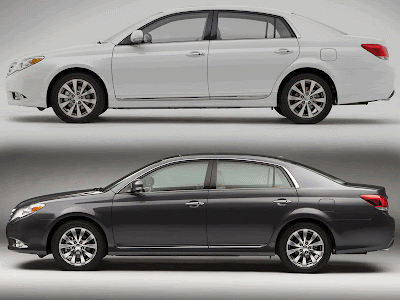
Evoking a time when travel was sophisticated, elegant and comfortable, the new Toyota Avalon possesses a distinctive new exterior style while offering a restyled interior rich with premium touch points and practical new technologies. Toyota introduced the boldly redesigned 2011 Toyota Avalon at the 2010 Chicago Auto Show. The third generation Toyota Avalon was introduced in four models: the standard XL, the sport Touring, the XLS, and the luxury Limited. Each combined generous interior room with powerful engine performance.
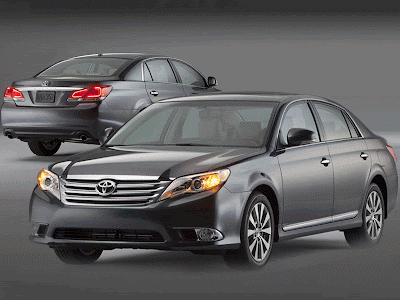
2011 Redesigned Toyota Avalon Third Generation
Designed at Toyota’s Calty Design Research in California, and assembled at Toyota’s Georgetown Kentucky manufacturing plant, the third-generation Avalons all have front grilles with horizontal chrome bars, large tail lamps, distinctive trunks, and dual exhaust outlets.
Even with numerous refinements inside and out, the Toyota Avalon remains true to the idea that comfort is honest and uncomplicated, and "Traveling Avalon Class" is rich in simple, familiar pleasures.
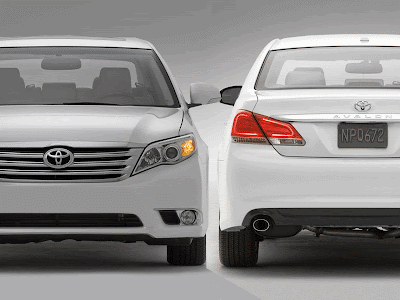
2011 Redesigned Toyota Avalon Third Generation
The new Toyota Avalon has dynamic and expressive lines, and an infusion of comfort, safety and technology advancements that enrich the driving experience. Upgraded equipment and technology features, such as a touch-screen navigation system with real-time traffic, and Bluetooth® hands-free phone capability with music streaming to the audio system are among the improvements that enhance the 2011 Avalon's excellent blend of spaciousness, comfort and technology.
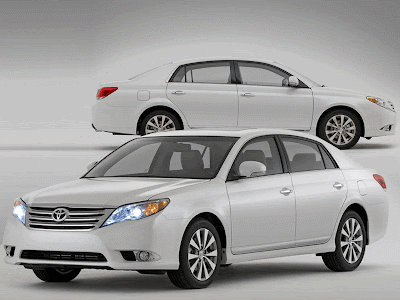
2011 Redesigned Toyota Avalon Third Generation
"The Toyota Avalon has long been appreciated by smart, conscientious consumers who recognize quality materials and the beauty of detailed craftsmanship," said Bob Carter, group vice president and general manager, Toyota Division, Toyota Motor Sales, U.S.A. "The changes made for 2011 will allow us to build on our position in the premium large car segment. The competition does not stand still, and neither do we."
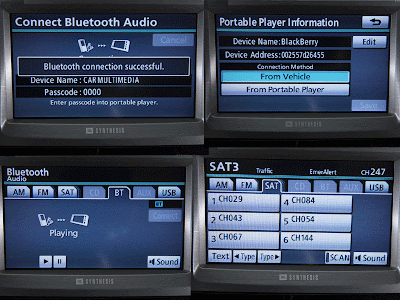
2011 Redesigned Toyota Avalon Third Generation
Restyled at Calty Design Research in Newport Beach, Calif., the Toyota Avalon is assembled at Toyota Motor Manufacturing Kentucky (TMMK), a "zero landfill" facility that also assembles the Camry, Camry Hybrid, and Venza. It was also developed at the Toyota Technical Center (TTC) in Ann Arbor, Mich. For 2011, Calty restyled Toyota Avalon to project an elegant, outgoing presence. A wider, more substantial grille ties into state-of-the-art projector headlamps, working with a broad, undisturbed front hood to suggest a lowered center of gravity and emphasize the Toyota Avalon's wide stance.
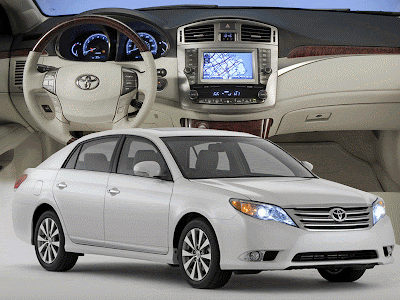
2011 Redesigned Toyota Avalon Third Generation
A power rear sunshade, deployable via a one-touch lever, filters direct sunlight coming through the rear window. The sunshade, which helps to protect rear seat passengers from unwanted light and heat, automatically detracts when the driver selects reverse gear. Toyota Avalon's exceptional combination of ample horsepower and excellent fuel economy offers one of the best overall dynamic performances in the large sedan segment.
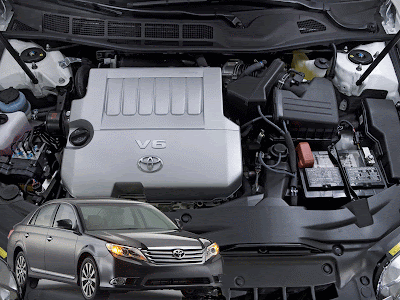
2011 Redesigned Toyota Avalon Third Generation
The 2011 Avalon is powered by a 24-valve, dual-overhead cam 3.5-liter V6 engine that produces 268 horsepower at 6,200 rpm. The engine is equipped with the latest dual VVT-i electronic valve-control mechanism that provides a broader powerband, while requiring less fuel and generating fewer emissions. It is mated to a multi-mode six-speed automatic transmission. The 2011 Toyota Avalon is an Ultra Low Emission Vehicle (ULEV), EPA-estimated to deliver 20 mpg in the city, 29 highway, and 23 combined, as good as or better than any V6 model in the segment.
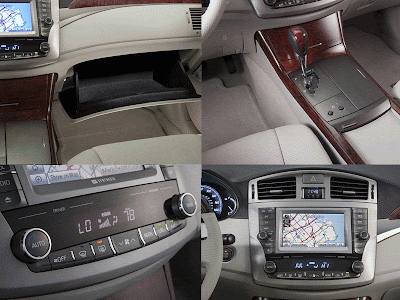
2011 Redesigned Toyota Avalon Third Generation
The 2011 Toyota Avalon will be available in two grades when it arrives in showrooms in the spring of 2010, Avalon and Limited. Both grades will be well equipped with standard equipment like eight-way leather-trimmed power driver's seats, back-up camera, dual zone automatic climate control with air filtration, moonroof and 17-inch alloy wheels. Toyota Avalon will be available in nine exterior colors including three new colors: Zephyr Blue Metallic, Cypress Pearl and Sizzling Crimson Mica.
Tuesday, March 2, 2010
Geneva 2010: Mercedes-Benz F 800 Style concept

While most automakers have scaled back their auto show vehicle press introductions due to budgetary cutbacks or newfound modesty, Mercedes-Benz hasn't forgotten the value of theater. As part of its press conference today showing off several models, the Three Pointed Star kept it flashy with dancers who tubed and bungied in from the ceiling, not to mention the lights blaring debut of the SLS AMG F1 safety car with Messrs. Rosberg and Schumacher inside. Peeling back the frosting, the real focus of Benz's show is this car, the F 800 Style concept.
Said to preview the next CLS, the F 800 Style is a plug-in hybrid with a 272-horsepower gasoline-fed V6 engine. Together with the electric motor, the combination is said to be good for over 400 horsepower and incorporate an electric-only range of 18 miles. Benz also says that the F 800 Style could incorporate a fuel cell powertrain.
The five-passenger sedan looks quite tidy in person, with a shorter tapered trunk than the current CLS, and indeed, the entire concept appears smaller than the aforementioned, with a bluffer face that is said to presage the new face of Mercedes. When viewed in profile, the front looks almost Maserati GranTurismo.
In addition, the F 800 also shows a future derivation of Benz's COMAND all-in-one interior control system that includes a touchpad console. Unlike the production touchpad application in the new Audi A8, the F800 also employs a camera that "...records video images of the user's hand as it works the pad. The live image of the hand is presented in transparent form on the central display above the center console." Uh-huh.
The F 800 also features an evolution of the company's Distronic Plus system that is optimized for use in traffic jams as well as a 360-degree implementation of its Pre-Safe system that monitors for rear impacts. If it senses an impending rearward crash, the system applies the brakes to prevent the car from being pushed forward into other vehicles or pedestrians, though the driver can take control of the vehicle and override the system by hitting the accelerator should that be the safer option.
[Source: Mercedes-Benz]
Geneva 2010: Touring Superleggera Flying Star

The majority of auto journalists are car freaks by nature. One of the many defining characteristics of a car freak is an undying, unadulterated love of any sort of shooting brake. If you're not a car freak, or just don't know the term, a shooting brake is a two-door station wagon. Why is this bodystyle so beloved? Many reasons, but let's just chalk it up to the impracticality of a sports car mixed well with the practicality of a station wagon. What can we say, it's a boat floater.
For Geneva, Italian car maker Touring Superleggera showed us freaks their new, stunning Flying Star. Built at the request of a customer and with the full cooperation of Bentley, the Flying Star is a shooting brake built from the Bentley Continental GTC. Honestly, there's not all that much to tell. Underneath the new skin sits... a Bentley Continental GTC, complete with its 560-horsepower, 479-pound-feet-of-torque twin-turbo 6.0-liter W12. Or, if you insist, Touring Superleggera will build you a GTC Speed-based Flying Star with 610 hp and 553 lb-ft of torque. Oh, and there's a support structure between the rear shocks that acts as both a hard structure for the new roofline and an integrated roll bar.
The real story, however, is being told by your eyeballs. Many of us have never been all that enthused by the shape of the Continental. But the Flying Star, well, it completes the design. How good? Four of us Autobloggers were gathered around a single laptop gasping at admiring Touring Superleggera's handicraft work. So yes, we think this is a very wonderful looking car. 100-percent picture perfect? No, as the tailgate's not quite... something. But let's not be petty, the Flying Star is fantastic looking.
Useful, too, as you can fit four golf bags in the rear. You might be wondering why a two-seat vehicle would need to carry four golf bags, but if you look closely you'll notice two additional seats in back. They of course fold down, allowing the Flying Star to swallow even more golf bags (no official word on exactly how many).
Besides the Flying Star's overall shooting brakeness, our favorite part has to be the woven leather "boot carpet," i.e. a beautiful material that covers the rear cargo area, the back of the rear seats and the rear floormats. Have we ever been excited about carpet before? No, never. And we doubt we ever will be again. That said, we doubt we'll be seeing any coachbuilt cars that get us as excited as the Flying Star. Now word on price (think: expensive!) but Touring Superleggera will be building just under 20 examples per year. Go car freaks, go.
[Source: Touring Superleggera]
The origins of the Bentley Continental Flying Star by Touring
It takes an avid and passionate collector, with a taste for special coach building, to be at the basis of a project like the Bentley Continental Flying Star by Touring. Exactly such a person contacted Touring Superleggera in early 2008.
An interesting initial creative process emerged involving parameters for design, proportions, vehicle concepts and - last but not least- feasibility and technical factors.
Many steps from design to execution were shared with the customer, who contributed with his own ideas and taste to personalise the project and create a unique automobile.
A basic idea was formed by the desire to diversify Bentley's very successful Continental model range, and to explore new concepts.
The transformation of a 2-door coupé, by expanding the roof line and enlarging the interior dimensions, has led to a design concept baptised as shooting brake: a sports car featuring enough space to join a hunting party or a golf tournament with elegance and efficiency. Touring Superleggera explored the same field back in 1966, resulting in the amazing Lamborghini Flying Star II prototype. It was a dramatic interpretation of a sports car based on a new 2-volume design, safeguarding the dynamic performance. The Flying Star reference is a Touring parameter of sportive elegance, applied to many famous cars since the companies' start in 1926.
Flying Star in 2010 - the Bentley challenge
The Bentley Continental GT range set innovative and high standards for a new generation of very sophisticated Grand Tourers. As such, this model triggered the imagination of automotive designers and coach builders elsewhere. The GTC convertible, featuring a very rigid platform, proved to be a fully congruent basis to Touring Superleggera's plans for the new Flying Star.
The new project required the modification of a number of external dimensions starting from the car's A-pillar backwards: extended roof line, a wider section including the doors, new aluminium door skins and a new all-aluminium, electrically operated tailgate. It also includes a completely new rear compartment with two foldable rear seats and a variable loading space.
This long list of modifications and transformations had to be paired with, and to remain fully compatible to the basic car's technical layout and components. Given the sophistication of the basic car, a new challenge was laid out for Touring's craftsmen and engineers. The final result proves that special coach building can live on well into the 21st. century working with respect to the original manufacturers.
Touring Superleggera is particularly proud of the fact that the complete productive cycle of the special coach building process was realized in their workshop near Milano. Modern body engineering went hand in hand with traditional handicraft skills, maintaining the highest quality directives for the final product.
The Bentley Continental Flying Star by Touring
Project Engineering
The body engineering processes at Carrozzeria Touring are aimed at safeguarding key parameters for quality, safety and feasibility, within the perspectives of low-volume automotive production. The project went through 1:4 and 1:1 modelling, based on the CAD and CATIA data from the basic vehicle. This digital basis resulted in a milled 1:1 master model and a number of 1:1 moulds for the manufacturing of the new external skin, and for important new body components. The rear bodywork was reinforced with an integrated structure between the rear suspension domes, functioning both as roll bar, and as support for the new, extended roofline.
All structural additions and modifications were thoroughly studied, using advanced simulation methods and FEM-analysis. As a parallel process, these data served for the homologation of the structural changes, including the new foldable rear seats. An important number of hard points from the basic car could be saved and carried-over. The engineering team at Carrozzeria Touring was particularly pleased with the quality assurance support from Bentley engineers.
Design
'Variations on a theme' not rarely implicate a larger design challenge, than starting-off with a white sheet of paper. The basic mission was to create a body incorporating the essence of Touring elegance and harmony, while clearly recognizable as a Bentley. This task was challenging because a fully new volume had to be added to the GTC basis. The proportions were totally new, but the overall design had to be kept consistent. That is why only the section in front of the car's A-pillar, including the windshield has been maintained.
Viewed from the rear, the new tailgate dives between the wide rear wings. The oval rear light chrome bezels are a reference to Bentley fastback cars of the '50. The side view features a low roof, prominent quarter panel shoulders and wide wheel arches, suggesting perfectly mastered energy.
The Touring Superleggera designers were challenged by the target to give the new interior equal elegance, whether the back of the rear seats are folded or not. The solution was to design an "S" shaped trim of the rear quarter panels linking the passenger area to the rear luggage area. The beige and dark green leather contrast also adds to this visual unity.
First time ever in this class and size, the twin individual rear seats fold completely to create a flat loading surface more than 2m long with 1200lt capacity. This is instrumental to fulfill the functional mission profile, which requires loading in full comfort a wide array of leisure equipment, including 4 full golfing bags with the rear seats up. An example of bespoke finish is the woven leather boot carpet offering superior endurance and coordinated with the special luggage set.
The overall result is perfectly in line with the Touring and Flying Star heritage: a timeless shape, a design statement combining elegance and sportiveness, with a strong and unmistakable own personality and individuality.
Manufacturing
When digital technologies are blended with traditional manufacturing skills, a fascinating process emerges that is typical for Touring Superleggera. A discriminating factor for traditional coach building was and is the vast amount of handwork that is involved in the creation of a new body. In this process, multiple practical solutions are also found for a wide variety of minor technical issues. This includes quick, practical solutions based on years-long experience, common sense and an expert eye.
The result is a final product entirely produced within the high quality parameters of today's automotive industry.
From the A-pillar backwards, new exterior body panels were hand shaped in steel - including the roof, new wider rear wings, and the internal reinforcements of the complete rear section of the car. Aluminium was used for the door skins, and for the complete rear bonnet including its structure. New, handmade brightwork was added according to the new exterior design.
The all new rear compartment required shaping of the foldable rear seats and a full set of interior panels, leather trimmed with meticulous care. Wide leather hides were selected with great attention to provide uniform finish to the vast continuous surfaces.
After inspection, the body in white was prepared and painted in the Touring state-of-the-art paint facilities. The final result underwent again a special final quality audit.
Performance
The Bentley Continental Flying Star by Touring inherits the chassis of the Continental GTC. The 6-liter, W12 engine is available either in the 560HP version which delivers 650NM of torque at 1600rpm or the GTC Speed variant which delivers a massive 750Nm from 610HP. The car exhibited in Geneva Motor Show features the GCT Speed specifications.
Performance braking, cornering and traction functions mesh together to provide precise and immediate driving control under extreme or difficult conditions.
Self-adjusting air springs and electronic dampers operate independently for each wheel. All-wheel drive promotes advanced traction.
Homologation
The model is CEE homologated according to the new low-volume production directive. For the first time since its introduction, the type approval was awarded without destructive test, using simulation and FEM-analysis.
Future Programme
Touring Superleggera undertakes a limited production run of up to 20 units of the Continental Flying Star. This series will be exclusively built to special order and customer specifications. The car is offered at a basic price of 2 590.000 when based on a Continental GTC - 560 PS. Other versions on request.
The car will be serviced at the Bentley dealers. Bentley Motors and Touring Superleggera have developed a special mutual warranty program, which safeguards warranty clauses for both the basic car, and the transformation by Touring.
Personalisation
The customers are actively involved in the early stage to choose the specifications of their own unique automobile, ranging from bespoke cabinetry and trim to a wide choice of dedicated options. The accessory collection includes the Touring designed luggage set coordinated with the boot trim, and the distinctive Borrani X-Ray spoke wheels.
Blending advanced technology with craftsmanship, Borrani 20" 9.5j X-Ray spoke wheels provide distinctive design, precision and comfort. Featuring monolithic spun aluminium rim and hand assembled steel spokes, they can be tailored to the car's painting and finish.
Louis de Fabribeckers, Head of Design
Responsible for the design team of the Flying Star project is the 32 years young Belgian designer Louis de Fabribeckers.
Graduated from the ISD of Valenciennes in France in Engineering Design, de Fabribeckers started to work with Touring in 2006 as project leader.
Under his hands, the Maserati based Bellagio and A8GCS Berlinetta projects materialized; the first one being a fastback, 5-door version of the Quattroporte model, and the second a magnificent concept for a light and compact, modern sports car. Both new projects were presented at the occasion of the 2008 Villa d'Este Concours d'Elégance. The A8GCS Berlinetta was granted the 'Plus Belle Supercar de l'Année 2008' award by the expert jury of the 24th. Festival Internationale de l'Automobile in Paris.
Louis de Fabribeckers lives and works in Milan.
Technical information
(where appropriate based on a Continental GTC Speed)
ENGINE
Capacity 5998 cc W shaped 12 cyl.
Max.Power 610 PS /449 kW @ 6000t/m
Max. Torque 750 NM @ 1700-5600t/m
DRIVELINE AND TRANSMISSION
Continuous all-wheel drive
6-speed automatic transmission
PERFORMANCE
Max. Speed 322 km/h (TBC)
Acceleration 0-100km/h 4.8 seconds (TBC)
DIMENSIONS
Overall length 4815mm
Width 1943mm
Overall Height 1395mm
Min. Boot volume 400L
Max. Boot volume 1200L
The Touring A8 GCS Berlinetta is now ready for one-off production
Geneva is the first public appearance of this prototype after the Concours d'Élegance previews.
Touring Superleggera has completed the development stage and is now ready to produce a rolling concept for one of the passionate clients who showed their enthusiasm since the first debut.
The Berlinetta is based on a high-end production platform revised by Touring. It has been carefully selected to match the mission profile in power, torque, and handling.
Compact, light and powerful, the shape embodies the perfect high performance sports car in the Touring tradition. The A8 GCS Berlinetta is a strict two-seater with perfectly balanced volumes and frugal decoration.
"We wanted a strong project" – says the Belgian Head of Design of Touring Superleggera, Louis de Fabribeckers – "I drew from the stylistic heritage of Touring the work of surfaces and also this sinusoidal line across the side of the Berlinetta".
The car is 4,20 m. long and only 1,22 m. high on a 2,50 m. wheelbase. Engineers target a 1500 kg weight for the finished car.
Carrozzeria Touring Superleggera
Founded by Felice Bianchi Anderloni and Gaetano Ponzoni in 1926, the company started to produce custom built automotive bodywork with two distinctive features form the very beginning: sporting elegance and lightness. Early customers were reputed car makers as Isotta Fraschini and Alfa Romeo. It would mark the start of a flamboyant period, also culminating in the 'Flying Star' period with several spectacular spider coachworks.
Touring Superleggera also gradually researched the streamlining process. The marriage between this, and their Superleggera construction system using aluminium body panels over a light but rigid tubular steel frame, resulted in some extremely elegant masterpieces such as the 1938 Alfa Romeo 8C2900 Touring spider, which today have become icons of automotive design and body construction. In 1945, the excellent Carlo Felice Bianchi Anderloni joined his father at the company, which soon started to receive its first orders from a motivated Modenese entrepreneur called Enzo Ferrari. The Tipo 166 Touring 'Barchetta' of 1950 formed a new milestone for light, elegant and effective design on a competition chassis.
Under Carlo Felice, Touring saw its industrial customer basis grow in the mainstream of the expanding automotive industry in Italy and Europe. A number of niche models were designed and built on Alfa Romeo 1900, Lancia Flaminia and Maserati 3500. Another new inspired car manufacturer from the Bologna area relied on Touring's skills: Lamborghini. At the same time, Aston Martin produced their DB4, 5 and 6 models with a license for the Superleggera system.
The energy crises of the early seventies, and the increasing mass production methods in the car industry would regretfully force many specialist companies to close their doors. The last production car left Carrozzeria Touring in 1966, but the true Touring spirit was firmly consolidated in the company's products, that found their ways to an international community of motoring enthusiasts and car collectors.
In 2006, the year of its 80th. Anniversary, Carrozzeria Touring Superleggera of Milan restarted its activities, now part of Zeta Europe BV, a private company specializing in automotive high-end products and brands.
Geneva 2010: Ferrari 599 HY-KERS

Onlookers green with envy. Waiting twitchingly for the traffic light to turn green. A briefcase full of greenbacks. Even British Racing Green, if you're talking about a GT. You could find a few ways to associate Ferrari with the color green, but the environmental sense would be a bit of a stretch – historically speaking, at least. But the times, as one Mr. Zimmerman wrote, they are a-changing. Now even Maranello has been forced to get on board the "Heal the World" train. And this is the result.
Called the HY-KERS, what you're looking at is a rolling test bed. It's a hybrid, sure, but if you thought this was a haphazard application of a plug-and-play hybrid system, think again. The HY-KERS incorporates a roadgoing derivative of Ferrari's Kinetic Energy Recovery System – fancy-talk for regenerative braking – from last year's Formula One program.
Ferrari has worked diligently to optimize the benefits of the system to the 599's performance. The entire system weighs a modest 40 kilograms, partially offset by the obviation of the starter motor and conventional battery. Integrated into the seven-speed dual-clutch transmission and mounted below the car's center of gravity, the system returns over 100 horsepower, supplementing the V12 engine under hard acceleration and it can even operate under full electric power when puttering around town. Of course, a Ferrari never putters around anything, save for when it takes its owner for a round of golf at the local country club.
FERRARI DEBUTS AT GENEVA WITH THE HY-KERS, A 'VETTURA LABORATORIO'
Geneva, 2 March 2010. Ferrari presents a vettura laboratorio (experimental vehicle) at the 80th edition of the Geneva Motor Show based on the 599 GTB Fiorano equipped with an advanced new hybrid transmission.
Hybrid technology is one of the solutions examined by Ferrari in its on-going research and development into making its production cars ever more efficient. Experimenting with alternative technologies represents the company's long-term strategy after the announcement in 2007 of a five-year plan to reduce fuel consumption and emissions across the range. With the launch of the Ferrari California (2008) and the 458 Italia (2009), in fact, Ferrari's average fuel consumption and CO2 emissions figures have already been reduced by around 30 per cent compared to 2007.
The HY-KERS displayed at the Geneva Motor Show is an example of how Ferrari is studying the application of hybrid technology to high-performance sports cars. Central to Ferrari's objectives is maintaining the balance, handling and performance characteristics typical of its cars despite the inevitable disadvantages in terms of weight represented by applying hybrid solutions to existing models.
To this end Ferrari has employed its racing experience to adapt a lightweight hybrid drivetrain to the 599 GTB Fiorano with the aim of ensuring that vehicle dynamics are unaffected. This was achieved by the careful integration of all system components, positioning them below the centre of gravity and ensuring that interior and luggage space are entirely unaffected. Similarly the flat lithium-ion batteries are positioned below the floorpan of the car inside the aerodynamic underbody. The result is a centre of gravity that is even lower than in the standard car. In addition, a part of the weight gained by fitting the electric motor, generator and the batteries is offset by being able to do away with the traditional starter motor and battery.
Ferrari has also applied its F1 technology to the design, engineering and construction of a new kind of electric motor which also helps optimise the longitudinal and lateral dynamics of the car, enhancing traction and brake balance. The motor cuts in during acceleration, providing instantaneous torque when moving away from a standstill and during overtaking manoeuvres, with torque control a function of grip, gear and accelerator pedal angle. Depending on vehicle speed and engine load – for example in town driving – the hybrid system can also function as a full-electric drivetrain. The result is a direct reduction in consumption and emissions. The motor also features a unique cooling and lubrication system for maximum efficiency under all operating temperatures and loads. The castings of the motor are made in the Ferrari foundry, complete with Prancing Horse motif.
Weighing about 40 kg, the compact, tri-phase, high-voltage electric motor of the HY-KERS is coupled to the rear of the dual-clutch 7-speed F1 transmission. It operates through one of the transmission's two clutches and engages one of the two gearbox primary shafts. Thus power is coupled seamlessly and instantaneously between the electric motor and the V12. The electric motor produces more than 100 hp as Ferrari's goal was to offset every kilogram increase in weight by a gain of at least one hp.
Under braking the electric drive unit acts as a generator, using the kinetic energy from the negative torque generated to recharge the batteries. This phase is controlled by a dedicated electronics module which was developed applying experience gained in F1 and, as well as managing the power supply and recharging the batteries, the module also powers the engine's ancillaries (power steering, power-assisted brakes, air conditioning, on-board systems) via a generator mounted on the V12 engine when running 100 per cent under electric drive. It also incorporates the hybrid system's cooling pump.
In keeping with Ferrari's 360-degree approach to efficiency and its commitment to environmental sustainability, new technologies for its road cars are matched by the considerable investments already made to reduce the environmental impact of the company's production activities in Maranello.
After the inauguration of the photovoltaic installation on the roof of the Mechanical Machining facility in January 2009, which reduced the factory's power requirements by over 210,000 kWh annually, 2009 also saw the opening of the trigeneration plant (the simultaneous production of power, heat and cooling from a single source) – the first of its kind to be implemented by a sports car manufacturer. This enabled Ferrari to reduce CO2 emissions by 15 per cent, with the goal of reaching a reduction of over 40 per cent by the end of 2010. Thanks to these ecological solutions, Ferrari is completely autonomous for its energy requirements.
Geneva 2010: 2011 Volkswagen Touareg sports

We could say Volkswagen was tired of making an SUV that ended up being rather expensive – for a VW – after you stuck a few options on it. So in addition to the lost weight, the new Touareg has lost some of the four-wheel drive equipment that made the last one so spendy. This one comes standard with a Torsen limited-slip differential, and then you can order a Terrain Tech Pack that adds the differentials and serious off-road capability that once came standard. That takes fuel economy upward, an boost also helped by the increased curve and lower Cd. VW sold 500,000 units of the previous-gen Touareg and it should do even better with this one.
Show Premiere I:
New Touareg Guides SUV Idea into the Future
Touareg debuts with hybrid drive and high-tech TDI engines
Volkswagen SUV is 208 kilograms lighter and 20 percent more fuel efficient
Wolfsburg/Geneva, March 2010. In a show premiere at the Geneva Motor Show Volkswagen is unveiling the completely redeveloped Touareg − and with it the most technically innovative Volkswagen since the brand has been in existence. This Touareg is reinterpreting the fasci nating idea of a multipurpose SUV in a contemporary way – thanks to its up to 25 percent more fuel efficient engines and a large variety of new assistance and safety systems. The Touareg will be the first Volkswagen to be offered in a hybrid version (V6 TSI plus E-motor).
When the V6 TSI and E-motor operate simultaneously (boosting), this produces a combined power of up to 279 kW /380 PS as measured on a dynamometer, and a torque of maximum 580 Newton-metres. The Touareg Hybrid sets standards among fully off-road capable SUVs with petrol engines with its fuel consumption value of just 8.2 litres fuel per 100 kilometres. It can be driven at speeds of up to 50 km/h in purely electric mode − emissions-free.
Fuel economy and emissions values of the conventionally powered Touareg versions were significantly improved. Consider the V6 FSI, a direct-injection petrol engine with 206 kW /280 PS: With a fuel econo my of 9.9 l/100 km, the powerful 360 Newton-metre 3.6-litre engine consumes a substantial 2.5 litres less than the previous model. This combined fuel consumption corresponds to CO2 emissions of 236 g/km. And that is exactly 60 g/km less than before.
The diesel engines were made more fuel efficient as well. With regard to power, an advanced version of the successful V6 TDI that continues to have 176 kW/240 PS (European version) right at market launch, marks the entry level into the world of the Touareg; the 550 Newton-metre strong turbo-diesel consumes a pioneeringly low 7.4 l/100 km (equivalent to 195 g/km CO2), which is 1.9 litres less than before. CO2 emissions were reduced by 49 g/km compared to the previous Touareg V6 TDI and a respectable 24 g/km compared to the already very good previous model with BlueMotion Technology. Completely new to the Touareg programme is a V8 TDI with 4.2 litres displacement and 250 kW /340 PS.
The combined fuel consumption here – extremely good considering its power and amazing maximum torque of 800 Newton-metres – is 9.1 l/100 km (equivalent to 239 g/km CO2). Engines offered, both diesel and petrol, will vary depending on the specific country.
New era SUV – lighter, more aerodynamic and fuel efficient
As has already been accomplished on the globally successful, smaller SUV, the Tiguan, Volkswagen is systematically striving for sustain ability on the new Touareg too. The first precondition has been met: The weight of the base model Touareg has been reduced by 208 kilograms.
A quantum leap. Yet, the body has five percent greater torsional rigidity, which makes it the leader in its competitive class. The second precondition has also been achieved: Designers attained a significantly improved Cd value. It was reduced from 0.38 to 0.35. Along with aerodynamic refinement measures, another factor at work here is that this Touareg sits lower to the ground than the previous model. This, to gether with a front end in the style of the new Volkswagen Design DNA, results in a smaller frontal area. The third precondition: All engines, now offered with a standard 8-speed automatic transmission – a first in this market segment – demonstrate significant fuel economy advantages over the previous model; in some cases the advantage is far greater than two litres per 100 kilometres.
SUV for all trails – all-wheel drive in two versions
Another element which has been modified in the quest for reduced fuel consumption is the Touareg's standard all-wheel drive. In the base version (4MOTION), all new generation Touaregs have all-wheel drive with Torsen limited-slip differential (4MOTION; 31 degree climbing gradient). Like the Tiguan Track & Field, the Touareg also has an "Offroad driving programme", which − at the press of a button − tunes the ABS, EDS and ASR for off-road duty, activates Hill Descent Assist and adjusts the automatic gearshift points.
Instead of a Torsen differential, the V6 TDI can be ordered with an optional "Terrain Tech Packet" that has an even more rugged transfer case designed for off-road driving. It includes reduction gearing and centre and rear differentials, each with up to 100 percent locking (4XMOTION; 45 degree climbing gradient). Similar to the system on the first Touareg generation, this "4XMotion" also has a rotary switch the driver now uses to adapt the car to specific conditions over five levels:
1. "On-Road";
2. "Off-Road" (like "Off-road driving programme" plus automatic control of the mechanical locks);
3. Low (like "Off-road" plus activation of reduced gearing, higher shift points, no automatic upshift in manual mode);
4. Addition of centre differential lock;
5. Addition of rear differential lock. Equipped like this, the Touareg can conquer a wide range of the Earth's terrains.
SUV for everyday life – more space, more innovations
Volkswagen has not only made the new Touareg lighter, more fuel efficient and an agile performer; it has also made it into an even more versatile, all-round vehicle. The new interior was made more functional, the seats more comfortable and leg room in the rear is increased thanks to a 41 millimetre extension of the wheelbase to 2,893 milli metres. Now the rear bench seat has 160 millimetres in longitudinal adjustment, and the backrest angle can be altered.
Electrically unlatched at the press of a button as an option, it folds down in seconds and frees up 1,642 litres of cargo space. Already standard equipment in the base version is a radio-CD and info system, which is intuitively controlled via a 6.5-inch touch-screen. The radio-navigation system in the top version offers a 60 Gigabyte hard drive and 3D building representation.
The parking brake is now activated by pushbutton. The engine (V6 versions) automatically shuts off at traffic lights and restarts as soon as the driver releases the brake pedal (Stop-Start system). The V6 versions gather valuable kinetic energy during braking and coasting and store it.
The oil dipstick has now been retired: The engine oil level is displayed electronically in this Touareg. As an option, the tailgate can be opened and closed automatically. The Touareg can also be specified with a large panoramic sunroof – the largest ever used on an SUV − to provide maximum light in the cabin even on overcast days.
There are new features in the vehicle's assistance systems too. The innovative "Area View" utilises four cameras situated around the car to transmit an accurate view of the Touareg's surroundings to enhance safety. Also offering protection are up to nine airbags. Lane Assist ensures that the vehicle does not stray from the right path; meanwhile, Side Assist warns of vehicles approaching from the rear when changing lanes. Adaptive Cruise Control (ACC) plus Front Assist can brake the car to a stop in an emergency. ProActive occupant protection, also completely new, networks the assistance systems and ensures that in case of an accident not only are the belts tensioned, but the windows and panoramic sunroof are closed as a function of the vehicle's transverse dynamics.
An absolute world's first: Bi-xenon headlights with Dynamic Light Assist.
This camera-based high beam headlight actually "sees" oncoming traffic and automatically adjusts – via the curve lighting module and individually for each headlight − the high beam to eliminate unwanted glare. The enhanced safety and convenience offered by Dynamic Light Assist is as significant as the introduction of Xenon technology itself once was. In the sum of its properties, the new Touareg is not only one of the most sustainable SUVs in the world, but definitively also one of the safest passenger vehicles of all times.
Touareg – the best of two worlds
About 500,000 car drivers chose to buy the first generation of the Touareg. It is a luxury sport utility vehicle that offers a high level of comfort, sporty driving properties, avant-garde styling, excellent quality and unlimited expedition capabilities – essentially the best of the passenger car and off-road worlds unified in one concept. This legacy is now being continued in the new Touareg – a high-end and versatile all-round vehicle that brings these two worlds together even more perfec tly. The Touareg will be available at dealers as soon as in April of this year.
Geneva 2010: BMW 5 Series ActiveHybrid Concept

The dispersion of BMW's ActiveHybrid – and conjoined word – initiative continues with the 5 Series ActiveHybrid Concept. Billed as a "future-oriented full-hybrid model in the upper midrange segment" it boils down to the turbocharged inline-six you love and along with a 53-horsepower electric motor you will learn to love working through an eight-speed auto 'box for the middle-management set. They'll get 10-percent more distance for the gallon, and a squirt of instant boost thanks to those hard working electrons.
Consistent Progress for Greater Efficiency and Driving Dynamics: The BMW Concept 5 Series ActiveHybrid.
Parallel to the world debut of the new BMW 5 Series Sedan at the 2010 Geneva Motor Show, BMW is also presenting the concept of a future-oriented full-hybrid model in the upper midrange segment: The BMW Concept 5 Series ActiveHybrid for the first time offers the combination of a BMW straight-six with electric drive, setting new standards for sporting pleasure at the wheel and superior sustainability in this segment.
The new concept car offers a particularly good rendition of the new BMW 5 Series Sedan in all its dynamic, efficient and innovative qualities, at the same time representing the ongoing development of the BMW ActiveHybrid X6 and the BMW ActiveHybrid 7 with their drivetrain technology already in production.
The drive system featured in the BMW Concept 5 Series ActiveHybrid consists of a straight-six gasoline engine with TwinPower Turbo technology, eight-speed automatic transmission, and electric drive. Integration of BMW ActiveHybrid technology in a sedan already extremely efficient with its "conventional" combustion engine reduces both fuel consumption and emissions once again by more than 10 per cent. At the same time the electric motor offers a boost function, supporting the gasoline engine in generating particularly dynamic drive power for an even more sporting driving experience in the car.
Intelligent energy management likewise serves to enhance the efficiency of the overall system, its unique functions ensuring appropriate control and management of all energy paths within the car and appropriate interaction of the drivetrain components precisely adjusted to driving conditions.
The drivetrain technology featured in the BMW Concept 5 Series ActiveHybrid allows all-electric, zero-emission motoring in city traffic. At the same time a special hybrid-based Auto Start Stop function offers additional efficiency by consistently switching off the combustion engine when stopping at the traffic lights, a road junction, or in congested traffic. Optimised comfort, finally, is provided by the auxiliary climate control function already featured
in the BMW ActiveHybrid 7.
Special development of ActiveHybrid technology as part of BMW EfficientDynamics.
The concept car based on the new BMW 5 Series Sedan for the first time presents the next generation of BMW ActiveHybrid technology, a special solution exclusive to BMW for intelligent interaction of the combustion engine and electric drive focused specifically on the requirements made of a dynamic sedan in the upper midrange segment.
Taking this approach, BMW is consistently continuing the development of hybrid technology according to a modular principle (best of hybrid), thus offering the optimum rendition of BMW ActiveHybrid technology for each concept and vehicle segment.
In accordance with the BMW EfficientDynamics development strategy, this ensures highly effective and practical use of hybrid technology for the reduction of both fuel consumption and emissions.
Also in the BMW Series Sedan segment: the BMW among hybrids combines supreme dynamics with maximum efficiency.
The combustion engine is supported in the BMW Concept 5 Series ActiveHybrid by an electrical drive system developed specifically for this model and arranged in compact dimensions between the straight-six combustion engine and the automatic transmission. Drawing its energy from a high-voltage battery at the back of the car, the electric motor develops maximum output of 40 kW.
An automatic clutch connects the gasoline engine and the electric motors.
Due to the particularly high level of torque generated from the start through the electric motors, the interaction of the two drive systems ensures extremely spontaneous and dynamic acceleration whenever required.
Perfectly integrated, precisely controlled: high-voltage battery supplying power to both the electric motor and the on-board network.
In overrun and when applying the brakes, the electric drive systems acts as a generator developing electric power fed into the high-voltage battery. This converts kinetic energy otherwise wasted as heat in the brake system into electric power saved for subsequent use. Such energy obtained without any further consumption of fuel may then be used to generate drive power or operate electrical functions in the car.
This principle is the same as that of Brake Energy Regeneration already applied in BMW's current production models, with the level of electrical energy generated by the electric motor being significantly greater and the increase in efficiency correspondingly higher.
The high-voltage battery likewise developed for this specific concept is fitted within a high-strength special case near the rear axle of the BMW Concept 5 Series ActiveHybrid. This leads to an optimum position in terms of both safety and harmonious weight distribution.
An integrated control unit permanently analyses the charge status of the high-voltage battery and controls both the battery charge process by way of Brake Energy Regeneration and the system cooling process. Apart from the electric motor, the high-voltage battery also delivers electric power to the car's on-board network. Among other things, this allows efficient operation of the car's auxiliary climate control activated whenever required by a remote control function to cool down the car's interior significantly even before starting the engine.
Convenient use of the all-electric driving mode and the Auto Start Stop function is likewise guaranteed in this way, with all electrical functions such as the audio system, climate control or navigation remaining fully available even with the combustion engine switched off.
Unique: intelligent energy management with advance analysis of driving conditions.
BMW ActiveHybrid technology provides its unique potential in terms of both efficiency and driving dynamics under all kinds of conditions and throughout a wide load range.
Unlike conventional hybrid cars whose extra efficiency is largely limited to city traffic, both the BMW ActiveHybrid X6 and the BMW ActiveHybrid 7, by combining the combustion engine and the electric motor, are able to offer significantly lower fuel consumption and emission ratings also at higher speeds. This is made possible by technically sophisticated power electronics masterminding the interaction of the combustion engine and electric motor and thus optimising the overall efficiency of the drive system as a whole.
The BMW Concept 5 Series ActiveHybrid once again raises the range of functions provided by such power electronics to an even higher standard. As an example, the energy contained in the fuel and provided by the high-voltage battery may now be used even more specifically and efficiently to provide that Sheer Driving Pleasure so typical of BMW.
Taking additional factors into account, the interaction of the two drive units in the BMW Concept 5 Series ActiveHybrid is tailored to the driver's requirements and current driving conditions with maximum precision. At the same time the power electronics also control the operation of the car's ancillary units and comfort functions, again in the interest of maximum efficiency.
The range and diversity of parameters taken into account by the system is indeed quite unique in the automobile, just as the number of functions controlled in this way. A high level of all-round networking allows the power electronics to provide intelligent energy management, thus optimising the operating strategy of the entire vehicle under all conditions.
A further unique feature of energy management in the BMW Concept 5 Series ActiveHybrid is the car's ability to adjust its operating strategy not just to current, but also to upcoming driving conditions. To do this the power electronics from the start evaluate data indicating a possible change in exterior conditions or the driver's wishes and prepare the components in the drivetrain as well as the car's electronic system for a possible change in requirements.
To analyse driving conditions up front, the system uses data provided by engine and chassis management as well as the sensors in the driver assistance systems on board the car. Data saved in the navigation system on the route chosen by the driver likewise goes into the final calculation, enabling the system to forecast driving conditions on the route directly ahead. Then, proceeding from this analysis, the car is coordinated in advance and the optimum use of all systems serves to use the energy available with maximum efficiency.
Should the system determine, for example, that the autobahn ahead is about to lead downhill, the charge level of the higf-voltage battery is intelligently controlled in advance to regain brake energy upfront with maximum efficiency. Similarly, the high-voltage battery may be fully charged in good time before the driver reaches his destination, enabling the system to switch off the combustion engine at an early point and change to all-electric drive along the final stretch of road. Indeed, this forward-looking function is able to extend the cruising range on electric power by up to 30%.
The BMW Concept 5 Series ActiveHybrid: the future of driving pleasure and efficiency in the upper midrange segment.
Optimised to an even higher standard in the BMW Concept 5 Series ActiveHybrid, the drivetrain and control systems underline the great significance of hybrid technology as a cornerstone of BMW EfficientDynamics. Looking at a new generation of hybrid technology from BMW featured in the BMW Concept 5 Series ActiveHybrid therefore offers particularly attractive perspectives, the ongoing development of BMW ActiveHybrid technology serving to provide substantial progress in all areas leading to a harmonious all-round concept with distinctive features typical of the brand.
The BMW Concept 5 Series ActiveHybrid is therefore more dynamic, efficient and more intelligent than conventional representatives of this drive technology, standing out clearly as the BMW among hybrid cars in this segment.
Geneva 2010: Volvo S60

American automakers are streamlining, big time. But we're looking at a Swedish car. In Switzerland. So what does this have to do with Detroit? Well, a lot. But not for long. Volvo's about to change hands from Ford to China's Geely, and (like fellow Swedish automaker Saab now under Spyker's wing) if it's going to survive, it'll need a solid product. This could be it.
Previewed in concept form at the Detroit Auto Show, the production version of the new Volvo S60 made its debut here at the Geneva Motor Show. A few details inevitably had to change on the bumpy road from concept to production, among them the anteater nose of the show car which was thankfully reshaped due to pedestrian impact requirements. And when it comes down to it, that's what Volvo's all about: safety. So it comes as little surprise that the new S60 also debuts the company's new Collision Warning system that will, if necessary, fully engage the brakes.
The S60 makes its debut in T6 guise, packing a turbocharged 3.0-liter inline six with 300 horsepower and 325 lb-ft of torque. More engines will be on offer worldwide once new S60 car reaches the market over the course of the coming months.
[Source: Volvo]
ALL-NEW VOLVO S60 MAKES ITS WORLD DEBUT AT GENEVA MOTOR SHOW
- All-New Volvo S60 makes its international debut at Geneva Motor Show 2010
- New Dynamic chassis tuned for an active drive
- Features the ground-breaking Pedestrian Detection with Full Auto Brake technology
Today, Tuesday 2 March 2010, the all-new Volvo S60 made its international debut at the Geneva Motor Show. It launches into one of the automotive world's most competitive segments backed by an elegant new coupé-like design, dynamic driving characteristics and ground-breaking Pedestrian Detection safety technology.
In its overall shape, the all-new S60 is a coupé; sportier and more distinct than any previous Volvo. In its design, it promises excellent driving characteristics, even before you get behind the wheel. To deliver the highest levels of driving enjoyment, the chassis team have refined every single detail that influences a car's driving properties and fine-tuned the driving experience to offer the most dynamic ride ever seen before on a Volvo.
The all-new S60 range will be available from launch with a choice of two diesels and one petrol engine, including an uprated high-performance 3.0-litre T6 petrol version with 304bhp, a 2.4-litre 205bhp D5 and a 2.0-litre 163bhp D3 powerplant. A DRIVe version powered by a 1.6-litre diesel engine with CO2 emissions of approximately 115g/km and fuel economy of up to 65.7mpg (combined cycle, preliminary figure) will join the range later in 2011.
DESIGN
In its overall shape, the all-new S60 is a four-door coupé - sportier and more distinct than any previous Volvo.
The C-pillar of the all-new S60 stretches all the way to the tail lamps – and the slim coupé -like roof line is accompanied by a new contour on the shoulders on either side of the lower body. This creates a gentle double wave in the line from the headlamps at the front to the tail lamps at the rear.
The S60's athletic stance is accentuated by a sculpted bonnet and short overhangs front and rear, plus what Volvo's design team calls the "racetrack" design. The car's lines do not end abruptly but instead continue to flow organically, echoing the smooth shapes of the racetrack.
This sporty appearance can be further enhanced with an exterior styling kit that incorporates front and rear skid plates, two frames in the lower valence, side scuff plates, exhaust tailpipe finishers and 18-inch alloy wheels.
Volvo's designers have also used LED (Light Emitting Diode) technology to create distinctive, signature lights at the front and rear that make the car clearly identifiable as an S60, even in the dark.
The all-new Volvo S60 is being introduced with a range of exterior colours including two new shades: Vibrant Copper and Electrum Gold.
NEW DYNAMIC CHASSIS
The new Volvo S60 is the most sporting Volvo ever built and during the development process, the chassis team refined every single detail to fine tune the driving experience. The result of their labours is a newly-developed Dynamic chassis, standard on every new Volvo S60.
The steering gear ratio is 10 per cent faster than in previous models to give enhanced steering feel and sharper response. The steering column's thicker tubing and stiffer bushes have increased torsional rigidity by 100 per cent. This also contributes to the increased feeling of direct contact with the wheels and the road.
The front spring struts have thicker pistons compared with the sports chassis in the Volvo S80. The resultant 47 per cent increase of stiffness means that the body structure is better able to absorb lateral loads. The springs themselves are shorter and stiffer than before and the Eigen frequency has increased by 10 per cent. At the front, spring strut mounting stiffness has increased by 50 per cent. The front and rear subframe bushes are up to twice as stiff compared with previous models. The link arm bushings have also been optimised for sporty driving and full control.
The damper mountings at the rear are made of PUR (polyurethane) instead of rubber to provide better balance between comfort and dynamic control.
Stefan Sällqvist, responsible for the S60 chassis development explained: "We spent many weeks fine-tuning the dampers out in the English countryside. We drove on old Roman roads that have only ever received a few layers of tarmac over the centuries – a perfect environment for finding the right damping qualities."
Advanced Stability Control
The Dynamic Stability and Traction Control (DSTC) in the all-new S60 has a number of sophisticated features to improve driving pleasure and safety. The S60 is the first saloon on the market with Volvo's Advanced Stability Control. With a new roll sensor, it's possible to identify any skidding tendency at a very early stage. This means that the anti-skid system can step in earlier and with greater precision. Advanced Stability Control is a great asset in dynamic driving that involves considerable lateral forces.
New Corner Traction Control for smoother curves
The dynamic new chassis is backed up by a range of electronic systems that further sharpen the sporty driving experience. Corner Traction Control is a new feature that uses torque vectoring so the car takes corners more smoothly. This technology is a further refinement of the DSTC system. When taking a curve, the car's inner driven wheel is braked at the same time as more power is transmitted to the outer driven wheel. This allows the driver to take the corner more tightly while reducing any tendency to understeer.
Advanced, integrated braking functions
A highly advanced braking system is an important part of the dynamic driving properties of the all-new S60. A number of features interact to provide the shortest possible stopping distance in all scenarios. Technology includes:
In its overall shape, the all-new S60 is a coupé; sportier and more distinct than any previous Volvo. In its design, it promises excellent driving characteristics, even before you get behind the wheel. To deliver the highest levels of driving enjoyment, the chassis team have refined every single detail that influences a car's driving properties and fine-tuned the driving experience to offer the most dynamic ride ever seen before on a Volvo.
The all-new S60 range will be available from launch with a choice of two diesels and one petrol engine, including an uprated high-performance 3.0-litre T6 petrol version with 304bhp, a 2.4-litre 205bhp D5 and a 2.0-litre 163bhp D3 powerplant. A DRIVe version powered by a 1.6-litre diesel engine with CO2 emissions of approximately 115g/km and fuel economy of up to 65.7mpg (combined cycle, preliminary figure) will join the range later in 2011.
DESIGN
In its overall shape, the all-new S60 is a four-door coupé - sportier and more distinct than any previous Volvo.
The C-pillar of the all-new S60 stretches all the way to the tail lamps – and the slim coupé -like roof line is accompanied by a new contour on the shoulders on either side of the lower body. This creates a gentle double wave in the line from the headlamps at the front to the tail lamps at the rear.
The S60's athletic stance is accentuated by a sculpted bonnet and short overhangs front and rear, plus what Volvo's design team calls the "racetrack" design. The car's lines do not end abruptly but instead continue to flow organically, echoing the smooth shapes of the racetrack.
This sporty appearance can be further enhanced with an exterior styling kit that incorporates front and rear skid plates, two frames in the lower valence, side scuff plates, exhaust tailpipe finishers and 18-inch alloy wheels.
Volvo's designers have also used LED (Light Emitting Diode) technology to create distinctive, signature lights at the front and rear that make the car clearly identifiable as an S60, even in the dark.
The all-new Volvo S60 is being introduced with a range of exterior colours including two new shades: Vibrant Copper and Electrum Gold.
NEW DYNAMIC CHASSIS
The new Volvo S60 is the most sporting Volvo ever built and during the development process, the chassis team refined every single detail to fine tune the driving experience. The result of their labours is a newly-developed Dynamic chassis, standard on every new Volvo S60.
The steering gear ratio is 10 per cent faster than in previous models to give enhanced steering feel and sharper response. The steering column's thicker tubing and stiffer bushes have increased torsional rigidity by 100 per cent. This also contributes to the increased feeling of direct contact with the wheels and the road.
The front spring struts have thicker pistons compared with the sports chassis in the Volvo S80. The resultant 47 per cent increase of stiffness means that the body structure is better able to absorb lateral loads. The springs themselves are shorter and stiffer than before and the Eigen frequency has increased by 10 per cent. At the front, spring strut mounting stiffness has increased by 50 per cent. The front and rear subframe bushes are up to twice as stiff compared with previous models. The link arm bushings have also been optimised for sporty driving and full control.
The damper mountings at the rear are made of PUR (polyurethane) instead of rubber to provide better balance between comfort and dynamic control.
Stefan Sällqvist, responsible for the S60 chassis development explained: "We spent many weeks fine-tuning the dampers out in the English countryside. We drove on old Roman roads that have only ever received a few layers of tarmac over the centuries – a perfect environment for finding the right damping qualities."
Advanced Stability Control
The Dynamic Stability and Traction Control (DSTC) in the all-new S60 has a number of sophisticated features to improve driving pleasure and safety. The S60 is the first saloon on the market with Volvo's Advanced Stability Control. With a new roll sensor, it's possible to identify any skidding tendency at a very early stage. This means that the anti-skid system can step in earlier and with greater precision. Advanced Stability Control is a great asset in dynamic driving that involves considerable lateral forces.
New Corner Traction Control for smoother curves
The dynamic new chassis is backed up by a range of electronic systems that further sharpen the sporty driving experience. Corner Traction Control is a new feature that uses torque vectoring so the car takes corners more smoothly. This technology is a further refinement of the DSTC system. When taking a curve, the car's inner driven wheel is braked at the same time as more power is transmitted to the outer driven wheel. This allows the driver to take the corner more tightly while reducing any tendency to understeer.
Advanced, integrated braking functions
A highly advanced braking system is an important part of the dynamic driving properties of the all-new S60. A number of features interact to provide the shortest possible stopping distance in all scenarios. Technology includes:
- Ready Alert Brakes can predict when emergency braking is needed. The brake calipers are applied lightly to the brake discs even before the driver presses the brake pedal.
- Hydraulic Brake Assist helps the driver brake in the shortest possible distance. In an emergency situation where the driver does not press the brake pedal fast or hard enough, Hydraulic Brake Assist can help utilise the ABS system optimally and thus shorten the overall braking distance.
- Optimised Hydraulic Brakes is a system that amplifies braking ability during firm braking by using hydraulics to compensate for low vacuum pressure in the brake servo.
- Fading Brake Support uses the hydraulic system to gradually build up brake pressure during long, hard braking. This helps reduce the risk of brake fade and maintains pedal feel.
- The all-new S60 is equipped with an Electronic Parking Brakeas standard.
FOUR-C as an option
All variants of the new S60 can be specified with the FOUR-C active chassis, which has been modified and refined for better control and comfort. This is an advanced, self-adjusting chassis system that uses a number of sensors to continuously monitor the car's behaviour. In mere fractions of a second, the dampers are adjusted to suit the current driving situation.
With three alternative chassis settings, all it takes is for the driver to press a button to alter the car's character: Comfort, Sport or Advanced.
ENGINE RANGE
At launch, the S60 range will be available with a choice of two diesels and one petrol engine. All the engines have been developed to meet the highest demands on sporty, dynamic driving with competitive fuel consumption.
All-new Volvo S60 engine programme from start of production:
Petrol engines Displacement Configuration Output Torque
T6 AWD 3.0 6-cyl in-line 304 bhp 440 Nm
Diesel engines Displacement Configuration Output Torque
D5 2.4 5-cyl in-line 205 bhp 420 Nm
D3 2.0 5-cyl in-line 163 bhp 400 Nm
Two five-cylinder turbo diesels
The high-performance twin turbo D5 produces 205 horsepower and 420Nm of torque. Acceleration from 0-62mph takes 7.8 seconds (manual and automatic) and top speed is 146mph (manual) and 143mph (automatic). In the most recent D5 version, introduced in spring 2009, the performance and driveability requirements have been met by fitting two turbochargers of different sizes, one taking over from the other and providing added power within a broader rev range. The result is alert response and rapid acceleration at all speeds, with seamless transfers in the turbo rev range between the two turbochargers. The complementary properties of the two turbos combine high performance with lower fuel consumption of 47.9mpg (EU Combined, preliminary figure).
Advanced fuel injection technology using piezoelectric fuel valves gives exact distribution of fuel in the combustion chamber, with efficient combustion and low emissions as a result.
Smaller displacement lowers fuel consumption
In addition there is the newly-developed 2.0-litre D3 engine producing 163hp and 400Nm of torque. Acceleration from 0-62mph takes 9.2 seconds (manual and automatic) and top speed is 137mph (manual) and 134 mph (automatic).
The new five-cylinder 2.0D is, in principle, the same engine as the present 2.4D, but cylinder capacity has been reduced with a shorter stroke to optimise fuel consumption. With a manual gearbox fuel consumption is now up to 54.3mpg (EU Combined, preliminary figure).
The engine has been optimised to offer reduced fuel consumption and the injection system has a different type of piezoelectrical fuel valve compared with the D5 engine. These valves keep fuel consumption to a minimum thanks to exceptionally fast and precise injection pulses under high pressure. This results in far more efficient combustion.
In order to give the car better driving properties, the turbocharger has been fine-tuned for high torque from low revs.
Both turbodiesels are available with six-speed manual gearbox as standard or an optional six-speed automatic transmission. A maintenance-free particulate filter that traps about 95 percent of the soot particles is fitted as standard in both engines.
High-performance T6 petrol engine
The 3.0-litre T6 petrol engine generates 304 hp and 440 Nm of torque, enhancing acceleration and smooth progress on the road. Acceleration from 0-62 mph takes 6.5 seconds and top speed is 155 mph. Volvo Cars' engine specialists have succeeded in cutting fuel consumption by about 10 per cent to 27.7 mpg (EU Combined, preliminary figure).
The engine's power is delivered to the wheels via Volvo's second-generation six-speed automatic Geartronic transmission. New valves and lower friction mean faster gear changes than before. AWD (All Wheel Drive) is standard on the T6.
Engines to be added during first year of production:
Petrol engines Displacement Configuration Output Torque
T5 2.0 4-cyl in-line 240 bhp 320 Nm
T4 1.6 4 cyl in-line 180 bhp 240 Nm
T3 1.6 4-cyl in-line 150 bhp 240 Nm
Diesel engines Displacement Configuration Output Torque
1.6 D DRIVe 1.6 4-cyl in-line 115 bhp 270 Nm
DRIVe diesel below 115 g/km
During the first year of production a DRIVe version of the all-new S60 will be introduced, featuring a new 1.6-litre diesel engine. Fuel consumption will be an impressive 65.7mpg (EU Combined, preliminary figure), corresponding to CO2 emissions approximately below 115 g/km. The uprated engine produces 115 hp and 270 Nm of torque, and will only be available with a six-speed manual gearbox.
Later during the first year of production, the all-new S60 will also become available with a 2.0 GTDi variant (T5) producing 240 hp and torque of 320 Nm. Furthermore, there will be a 1.6-litre GTDi engine available in two versions: 180 hp (T4) and 150 hp (T3) with torque of 240 Nm.
All the GTDi engines will be available in combination with Volvo's optional automatic six-speed Powershift transmission or a six-speed manual gearbox as standard. The Powershift concept works like two parallel manual gearboxes with separate clutches, giving quick and fuel-saving gearchanges.
Further information on these engines will be communicated at a later date.
PEDESTRIAN DETECTION WITH FULL AUTO BRAKE
The all-new Volvo S60 features the ground breaking Pedestrian Detection with Full Auto Brake system. Pedestrian Detection consists of a newly developed radar unit integrated into the car's grille, a camera fitted in front of the interior rear-view mirror, and a central control unit. The radar's task is to detect any object in front of the car and to determine the distance to it. The camera determines what type of object it is.
The full auto brake part of the technology also responds to vehicles in front that are at a standstill or that are moving in the same direction as the car fitted with the system.
The newly developed dual-mode radar's much wider field of vision ensures that pedestrians about to step into the roadway can be detected early on. The camera has higher resolution than the previous-generation auto brake which makes it possible to detect the pedestrian's pattern of movement.
"The auto-brake system requires that the object is confirmed by both the radar and the camera. Thanks to the advanced sensor technology used, it is now possible to increase to full braking power," explains Thomas Broberg, Senior Safety Advisor at Volvo Cars.
"Detecting pedestrians with sufficiently high reliability has been a complex challenge. Our innovative technology is programmed to trace a pedestrian's pattern of movement and also to calculate whether he or she is likely to step into the road in front of the car. The system can detect pedestrians who are 80 cm tall and upwards, that is to say including children."
New technology permits full braking force
In an emergency situation the driver first receives an audible warning combined with a flashing light in the windscreen's head-up display. In order to generate an immediate, intuitive reaction, this warning resembles a brake light. At the same time, the car's brakes are pre-charged. If the driver does not react to the warning and an accident is imminent, full braking power is automatically applied.
This technology has the same limitations as the human eye, and just like us it "sees" less well in the dark and in poor weather.
Pedestrian Detection with Full Auto Brake can avoid a collision with a pedestrian at speeds of up to 21mph if the driver does not react in time. At higher speeds, the focus is on reducing the car's speed as much as possible prior to the impact. The speed reduction is up to 21mph.
Statistics reveal that the car's speed has considerable importance for the outcome of the accident. A lower speed of impact means that the risk of serious injury is significantly reduced. For instance, if speed is cut from 30mph to 15mph, Pedestrian Detection with full auto brake is expected to reduce the fatality risk by as much as 20 per cent and in certain cases by up to 85 per cent.
City Safety
The all-new Volvo S60 also features City Safety as standard, as seen on its bigger brother - the XC60. The system can reduce or even entirely avoid low-speed rear-end impacts at speeds up to 18mph.
Additional safety systems available:
- Driver Alert Control (DAC). A unique technology to alert tired and distracted drivers. This function monitors the car's progress between the lane markers and warns the driver if his or her driving pattern changes in a random or uncontrolled way.
- Blind Spot Information System (BLIS) helps detect vehicles in the rear blind spot on both sides of the car. A warning lamp beside the relevant door mirror comes on to alert the driver to the danger.
- Active Bi-Xenon Lights are articulated headlights that follow the curve of the road. For best possibility illumination when driving in the dark on twisting roads.
- Lane Departure Warning alerts the driver if the car runs across the lane markers without the turn indicator being used.
- Advanced Side Impact Protection System
- Seat-mounted side airbags
- Improved Inflatable Curtains
- Whiplash Protection System
INSIDE THE CABIN
Drivers and passengers can experience the agile new chassis in complete comfort thanks to the spacious and refined cabin. The interior of the new S60 has been designed with driver-oriented details, but is still a five-seater car offering comfortable space for all its occupants. The sculpted outer rear seats give the passenger in the middle welcome side support. Knee space in the rear seat has increased by 30 mm compared with the previous-generation S60.
The designers also took the exterior's racetrack inspiration into the interior of the car. "Every detail looks like it's in motion. All the lines 'embrace' the driver's cockpit. The instruments and centre stack are angled towards the driver to create a sensation of focus and control. The new dynamic three-spoke steering wheel and the new sports seats with extra side supports are standard. There isn't any compromise anywhere in the dynamic approach we adopted from the very beginning," says Jonathan Disley, head of interior design in the all-new Volvo S60.
Easily accessible storage space is another important part of interior comfort and convenience. The all-new Volvo S60 has a storage compartment behind the centre stack and another in the centre console armrest, while in the door pockets there is space for books, maps, soft-drink bottles and cans. Both the front and rear seat occupants have seat pockets within easy reach. The rear seat splits 40/60 and the boot opening has been made 100 mm wider than in the previous-generation S60.
Beige and black are the main colours of the upholstery range, which is spiced up with the new highlight shade of Beechwood Brown – a tan leather upholstery that traces its proud roots back to classic Volvo models such as the P1800 ES and 164.
Clean Zone Interior gives enhanced comfort
The Electronic Climate Control system, (ECC), offers automatic control of both temperature and ventilation. The all-new Volvo S60 can be equipped with IAQS (Interior Air Quality System) which prevents particles and unpleasant odours from entering the cabin. To offer highly-sensitive passengers even better climate comfort, the system has also been equipped with Clean Zone Interior, a system based on ECC and IAQS. When the car is unlocked using the remote control, the passenger compartment is automatically ventilated if the outdoor temperature exceeds 10 degrees Celsius.
The all-new Volvo S60 also features:
- Optional Adaptive Cruise Control (ACC) with Queue Assist, automatically maintains a set gap to the vehicle in front and operates at speeds below 18mph, all the way down to standstill.
- Optional front and rear parking sensors and a rear Park Assist camera.
- Optional camera in the front grille with a 180-degree field of vision that can 'see around the corner' to help drivers negotiate blind exits and park with greater safety.
New Infotainment system
The all-new S60 also gets a new Infotainment system that integrates information from the audio unit, navigation system, mobile phone and other functions into a five- or seven-inch colour screen in the upper part of the centre console. The screen is in a high position to make it easy for the driver to keep their eyes on the road.
All the functions can be controlled from the steering wheel or via controls located directly below the colour screen. In addition there is a separate remote control for passengers to use. Integrated navigation with voice control is available as an option, as is the possibility of using Bluetooth to connect the driver's own mobile phone to the car's infotainment system.
One of the first cars with MultEQ from Audyssey Laboratories
The all-new Volvo S60 is one of the first cars in the world to use Audyssey Laboratories MultEQ technology, the standard for room equalization in the home and professional theatre markets.
MultEQ removes distortion caused by the cabin's acoustics enabling crisp, clear sound for everyone in the car.
In addition to the top-of-the line Premium Sound, which comes with a seven-inch screen, the all-new Volvo S60 is available with a choice of three other audio systems:
- Performance – with a 4x20 W amplifier, six loudspeakers and a five-inch screen.
- High Performance – with a 4x40 W amplifier and eight loudspeakers. This system also comes with a five-inch screen.
- High Performance Multimedia – with a 4x40 W amplifier and eight loudspeakers. This level is combined with the optional navigation system and the larger seven-inch screen.
GLOBAL SALES
The first-generation Volvo S60 was launched in 2000. It soon became Volvo Cars' most popular model, enjoying worldwide acclaim and peak sales of 110,000 cars in 2002. In total, there are about one million S60s on roads the world over today.
The initial annual global target for the all-new Volvo S60 is 90,000 cars and the car's customer base is spread unusually uniformly throughout the world. Europe (including Russia), North America, and the rest of the world will each account for about one-third of total sales. The five largest single markets will be the UK, USA, China, Russia and Sweden. The all-new Volvo S60 will be built at the Volvo Cars factory in Ghent, Belgium and first cars will be delivered to customers in early summer 2010.
Subscribe to:
Posts (Atom)