Saturday, October 17, 2009

Studio AC Schnitzer has improved BMW Z4

Roadster BMW Z4

German tuning studio AC Schnitzer has developed a package for the second generation of roadster BMW Z4.

Roadster BMW Z4

Power of the 3,0-l engine makes 260 km/h, dispersal to 100 km/h for 4,9 seconds.
On the car have put a new suspension bracket and a sports exhaust system with pair double exhaust pipes.

The thin aerodynamic package includes the chromeplated lattice of a radiator, the forward spoiler, new air inlets on each side, a back spoiler from two parts and 18-inch wheel disks Type IV or 19/20-inch Type VI.

BMW i-Drive System

In salon there were aluminium pedals and supports for feet, the handle of a manual brake and controller BMW cover i-Drive System.

Related Posts: BMW

Brabus has shown the variant of electromobile Smart

Brabus

Tuning company Brabus has constructed on the basis of Smart ForTwo car Brabus Ultimate R.

Brabus Ultimate R

Power of three-cylinder turbo-engine OEM have increased to 112HP/82,4 kw at 5750rpm. Twisting moment — 150Nm for 3900rpm. Dispersal to 100 km/h for 9,5 seconds. The maximum speed — 170 km/h. The car have equipped with the new sports suspension bracket underestimated on 30 mm, and more rigid gas shock-absorbers.

The car has received carbon details both inside, and outside, and also the updated exhaust system. Besides, Brabus Ultimate R equip with an automatic transmission, navigating system, radio and the climate control.

Smart ForTwo

Related Posts: Smart ForTwo

Ferrari California from Hamann

Ferrari California

Well-known German tuning studio Hamann has presented on Autoshow in Frankfurt a new styling-package for Ferrari California, set in motion the standard 4,3-litre engine V8 developing 460HP, that on 20% more than factory values. Additional power is caused by reprogramming of the electronic block of management (ECU) and new sports system of an exhaust.

Hamann Ferrari California

The package of updating of aerodynamics includes carbon a cowl, forward and back bumpers, skirts and a small back spoiler. Updated Hamann Ferrari California moves on 21-inch wheel disks with tyres 245/30ZR21 in front and 345/25ZR21 behind.

Updated Ferrari California by Hamann

Except external and power restyling, German tuners offer the wide program of an individualization of an interior of a coupe-cabriolet at will of clients. From rugs before full furnish by a skin of all salon.

Related Posts: Ferrari

Studio Mansory has presented a new supercar

Aston Martin DB9

German tuning studio Mansory has presented in Frankfurt the imagination on theme Aston Martin DB9. Supercar carries name Mansory Cyrus in honour of legendary tsar Cyrus and shows the skilful design work embodied in a carbon body with wide wheel arches, a massive back bumper and an additional spoiler.

Legendary Aston Martin DB9

In Mansory have worked and over 510-strong engine V12, having added additional 28HP of power, and also have strengthened a suspension bracket and have added a number of other improvements. For this work of studio asks to add to cost initial Aston Martin 380,000 euros more.

Supercar Mansory Cyrus

Related Posts: Aston Martin

Studio Sportec "has charged" Audi S4 Avant

Universal Audi S4

Tuning studio Sportec "has charged" universal Audi S4 Avant. At the expense of completion of the block of engine management and installation of new filters, power standard 3-litre V6 has increased about 333 to 425HP And if the maximum twisting moment at Audi S4 Avant makes 440Nm at tuning version RS425 of 520Nm.

Audi S4 Avant

Time of dispersal of 0-100 km/h for now 5,2 seconds, instead of former 5,6 seconds the Maximum speed of the "pumped over" versatile person is limited by electronics on a mark in 250 km/h. Besides other, the car is completed by an exhaust system with 4 branch pipes, an adjustable suspension bracket and 20-inch wheel disks from easy alloys.

Audi S4 Quattro

Related Posts: Audi

Studio MFK Autosports has improved Audi R8

Sportcar Audi R8

German tuning studio MFK Autosports has developed a package for sportcar Audi R8 with the eight-cylinder engine.

Sportcar Audi R8

Having reprogrammed the electronic block of management, power of the 4,2-l motor have increased with 420 to 450HP. "Reinsertion" will manage to the customer in 1995 euros. And installation of new final system — 5,700 euros.

The car have completed with 19-inch wheel disks with tyre covers dimension 245/35 on a forward axis and 315/30 on back for 7,699 euros. For an additional payment tuners suggest to put special accessories on the car and to modify a technical stuffing.

Audi R8 vs Porsche Carrera 911

Related Posts: Audi

Friday, October 16, 2009

2010 Grand Sport coupe Chevrolet Corvette LS3 6.2L engine


Grand Sport coupe Chevrolet Corvette

Grand Sport coupe Chevrolet Corvette LS3 6.2L engine.
The Corvette Grand Sport is available in both coupe and convertible body styles, with either a six-speed manual or six-speed automatic transmission. The LS3 6.2L engine is rated at 430 horsepower (321 kW) and 424 lb.-ft. of torque (575 Nm) with the standard exhaust system. An optional two-mode exhaust system raises the power output to 436 horses (325 kW) and 428 lb.-ft. (580 Nm).
The 2010 Chevrolet Corvette Grand Sport which was introduced at the 12th annual C5/C6 Corvette Birthday Bash, held at the National Corvette Museum, in Bowling Green, Ky. combines the Corvette’s LS3-based powertrain with unique, wide-body styling and a racing-derived suspension.
Grand Sport coupe Chevrolet Corvette

The Grand Sport replaces the Corvette’s previous Z51 package and brings a greater degree of handling performance, with wider wheels and tires; revised shock, stabilizer bar and spring specifications; and specific gearing. The equipment enables cornering capability of 1.0 g, as well as a 0.2-second improvement in 0-60 acceleration over the standard .
With its special equipment, the Corvette Grand Sport offers a unique blend of performance and amenities. Its suspension package approaches that of the Z06, but includes a removable roof on coupes (Z06 has a fixed roof) and, of course, the availability of a convertible body style. Also, the paddle-shift six-speed automatic transmission is offered, while a manual transmission is the only choice with the Z06. Essentially the Grand Sport sits somewhere between the standard C6 Corvette and the Z06 Corvette for performance and comfort.
Corvette Grand Sport coupe models equipped with the manual transmission are uniquely outfitted for race track competition, too, with a dry-sump oiling system, differential cooler and a rear-mounted battery - this is the model you want to go for, otherwise you're wasting your money and may as well get the standard model.

Thursday, October 15, 2009

Yamaha OX99-11 Supercar 3498 cc V12


Yamaha OX99-11 Supercar 3498 cc V12

Yamaha initially approached a German company to come up with some designs for the supercar. However Yamaha dismissed the proposals as they were considered to similar to existing supercars. IAD were at this point hired to continue work on the project. In 1992 IAD came with an initial version of the OX99-11.
The Yamaha OX99-11 was a supspercar designed by IAD, an English engineering consultancy, and Yamaha subsidiary Yilon Technology.
While the Yamaha OX99-11 was originally slated to appear in 1994, the roots of the OX99-11 project began in 1989 when Yamaha began competing in Formula One, later this spawned the desire to create a supercar based on Formula One technology.
Despite the fact the Formula One team was less than competitive, a new engine called the OX99 appeared in 1991, helping to give the new car a name.
Yamaha OX99-11 Supercar 3498 cc V12

The new car featured an unusual and somewhat ugly design, features like the prominent front spoiler, tandem seating, cockpit shaped roof and protruding engine scoop stood out from other vehicles. Other features of the car which were rather extreme included the carbon fiber chassis and OX99 engine which were borrowed from the F1 car.
Budget disagreements meant the Yamaha OX99-11 project was taken from IAD and handed over to Ypsilon Technology, who were given 6 months to finish the project. A further blow to the project was came in the form of a financial crisis which hit Japan and it was decided that there wouldn't be enough buyers capable of handing over the vast sums of money needed to buy the car. In 1994 the Yamaha OX99-11 project was axed. By this point only 3 prototypes had been constructed.

Cardi Curara Sports Car V12 engine


Cardi Curara Sports Car V12 engine

Cardi Curara is a convertible 2 seat sports car from Russia. Power for the Curara comes from a front mounted BMW V12 engine supplying power to the rear wheels.
Cardi Curara Sports Car V12 engine

The chisled styling of the Cardi Curara was highly advanced for its time. The front end is dominated by the large central air intake and slit like headlights on either side. Below are two prominent circular driving lights sculpted into the bodywork. At the rear, the spare wheel is sunk into the bootlid in a modern twist on the style often found on 1930's sports cars. The taillights are almost invisible, recessed into a single slit running the width of the vehicle.

Chrysler Firepower V8 engine The extreme rear of the sport concept car

Chrysler Firepower V8 engine The extreme rear of the sport concept car

The Chrysler Firepower is an attractive and powerful concept, reaching 60 miles an hour in less than 4.5 seconds and continuing on to 175mph.
The Chrysler Firepower is based on a Dodge Viper chassis, and it's not impossible to see a resemblance. Muscular rear arches, wide low and flat bonnet and a cockpit pushed to the extreme rear of the car.
The rear view, especially the taillights and boot lid, have a distinct Aston Martin vibe. This similarity is not by accident, both cars are intended as luxury tourers designed to compete in the same market. Although the Firepower would probably be termed 'the poor mans Aston Martin.
Chrysler Firepower V8 interior

Wednesday, October 14, 2009

2009 LM5 McLaren Concept Car by Matt Williams


2009 LM5 McLaren Concept Car

The LM5 was designed as a vehicle which could rekindle the drama and sophistication of the legendary McLaren F1. And while McLaren have since revealed the MP4-12C supercar, it's not exactly in the same league as the technological tour-de-force which was the original F1.
The McLaren LM5 is a concept created by Matt Williams, a graduate of Coventry University's Transportation Design degree program. The LM5 was produced as his final year project.
The styling of the F1 was primarily dictated by function. However it also retained a unique sense of character and presence. Williams thought it would be interesting to develop the brand identity of McLaren - but more specifically the F1 model - and bring it into the 21st Century. And while the LM5 concept was designed to offer a similar personality and overall stance to the F1, it was also designed to utilize more extreme and race-influenced bodywork.
2009 LM5 McLaren Concept Car

The McLaren LM5 concept features the same three-seat layout with a central drivers seat as the old F1. All three sports seats have an extremely slim profile to reduce weight and free up interior space, and instead of conventional safety belts all the seats feature racing-style four-point harnesses. The multifunction steering wheel features a central display for the tachometer.
The proposed engine for the McLaren LM5 concept is a worked over 5.0 litre V10 sourced from BMW. Mounted midship in the carbon fibre pre-preg chassis this unit would make the LM5 a force to be reckoned with on both road and track.
While the LM5 is at the moment just one man's idea of what the F1's successor could look like, the design itself uses both past and present McLaren influences giving it a sense of realism. And It's important to remember that McLaren themselves have made it public knowledge that they're working on developing a successor to their most iconic car within the next couple of years.

Splinter Wooden Supercar the first supercar ever to be designed and engineered using wood


Splinter Wooden Supercar twin supercharged V8 engine

The Splinter is a very unusual and innovative vehicle. It's the first supercar ever to be designed and engineered using wood as the primary construction material. In the past some vehicles have used wood to various degrees in their construction, but never to the extent the Splinter does.
The Splinter is a graduate project by students at North Carolina State University. Wood has been used where possible, including the chassis, body, and even a large percentage of the suspension components and wheels.
While moving components like the suspension might seem impossible to fashion out of wood, the Splinter team realized that a leaf spring shares many traits with longbows, flexible, durable and with progressive spring rates. After research they decided to use Osage orange wood, which is the strongest wood found in North America. The front suspension therefore comprises of a laminated Osage orange wood leaf spring transversely mounted and providing suspension for both front wheels.
Splinter Wooden Supercar twin supercharged V8 engine

The wheels of the Splinter are made from rotary cut oak veneers. Each veneer was rotated 36 degrees from the previous layer to maximize grain direction alignment with the spokes. A walnut sunburst was cut for the front while a cherry sunburst was used on the back.
The mid-engined layout of the Splinter wooden supercar comprises of a 4.6 litre, twin supercharged V8 mated to a 6 speed manual gearbox and Getrag limited slip differential.
The Splinter is not intended for mass production, nor is it designed to break and performance or handling records. The design is merely to show that with intelligent and creative thinking a car can be created out of the most unlikely materials.

Tuesday, October 13, 2009

Review: 2010 Ford Flex EcoBoost

2010 Ford Flex EcoBoost
We were headed on a road trip, because that's what you do when the summer draws to a close and something as gigantic as the Ford Flex rolls into your driveway. Destination: Brooklyn. Five miles into the journey, the Sony audio system belts out the Beastie Boys' "No Sleep Till Brooklyn," and the two sub-five-year-olds in tow agree. But we had an ace up our sleeve: our Flex SEL tester was packing a six-shooter augmented by Ford's EcoBoost turbo system, good for another 100 horsepower over the standard model. If the trip was going to be hellish, at least it would be short.

There's newfound muscle to... flex.
There's a price premium to pay for the heavy breathing, but even at $40,000 as-tested, the kitted out Flex stickered for less than expected, and mitigating drawbacks seems to be a running theme with the EcoBoosted Flex. Its EPA estimated fuel economy in all-wheel drive trim of 17/24 16/22 mpg city/highway, is exactly the same as the unboosted Duratec 3.5-liter, but there's newfound muscle to... flex. A turbocharged engine immediately makes thoughts of premium fuel dance through your head, but nope, the direct-injected V6 is happy to perform tricks on regular, though Ford recommends you run higher octane for maximum performance.
The Flex's T-square styling strikes some as boxy, others as handsome and broad-shouldered. Our sampler looked great in metallic black with a contrasting silver roof, though that color combination does little to quell the occasional comparison to a hearse. The optional 20-inch wheels, with a design echoing the high-speed turbines underhood, aren't coated in garishly shiny chrome, but for a performance model, the Flex EcoBoost would look far more sinister with a dropped ride height to tuck those massive hoops into its bold arches.

Only a small Ecoboost badge on the tailgate denotes this Flex as anything different from its lesser brethren, and other than the oddly tall stance, the overall demeanor is fitting, from the dark paint to the dual exhaust tips out back; this may be a wagon, but it's not a mamby-pamby Mike Brady thing.


Like the outside, the interior of the Flex is styled with a combination of contemporary and classic mid-century-modern forms. With a dash contour inspired by classic Electrolux vacuums of the Fifties, it would have been easy to go all retro inside, but thankfully, the Flex interior has been rendered in timeless forms. Who wants to remember those old three-row wagons from the old days, anyway? Those are the cars that made the minivan and SUV so popular by not being wagons in the first place.

Materials inside are high quality, better than a GMC Acadia, say.
Nothing inside the Flex is overly styled, but it's all styled well. The gauges are clean and simple, with four clean dials rimmed in chrome. The leather-covered seats with contrasting stitches are not just attractive, but living room comfortable, too. There's a mixture of textures and materials, from typical plastic graining that imitates leather to a pattern evocative of post-war household appliances. Faux wood, plated plastic, and a flat silver center stack complete the interior fitment. However, the silvered plastic does a bad imitation of aluminum – if that's what it's there for – and over the years, we suspect it will not wear gracefully. The rest of the materials inside are high quality, better than you'll find in the GMC Acadia, one of the Flex's main competitors.


Usability of the controls in the Flex is tops, with or without the formidable list of technology that Ford makes available. There's virtually no need to open the manual to operate the secondary controls. There are knobs for the audio system's volume and tuning, as well as the climate control's temperature setting. We did keep grabbing for a non-existent fan knob, and occasionally had to stare at the buttons for the audio system before discovering which of the multiple like-sized ones we needed. Cupholders sprout like dandelions in the spring aboard the Flex, and other niceities like rear-seat HVAC controls and a 110- volt outlet are packed in to make long journeys just a bit more comfortable.

This is an ideal car for gobbling up the miles while dragging a modest brood and their stuff, or carrying a bunch of people armed with credit cards for when you arrive. There's not a huge amount of cargo room when running sold-out seating, but passengers will enjoy good comfort and room, though your more compact acquaintances would be better served in the third row. Besides people hauling, the other trick the Flex excels at is hauling goods. There's a deep well behind the third row, and folding those seats down is an easy strap pull away. The second row seats operate in much the same manner, and when folded, there's a cavern at your disposal. Visibility from the driver's seat is very good, though the sheer size of the Flex may make parallel parking or reversing a little unsettling for the unpracticed. Dark tinted glass out back adds to the difficulty at night, though big mirrors and an available backup camera help. The car-based Flex, however, is immensely easier to position than most truck-based 'utes.


Our interest in this Flex centered on what's packed under that dining room table-sized hood. The EcoBoost engine is strong, yet it doesn't feel laggy in the least, despite (or perhaps because of) the pair of turbos feeding it. There's no wheezing or huffing and puffing, either. Ford's EcoBoost is very much like BMW's lauded twin-turbo six – brawny and drama-free. The EcoBoost even matches BMW's 100 hp/liter output, with the V6's 3.5 liters serving up 355 horsepower. The muscular engine and all-wheel drive system team up to make the Flex confident without exhibiting any bad behavior. It's a relaxing vehicle to drive despite its size.

The standard Duratec 35's 263 horsepower work constantly to keep the Flex going, but the EcoBoost engine only ups the thrust when needed and turns off the huffer when it's not, so the mileage penalty is negligible. More power means not having to flog it so much, too, and the well behaved powertrain would be interesting to sample in something lighter (Taurus SHO notwithstanding). The substantial weight of the Flex smothers some of the EcoBoost's impressiveness, though it will hike up its skirt and zip along quickly without hesitation.


Better still, Ford's six-speed automatic transmission is smooth up and down the ratios, easily one of the best behaved automatics currently on the market. While other transmissions are reluctant to kick down and take an eternity to do anything, Ford's tranny is responsive when left to think for itself and gives drivers what they ask for in an obedient manner. It may be that the engine's big torque mitigates some of the economy-minded shift behavior, or more likely, Ford's put the time into powertrain development to make it good. One bit of ridiculousness is the Flex's paddle shift capability, which seems out of place in this application, but they hardly cost anything, so no harm, no foul. As it is, the transmission is good enough the paddles can be ignored, but if you want to play race driver, they're present, although perhaps not as responsive as Family Foyt would like.

All the standard Flex attributes are there, just amplified.
Even though the Flex is a big, weighty thing with big power, it's not like the old land yachts with big cubes up front and handling that mimics a pat of butter on a hot griddle. All-wheel drive puts the turbo twist to the ground with no drama at the helm. When it's time to change direction, the steering is direct and weighted well, and while lacking in feel, maneuvering the Flex is not like playing a video game, either. On the open road, the wheel settles down and holds straight ahead, making it easy to roll up the odometer without fatigue. Brakes don't seem to lack any effectiveness in practice, though other vehicles on this same platform have posted rather unfortunate braking numbers and fade resistance. The big discs at all corners have a good, progressive feel with a firm pedal, assuming you don't go torching a mountain pass.

A looser suspension calibration with all the power at hand could be truly scary. Thankfully, the Flex has a well-behaved chassis. Quick lateral moves don't upset it. Bumps and suspension impacts don't perturb it much, either. The size is definitely something you're aware of, but the power and solid underpinnings make the Flex EcoBoost an easy plus-sized dance partner on the superspeedway of the everyday commute. There's enough go and control that the Flex EcoBoost drives 500 pounds lighter than it is. The engine is a revver, and the noise up high gets a little gravelly. It's never harsh or offensive though, and the interior of the Flex is quiet and relaxed.


Even the regular-strength Flex is difficult to dislike. It's a well thought-out family vehicle without being a van or SUV (or carrying the associated stigma). And although the price is higher than you'd prefer for a Ford wagon, the Flex is more on par with the Expeditions people eagerly snapped up not so long ago. It's cavernous inside and enormous outside, yet drives better than any silly truck-cum-wagon ever could. And with the Ecoboost V6 under hood, all the standard Flex's attributes are there, just amplified – without a trade-off on the fast-approaching horizon.

[Source: Autoblog]

Felipe Massa comes home to Maranello, meets the new 458 Italia, laps Fiorano, smiles for fans

Felipe Massa Ferrari 458 Italia

It doesn't seem like it's been that long, but for Felipe Massa, it must feel like it's been an eternity since he's been up to speed. The Brazilian Formula One driver hasn't been at work since July when he suffered a major blow to the head from some flying debris at the Hungarian Grand Prix.

A lot has happened since then: his mentor and former team-mate Michael Schumacher prepared for a comeback and then had to cancel it due to health concerns of his own, the Scuderia promoted test driver Luca Badoer for a couple of races before sending him home, and then Maranello hired Giancarlo Fisichella to fill in and stay on as a reserve driver for the future. Then they picked up Fernando Alonso to be Massa's wingman next year, and somewhere in the middle of it all, Ferrari launched its first all-new mid-engine production car in a decade. (Not to mention the new engine chief they hired, the senior executive they lost or the new designer who is said to be taking over).

Now, after his prolonged absence, Massa has returned home to Maranello for the first time since the crash. He got some practice time in the simulator before hitting the track in a privately-owned, retired F2007 with GP2 tires to reacquaint himself with his craft. And while he was at it, he stopped by the production line to check out the new 458 Italia.

[Source: Ferrari]

New-for-2010 Mitsubishi Evo MR Touring pricing announced, starts at $40,990

2010 Mitsubishi Lancer Evolution MR Touring

Mitsubishi finally posted pricing information on its new top-of-the-Evolution-ary-chart MR Touring model, and it definitely isn't cheap. A bargain to some maybe, but definitely not cheap. We had first seen this uplevel MR at a local car gathering that seems to attract just about every bit of new enthusiast candy, but back then, they were referring to it as the Limited. Now, it's called the MR Touring and with a base MSRP of $40,990, the top dog Lancer finally cracks the 40K barrier, pushing the definition of "bargain." If you go Sharpie-mad and check every box on the order form, the bottom line might make you think you're actually at an Audi dealer. The full boat 2010 Mitsubishi Lancer Evolution MR Touring would retail for – wait for it – $52,728. Yep, a fifty-plus-thousand-dollar-Lancer. (Editor's note: After checking over the list again, we see that some of the options are indeed redundant. Best we can tell, a Touring would run around $47,000, tops. Still quite a hefty sum though.)

For all those greenbacks, however, you'll get a wonderfully chuckable, largely-aluminum-bodied supersedan with a 291-horsepower turbo four-cylinder, a paddle-shifted dual clutch six-speed transmission, Brembo brakes, 18-inch BBS wheels wrapped in sticky Yokohama Advans, all working through Mitsubishi's Super All-Wheel Control (S-AWC) all-wheel-drive system to propel you along in any conditions on virtually any surface at alarming speeds. But all of that could be said for the regular Evo as well. So what makes the Touring so dear?

What the Touring adds are creature comforts that make the 40-grand price tag potentially less alarming, turning the car into something that can genuinely be cross-shopped against BMW, Audi, Mercedes and the like with few excuses. It's an Evo for grown-ups.

Standard on the Touring are things like a new higher-res info display between the gauges, an Evo-first moonroof, and genuine leather-covered heated Recaros. The car gains a few pounds with the extra equipment and additional soundproofing – even though it saves a bit by dropping the rear wing in favor of a small lip spoiler. The full list of standard and optional features can be found after the jump along with full pricing information. We've also added a new gallery of high-res pics so you can see all of the detail changes for yourself. At $40,000-$50,000 Mitsubishi is entering highly competitive waters, but we think they will find plenty of buyers. After all, the Evo has never been afraid of a little competition.

[Source: Mitsubishi]

Base Price
$40,990 + $720 destination

Standard Features
  • 291-horsepower turbocharged 2.0-liter DOHC MIVEC engine
  • 6-speed Twin Clutch Sportronic® Shift Transmission (TC-SST)
  • Super All-Wheel Control (S-AWC)
  • BREMBO® Braking System
  • 2-piece front brake rotors with alloy hats
  • Aluminum roof, hood and front fenders
  • Enhanced interior noise reduction
  • 18" x 8.5" BBS® Forged Alloy Wheels with 245/40R18 Yokohama ADVAN® tires
  • Power glass sunroof
  • Rain-sensing windshield wipers
  • Rear diffuser with dual exhaust outlets
  • Color keyed rear lip spoiler (Replaces large rear spoiler)
  • Sports ABS with Electronic Brakeforce Distribution
  • RECARO® semi-bucket racing seats with fixed head rests
  • Heated front seats and side mirrors
  • Full leather seating surfaces
  • Magnesium steering wheel paddle shifters
  • FAST-Key electronic keyless entry and starting system
  • 710-watt (max.), Rockford Fosgate® performance audio system with nine speakers, including a 10-inch trunk-mounted subwoofer
  • 40GB HDD Navigation with Music Server
  • Bluetooth® hands-free phone system with voice command recognition
  • Seven-airbag safety system including a driver's knee airbag*
Options

Packages

$1999 Navigation System

Accessories
$84 All Weather Floor Mats
$297 Aluminum/Leather Parking Brake Grip
$281 Aluminum / Leather Shift Knob (TC-SST)
$425 Back Up Sensors
$60 Cargo Organizer
$96 Carpet Floor Mats
$456 CD Changer - 6 Disc and Tuner
$107 Chrome Side Mirror Covers
$34 Cigar Lighter
$625 Front Air Dams
$125 Front Brake Air Guides
$515 Front Strut Brace
$319 Intercooler Pipes
$37 "Lancer Evolution" License Plate Frame
$244 Mud Flaps
$2499 Navigation System and Install Kit
$142 RALLIART Spline-Type Wheel Locks
$440 Rear Corner Air Dams
$110 Rear Spoiler Extension
$515 Rear Strut Brace
$506 Rear View Backup Camera
$900 Side Skirts
$85 Side Wind Deflectors
$85 Sunroof Deflector
$32 Wheel Locks

Genuine Mitsubishi accessories are all covered by the limited warranty. Installation labor is not included. See your Retailer for details.
Vehicle Warranty
Bumper to Bumper
3-year/36,000-mile, Bumper-to-Bumper New Vehicle Limited Warranty
Powertrain
5-year/60,000-mile, Powertrain New Vehicle Limited Warranty
Anti-Corrosion
7-year/100,000-mile Anti-Corrosion Perforation Limited Warranty
Roadside Assistance
5-year/Unlimited miles Roadside Assistance

*Airbags can cause serious injury or death to anyone too close to an airbag when it deploys. To decrease the risk of injury from a deploying airbag, all occupants must be properly restrained and seated well back, upright and in the middle of the seat. Do not lean against the door. Always place children 12 and under in the rear seat and use appropriate child restraints. Never place a rear-facing infant restraint in the front seat. See your Owner's Manual and instructions provided with your child restraint for more information.

†See retailer for limited warranty and roadside assistance terms and conditions.

*iPod is a registered trademark of Apple, Inc.

JB Design tweaks Lamborghini Murcielago past the 700 horsepower mark

Lamborghini Murcielago LP 640 JB-R by JB Car Design

The Lamborghini Murcielago may be getting old, but the raging bull still has some fight left in it. Some figure it just needs a little encouragement. Like JB Design.

The German tuning house has released a comprehensive tuning package for the LP-640 that leaves no stone unturned. The engine can be upgraded to 714- or 750-horsepower specifications. The shift paddles have been replaced with an F1-style rocker lever. An extensive carbon fiber aerodynamic package includes front and rear spoilers, rear diffuser, front air intake side skirts, and front and rear hoods. The wheels have been swapped out for 20-inch Schmidt Revolution alloys with steamroller Michelin rubber. The interior has been refinished in custom leather, Alcantara and carbon fiber trim. The stock exhaust has been replaced by an adjustable system. And the body has been re-sprayed in a custom paint that costs 280,000 euros per liter ($414k).

The cost of the modifications runs half a million euros (about $740k), but JB Design is looking to offload this particular demonstration car for 355,000 euros ($525k). Such a deal.

[Source: JB Design]
PRESS RELEASE:

JB Design presents the ultimate car among the coupés. The LP 640 JB-R is a sports car of breathtaking fascination, menacingly power and uncompromising luxury. The 12-cylinder engine performs now after power level I (28.000,00 Euro) 525 KW (710 hp). The Lamborghini comes in combination with a changed underbody (ground effect) to an unbelievable final velocity. Not until the sports car has reached 370 km/h the air drag decelerates it. Gears are changed using a F1 steering wheel rocker switch.

No question, with the upgraded LP 640 JB-R JB Car Design has raised the bar for competition in the section super sports cars again a lot: with his increased performance up to 710 respectively 750 hp and his VIP-finishing in "Blood to Black Diamond" he not just delivers again a clear growth in output but an individual visual appearance as well. The patent registered finish is only available through JB Car Design. It costs (ready to be sprayed on) 280,00 Euro per litre and is limited to 911 litre worldwide, whereby the exclusivity is guaranteed.

The sharpened version of the LP 640 JB-R is as close to racing as no other car with MOT approval. But luxury is also to be found, as for example in the interior. The whole interior was colour adjusted to the exterior by using high quality materials in combination with dark red Ultrasuede and black smooth leather in bi-colour as well as little extras made of carbon fibre. In addition very decent and in black: tinted windshield, back and side windows (2.370,00 Euro including the approval of the Technical control board).

After having made over the interior it is now turn of the wheelset. New three part 20" Schmidt Revolution aluminium rims with hardened outer rim made of stainless steel in combination with Michelin wide base tires size 265/30-20 and 335/30-20.

As impressive as the sprint on the long straight stretch might be, most fun with the LP 640 JB- R you have in the curves. This is the reason why JB Car Design has intensified the abrasion by using their own aerodynamic-package consisting of front- and rear spoiler, rear diffusor, air intake in the front, side coverings, side skirts, the front opening hood as well as the engine hood. They have newly adjusted the running gear and tuned the super athlete thus he practically sticks to the street.

The built in, premium flap controlled sport exhaust systems offers the best sound at the push of a button. With the provided remote control the customer can change the sound of the exhaust pipe while driving.

The demonstration car is available for a price of 355.000,00 Euro ( YOC 2008, 9.000 km). The original price incl. the costs of the conversion is 500.000,00 Euro!

For further information please contact: www.jb-cardesign.de

Tesla Roadster Electric Sports Car by Tesla Motors


Tesla Roadster Electric Sports Car by Tesla Motors

The first electric car manufactured by Tesla Motors, the high-performance, zero-emissions Tesla Roadster sports car, was unveiled before a crowd of car buffs and potential customers.
The electric Tesla Roadster has the equivalent of 135 mpg and a range of 250 miles on a single charge, a combination unseen until now in a mass-produced electric car. Its extended range is due to its state-of-the-art lithium-ion Energy Storage System.
The Tesla Roadster is capable of accelerating from 0-60 mph in four seconds.
Using a unique two-speed electrically activated manual transmission, the Tesla Roadster's power comes from a 3-phase, 4-pole AC induction motor. The motor is controlled by the Power Electronics Module (PEM) which also controls the inverting direct current to 3-phase alternating current, charging and braking systems.
Tesla Roadster Electric Sports Car by Tesla Motors

Tesla Motors's engineers have gone to great lengths to ensure that not only is the Tesla Roadster safe to drive, but also is safe when charging, at home or on the road.
The electric motor's efficiency rating is likely to be as high as 95 percent, while the internal combustion engine's efficiency is 20 percent or less. With this efficiency, the Tesla Roadster achieves the equivalent of 135 mpg.
That efficiency doesn't slow this sleek sports car down, either. Estimated 0-60 mph time is around four seconds, and with an electric motor
, the torque is instantaneous, throw-you-back-in-the-seat responsive.

2009 Corvette ZR1 Supercharged V8 Engine The Super Sports Car


2009 Corvette ZR1 Supercharged V8 Engine

The engine purrs like a kitten and roars like a lion at top speed. The interior of the car is everything you would expect from a sports car. This will be the next car on the top of every collector's list. Once rumored to be the "Blue Devil", the ZR1 Corvette offers comfort and charm all wrapped into one package. It will not be easy to produce a follow up Corvette that can match it's speed and style.
The carbon roof adds a touch of class to the 2009 Corvette ZR1 and only increases it's world class sports car appearance. The body style is designed for speed with the supercharged engine, there is not problem reaching top speeds on a good dry road. Chevy has created a new breed of luxury sports car that will surpass all others in its' class and price range.
The easy to reach dashboard controls has improved in the 2009 Corvette ZR1. The driver will easily be able to control the heat and cooling as well as all other controls without much effort when traveling at high speeds. The interior is a simplistic and refined while the exterior is bold and distinguished. The bucket seats have a stylish two color design that really sets it apart from other Corvettes. Rest assured, the interior is set up with the sophisticated driver in mind and has plenty of room for a comfortable ride.
The 2009 Corvette ZR1 was promised to be the best Corvette Chevy has ever produced and from the looks of the car and the horsepower, they have succeeded in delivering a car that is all that and more. The price of the 2009 Corvette ZR1 will be worth every penny based on the shear style & muscle this car provides. For die-hard Corvette collector, the MSRP is well worth what you will receive in return. For non-diehard Corvette individuals, you also will be nothing short of amazed by what this vehicle has to offer vrs sports cars within its' class. Don't believe me? Take a ride to our dealership and check it out for yourself. You will be happy you did!
The 2009 Corvette ZR1 has ABS, vented disc brakes in the front and the back. The driveline is rear wheel drive with tires that were developed just for the 2009 Corvette ZR1. They are Michelin Pilot Sport 2, P285/30ZR19 for the front and P335/25ZR20 for the rear. The front bakes have 6-piston calipers and the back has 4-piston calipers. The rotor diameter is 15.5 for the front and 15 for the back.
2009 Corvette ZR1 Supercharged V8 Engine

2009 Corvette ZR1 Engine The engine is a LS9 Supercharged V8 with a displacement of 376 cubic inches with 620 's for horsepower. The car has 595 pounds of torque. The clock and cylinder head are made from cast aluminum. The bore and stroke is 4.06 x 3.62 inches. The valve train has two valves per cylinder with an overhead valve. The fuel is delivered by sequential fuel injection and the engine has a compression ratio of 9.1 to 1. The recommended fuel is premium.
The transmission is a six speed manual transmission with a dual disc clutch. Gears ratios are 2.29 to 1 for first, 1.61 to 1 for second, 1.21 to 1 for third gear and 1.00 for fourth, 0.81 to 1 for fifth and 0.67 to 1 for sixth gear. Reverse is 3.11 to 1. The final drive ratio is 3.42 to 1. The clutch offers great clamping power with easy effort. The top speed can be achieved in sixth gear in this car. The twin disc clutch uses two discs to spread the torque of the engine load over a wider area. This also helps to dissipate the heat more and helps with extending the life of the clutch, which is needed in this sporty little car.
The length of the car is 176.2 inches with a height of 49 inches and 75.9 inches wide. The wheelbase is 105.7 inches. The fuel rank is 18 gallons and the engine holds 12.5 quarts of oil. The speedometer will read out up to 220 miles per hour, which is very easy to do with the supercharged engine and twin disc clutch.
The 2009 Corvette ZR1 comes with Bluetooth connectivity, navigation system, leather wrapped interior and leather trimmed sport seats that are power adjusted. The car does offer four different colors for the interior. The car will come with its own unique VIN number that will tell how many were built for the specific year and model. Come test drive one today!


Monday, October 12, 2009

EB 16.4 Bugatti Veyron Pur Sang The Supercar


EB 16.4 Bugatti Veyron Pur Sang The Supercar

The Bugatti EB 16.4 Veyron Pur Sang is made carbon and aluminum giving it a two-tone color without any paint involved.
Probably the hottest thing to happen to Frankfurt besides the BMW Concept X6, Bugatti unveiled the new EB 1.6 Veyron “Pur Sang” at the 62nd Annual IAA. Limited to only five units,
Weighing in at 1,888 kilogrammes, the Pur Sang produces 1,000 horsepower giving it a power / weight ratio of 4.15 lbs per horsepower. Top speed is clocked in at 248 mph.

Bugatti is presenting a special edition of the EB 16.4 Veyron limited to five worldwide – the Pur Sang – at the Frankfurt International Auto Show. The limited edition will be numerically consigned to the ranks of overall volume designed for 300 cars.
With the Bugatti EB 16.4 Veyron Pur Sang the company is continuing a tradition that produced icons like the T57 SC Atlantic and the numerous versions of the T41 Royale. Then as now Bugatti stands for a unique symbiosis of art, design and technology. Precisely this claim – manifested by company founder Ettore Bugatti and his son Jean – is reflected by the EB 16.4 Veyron Pur Sang, presented in a world premiere in Frankfurt. Reduced to pure design and technology, a car was created here that again was not the means to an end, but in fact had become a work of art in the sum of its parts. The EB 16.4 Veyron Pur Sang completely forgoes exterior paint.
EB 16.4 Bugatti Veyron Pur Sang The Supercar


The result is the EB 16.4 Veyron Pur Sang, a study in which carbon and aluminum blend into a unique two-tone color, although no paint is involved. “Interestingly,” explains Anscheidt, “the pure materials used to underscore even more clearly the unified extremes of this car. Power combined with comfort, technical structure and organic bodies, light and dark. A closer look at the details reveals the techincal logic behind the stylish appearance. The innovatively designed monocoque carries all main structural components, including the W16 engine, the passenger compartment, the crumple zone and the suspension. It’s precisely this foundation determined by function, made of carbon fiber coated with clear paint, that lies open in view at the heart of the Veyron. The use of aluminum linings is equally forceful. Through the bold and muscular coverings of the wheels as a perfectly designed wing they lend the car its stature and the unique body sculpture. Polished to a mirror finish, these perfectly curved shapes make the facinating surface reflections visible that characterize the Veyron.”

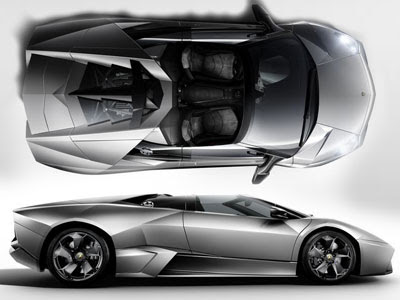
Lamborghini Reventón Roadster V12 engine Sports Cars


Lamborghini Reventón Roadster V12 engine Sports Cars

Designer piece with uncompromising performance
Lamborghini presents the ultimate driving machine among open-top two-seaters – the Reventón Roadster is a sports car of breathtaking fascination,
menacing power and uncompromising performance. The 6.5 liter twelve-cylinder generates 493 kW (670 PS), catapulting the Roadster from 0 to 100 Km/h (0 to 62 mph) in 3.4 seconds and onwards to a top speed of 330 KM/h (205 mph).
The open-top Reventón is not only one of the fastest, but also one of the most exclusive cars in the world – Lamborghini has limited the series.
The Lamborghini Reventón is not destined to remain a one-off. Less than 20 Lamborghini friends and collectors will be able to own this extraordinary car and, naturally, enjoy the incomparable pleasure of driving it.
Open-top sports cars are a tradition at Lamborghini that stretches back over 40 years. In 1968, the company from Sant'Agata Bolognese built a Miura without a fixed roof as a one-off.
The Diablo Roadster appeared in 1995 with its targa roof anchored to the engine cover.
All Lamborghinis are created with an avantgarde approach to design; a fast-moving technical sculpture.
The powerful arrowhead form at the front, the mighty air intakes pulled way forward, the broad side skirts, the upwards opening scissor doors and the rear end with its menacing edges – the Roadster is clad in a design of maximum functionality and spectacular clarity.
Details set stylish accents, such as headlamps featuring bi-xenon units with LEDs forming the daytime running lights and indicators. The rear lamps are also equipped with LEDs.
Like the Coupé, the Reventón Roadster measures 4700 mm (185 in.) long. It has a wheelbase of 2665 mm (105 in.) and is 2058 mm (81 in.) wide and 1132 mm (45 in.)
mm (45 in.) high. The driver and passenger seating positions are low and sporty, separated by a substaTebalntial central tunnel.
Lamborghini Reventón Roadster V12 engine Sports Cars

Behind the two seats are two hidden pop-up bars that deploy upwards in just a few hundredths of a second in the event of an imminent rollover. A fixed, horizontal wing-shaped member behind the seats bears the third brake light.
The design of the Roadster's long back is also quite distinct from that of the Coupé.
The engine bonnet is virtually horizontal and a total of four windows made from glass provide a view of the mighty V12 in all its technical elegance.
The base bodyshell of the Reventón is already so stiff that the Roadster requires only minimal reinforcement. It has a dry weight of only 1690 Kg (3,725 lbs.), just 25 Kg, (55 lbs.) more than the Coupé.
Like the Coupé, the cell of the Roadster is made from high-strength steel profile and carbon components joined with specialist adhesive and rivets.
The bodyshell is made almost entirely from carbon fiber elements, with sheet steel used only for the outer door skins.
The interior of the Reventón Roadster conveys the same powerful design as the exterior. The cockpit is structured with technical clarity, the interfaces arranged for functionality. Like a modern aircraft, the open two-seater no longer has classic analogue instrumentation – instead, information is delivered via two transreflective and one transmissive liquid-crystal displays.
The driver can switch between two modes at the touch of a button – one digital view with illuminated bars and one level with classic round dials, albeit with changing color graphics.
Centrally located at the top of the display is the G-force meter. It represents the intensity of the forces acting on the Reventón Roadster under acceleration, braking and heavy cornering; the same format used in Formula 1.
The instruments are mounted in a casing machined from solid aluminum which is housed in a carbon fiber dashboard. The interior displays uncompromisingly clean craftsmanship and features a host of carbon fiber applications – e.g. on the center tunnel – aluminum, Alcantara and leather.
The central panels and the seat cushions are perforated, with precision stitching gracing their outer edges.
The twelve-cylinder engine that powers the Reventón Roadster is a Lamborghini icon – and the technical feature that defines the character of the car.
It is one of the world's most powerful naturally-aspirated engines. With a compression ratio of 11 : 1 and a displacement of 6496 cc (396.41 in3,) it generates 670 PS (493 kW) at 8,000 rpm. Its maximum torque of 660 Nm (487 lb-ft) kicks in at 6,000 rpm.
The V12 engine is a masterpiece of Italian engineering. Two chains drive its four camshafts that, in turn, operate the 48 valves. Together with the three-phase adjustable intake manifold, the variable valve timing delivers a meaty torque build-up. Dry sump lubrication ensures that the hi-tech power unit has a constant supply of oil, even under heavy lateral acceleration.
The absence of the oil sump means a low mounting position – benefitting the car's outstanding handling characteristics.
The V12 catapults the Reventón Roadster from 0 to 100 Km/h (0 to 62 mph) in 3.4 seconds and onwards to a top speed of 330 Km/h (205 mph). It reacts he deep booming bass, the powerful mid-range and the exultant horn section play music that, once heard, can never be forgotten.
In classic Lamborghini style, the aluminum engine is mounted longitudinally in front of the rear axle, with the transmission ahead of it beneath the center tunnel.
This layout results in 58 percent of the overall weight being borne by the rear wheels – ideal for a powerful sports car.
This layout accommodates the Viscous Traction permanent all-wheel drive. Under normal conditions, it sends the vast majority of the driving force to the rear wheels.
Should they begin to spin, the central viscous coupling sends up to 35 percent of the power via an additional shaft to the front axle.
Limited-slip differentials are located there and at the rear axle with 25 and 45 percent lock respectively.
Lamborghini introduced the all-wheel drive principle with the Diablo. The reason back then was just as clear as it is today - four driven wheels grip far better than two, and the more powerful the engine, the greater the impact of this fundamental law of physics.
The Reventón Roadster keeps the extreme power of its engine in check with a running gear layout derived directly from motorsport. Each wheel boasts double wishbone suspension, with one spring strut on each side of the front axle and two each at the rear.
The front end of the car can be raised by 40 mm (about 1.6 in.) to protect the underside of the vehicle over potholes or on steep entrances into underground garages.
The open two-seater runs on 18-inch wheels. The front tires measure 245/35, while the rears are 335/30. Dedicated air channels in the bodyshell cool the four wheel brakes.
Carbon-fiber ceramic discs are standard – they have an extremely lightweight construction, operate with virtually no fade, are corrosion-free and achieve the highest service life.
Each disc has a diameter of 380 mm (~15 in.) and is gripped by six-piston calipers.
As fast as the open two-seater may be, its road manners are impeccable. Its performance limits are extremely high, yet effortless to control. And, on exiting a bend, all four wheels stick tenaciously to the asphalt.
The permanent all-wheel drive dovetails the car firmly with the road, delivering decisive benefits in traction and stability.
A further distinctive characteristic of the Reventón Roadster is its calm directional stability even at extremely high speeds – a feature that also turns fast highway stretches into sheer joy. Alongside the bodyshell design and the smooth underbody, which culminates in a powerfully formed diffuser, the rear spoiler carries responsibility for downforce. It deploys from the rear edge at about 130 Km/h (80 mph) and adopts an even steeper angle as of about 220 Km/h (136 mph). The entire aerodynamic concept – around and through the car – is radically laid out for performance.
The Design Department is directly linked to the neighbouring Ufficio Tecnico, ensuring rapid implementation of ideas. Lamborghini's capabilities also include the independent development of the complete electronic platform. This incorporates all control units – including those for the V12 and the innovative cockpit displays.
All units of the Reventón Roadster are being built on the Sant'Agata Bolognese production line, with perfect craftsmanship and to the highest levels of quality.


8c Competizione Alfa Romeo Maserati V8 engine Sports Car


8c Competizione Alfa Romeo

Designed and developed at the Alfa Romeo Style Centre, the 8c Competizione prototype pays homage to road racing Alfa's of the 30s and 40s which bore the 8c signature, while 'Competizione' refers to the 6C 2500 Competizione, a car driven by Fangio and Zanardi in the Mille Miglia race of 1950. (see 2006 BMW Mille Miglia concept)

8c Competizione Alfa Romeo


The Alfa 8c is a retro design powered by a Maserati V8 engine
Alfa Romeo are well known for producing flamboyant and beautifully styled cars, sometimes overlooking reliability. The 8c Competizione concept takes this philosophy to another level, and is one of the most stunning designs to come from the Italian manufacturer.

The flowing graceful lines of the 8c Competizione are a trait shared with another Alfa concept, the Nuvola. Both cars are inspired and shaped by Alfa Romeo models of the past, and their aesthetic design reflects this retro influence.

2009 MiTo GTA Alfa Romeo Turbocharged


2009 MiTo GTA Alfa Romeo Turbocharged

Visually the MiTo GTA stands out from the standard car with its deeper and wider front grille, redesigned front bumper and repositioned Alfa Romeo badge which now sits just above the trademark triangular grille. In profile the sideskirts which help connect the new lower front and rear sections of the MiTo GTA are obvious, as are the Alfa Romeo 8c Competizione inspired air vents integrated into the body panels just behind the front wheel arches. At the rear a massive diffuser houses the twin round tailpipes while also helping to provide additional downforce.
The Alfa Romeo MiTo GTA is a performance version of the standard MiTo hatchback which features enhancements to the drivetrain, chassis and bodywork.
Powering the Alfa Romeo MiTo GTA is a turbocharged, 1.8 litre, 4 cylinder engine with variable valve timing which develops a very healthy 240 horsepower. The engine is also designed to work with the Alfa D.N.A. system which allows the driver to select the driving mode and adjust the performance to suit driving styles and conditions.
As well as creating a very stiff chassis for the MiTo GTA, the engineers completely revised the suspension, lowering it by about 20 mm. The steering is more direct, precise and sensitive, allowing the driver to obtain maximum feedback. The steering can be personalized by selecting different positions using the Alfa D.N.A. system to suit driver preferences.

Sunday, October 11, 2009

Review : Alfa Romeo 8C Competizione

Alfa Romeo 8C Competizione

Imagine you're a male (Autoblog surveys say most of you are, so this shouldn't be hard). You've been invited to the Playboy Mansion for their annual Halloween party. You arrive, grab a flute of bubbly, get introduced to the crusty remains of Hugh Hefner and after a few minutes lay eyes on the most beautiful specimen of redheaded femininity the world has ever seen. You fight your knees from buckling, walk over and give it the ol' college try. Miraculously, you hit it off. She's entertaining, interesting and a joy to see and be seen with. One thing leads to another and you make your way upstairs into one of Heff's exotically appointed love dens.

You're ready to embark on one of the most pleasurable experiences of your life when... there's no spark. No connection. No chemistry. You use every trick in the book to make things work, but to no avail. Despite her arsenal of attributes, this exquisite example of sensuality just doesn't "do it" for you.

The 8C has been around long enough that you already know what matters. It's stunning, perfectly proportioned and should only be available in one color: Competition Red. Beneath its achingly gorgeous carbon fiber exterior you'll find the same platform that underpins the Maserati Gran Turismo, along with a dry-sump 4.7-liter V8 hand assembled by Ferrari. A six-speed sequential gearbox channels the bent eight's 450 horsepower (at 7,000 RPM) and 354 pound-feet of torque (at 4,750 RPM) to a limited slip differential nestled between the rear wheels, delivering a claimed 0-60 MPH sprint of 4.2 seconds and a top speed over 180 MPH.


Open up the long, upkicked door and another side of the 8C's character unfolds in front of you. The seats, which place your posterior a few inches from terra firma, belong in MOMA. They're masterfully sculpted, assertively clinging to your back and legs, and coated in the finest cowhide old man Giuseppe can rustle up outside Modena.

The dash is another modern masterwork of minimalism, with a faultless blend of carbon fiber and aluminum adorning the center stack, tunnel, doors and steering wheel. Ah, but wait. Something's amiss in the boot-shaped land. It would appear Alfa's beancounters couldn't stomach the cost of a carbon fiber dash, transmission tunnel and two door panels. They're all fake, save the panel housing the start button, transmission modes and parking brake switch. But no matter. After you depress the cold aluminum "Engine Start" button to breathe life into the high-strung V8 ahead of you, the faux fiber is the least of your concerns.


A rousing burble rockets out the rear, followed by an electronically controlled blip before the 8C settles into a soothing, seductive idle. The world melts away as you grab the paddle shifter, engage first, let off of the brake and beginning slowly making your way onto the road.

The ride is on the rough side, as if Alfa's engineers simply figured that Hard directly translates into Handling. But we've endured stiffly sprung rides before and the 8C is a proper exotic, so we want that sense of hardened agility with a wanton disregard for chiropractic costs.

But just as we start to stretch its legs across the rolling hills of the Napa Valley, it becomes abundantly clear that the while the 8C can make it through a workout, it doesn't enjoy the exercise.


The steering wheel, which is a bit on the big side for a such a sporting ride, conveys every lump and divot into your palms, but fails to completely communicate the interaction between the tires and the tarmac. The overly taut suspension crashes along some of the more neglected sections of our drive loop, causing the 8C to skip significantly when speeds increase and corner forces test the aging underpinnings. And while the power delivery and lock, load and explode gear changes – particularly with Sport mode engaged – are enough to send your skull into the headrest, the visceral thrills aren't a product of thrust – they come from manhandling the 8C into submission, keeping all four tires in constant contact with the road and avoiding tail-out, off-road excursions when trying to jump from apex to corner exit.

What we have here is a failure to communicate. And it never went away.


The more we pushed, the more it shoved. And after 20 miles of attempting to connect, all we were left with was a disconcerting air of apprehension. The only bright spot to be found were the brakes, which proved unflappable throughout our drive, providing consistent, fade-free pedal feel time after time. But even that lone light wasn't enough to instill confidence at anything beyond six or seven tenths, begging the question: What happened?

Realizing that only 500 examples would find their way to obscenely wealthy collectors, did Fiat – Alfa's parent company – simply rush the chassis and suspension development, trying desperately to keep costs in check, while focusing solely on appearance? Maybe. But for something so inexcusably attractive, you expect performance to be on par. And it simply isn't. Making the Alfa Romeo 8C Competitizione the one redheaded supermodel we would kick out of bed.

[Source: Autoblog]