Saturday, November 21, 2009

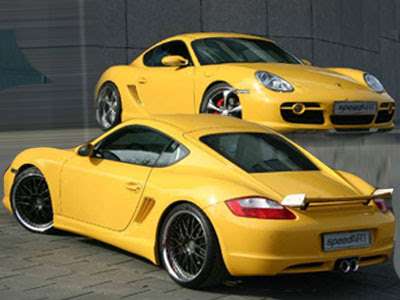
SRS Aerokit SpeedART The Sports Car Porsche Cayman a Sporty and Elegant.

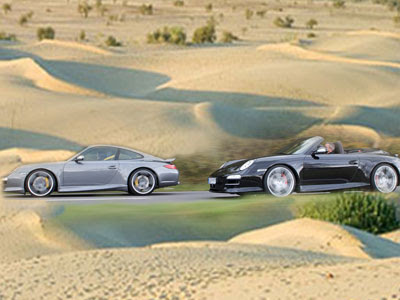
2009 SRS Aerokit SpeedART Porsche Cayman

SRS Aerokit SpeedART The Sports Car Porsche Cayman a Sporty and Elegant.
The SRS Aerokit from the German tuning firm SpeedART is a subtle and stylish way to spruce up the Porsche Cayman or Cayman S.
Unlike many bodykits which radically alter the appearance and persona of the car - sometimes for the good, but all to often for the bad - the SRS Aerokit is extremley in tune with the overall shape of the Cayman.The aerodynamic modifications include a 3-piece front chin spoiler - which provides additional downforce over the front axle, new deeper sideskirts, and an adjustable rear spoiler which has a distinct racing look to it. SpeedART have certainly taken the 'less is more' approach to design, and it's paid off.
A newly-enlarged 2.9-litre flat-six engine develops 255 bhp in the Boxster and 265 bhp in the Cayman, an increase of 10 and, respectively, 20 bhp over preceding models. The 3.4-litre power unit in the S versions, benefiting from Direct Fuel Injection, now delivers 310 bhp in the Boxster S and 320 bhp in the Cayman S, up by 15 and 25 bhp.
2009 SRS Aerokit SpeedART Porsche Cayman

The new Boxster and Cayman are significantly more fuel-efficient than their predecessors. The new 2.9-litre Boxer engine sips 8.9 litres of fuel per 100 kilometres (combined) – 11 per cent less than the former models with Tiptronic S. Reducing fuel consumption by 16 per cent to 9.2 litres/100 kilometres, the 3.4-litre versions with PDK offer an even greater saving.
For the first time, both models are available with a Lights Package featuring bi-xenon headlights, dynamic curve lights and LED daytime driving lights. Replacing the foglamps, these light units are made of four LEDs positioned next to one another on the Boxster, while on the Cayman four LEDs are arranged in round light units like the eyes of a dice.
The Boxster and Cayman are available for the first time with the seven-speed Porsche-Doppelkupplungsgetriebe, or PDK, which replaces the former Tiptronic S. Equipped with this double-clutch gearbox, the roadster and coupé accelerate to 100 km/h 0.1 seconds faster than with the six-speed manual fitted as standard on all models.
2009 SRS Aerokit SpeedART Porsche Cayman

PDK cars’ acceleration is even more dynamic with one of the optional Sports Chrono Packages featuring Launch Control for maximum acceleration from a standing start, while the Race Track Gearshift Strategy offers the fastest possible shifting on the track. With Launch Control, the respective models accelerate from a standstill to 100 km/h another 0.2 seconds faster. (For instance, the Cayman S with PDK and Launch Control accelerates to 100 km/h in 4.9 seconds, while the base Boxster with its new six-speed manual gearbox completes the same exercise in 5.9 seconds.)A new suspension set-up gives the new models a combination of even greater driving dynamics and enhanced comfort. Steering forces have been further reduced, giving the Boxster and Cayman even more agile and spontaneous steering behaviour.
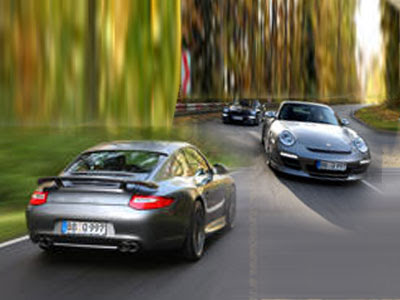
2009 SRS Aerokit SpeedART Porsche Cayman

The wheels come in new designs and are half an inch wider on the Boxster and Cayman than in the past in order to accommodate the larger brake system from the S models on the front axle. All Boxster and Cayman models feature the latest generation of Porsche Stability Management (PSM), with two additional functions: Brake Pre-Loading and Brake Assistant.
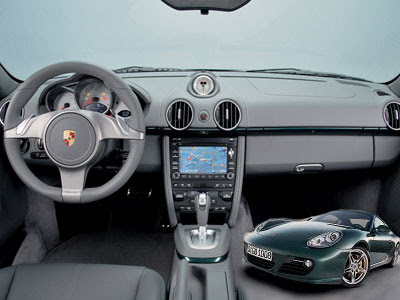
2009 SRS Aerokit SpeedART Porsche Cayman

Whenever the driver lets go of the gas pedal very quickly – which is typical of an upcoming emergency braking manoeuvre – the PSM control unit builds up an appropriate level of pressure on the brakes before the driver even presses down the brake pedal, moving the brake pads slightly towards the discs, which significantly improves brake response and shortens stopping distances accordingly.


Friday, November 20, 2009

First Drive: 2010 Dodge Ram HD

2010 Dodge Ram HD

Back in 1993, truck drivers had no choice but to depend on domestic automakers for work-ready pickups, and only Ford and General Motors offered competitive haulers. That all changed a year later when Dodge set the pickup truck market on its leaf springs with the introduction of its all-new Ram. With a big-rig appearance thanks to an imposing front grille that looked ready to kick you in the Truck Nutz, Dodge's truck sales tripled inside of 12 months and gave load-hauling manly men a real alternative to Ford and Chevy. But while Dodge hit a home run with the 1994 Ram, the Penta-horned brand didn't have a heavy-duty option in its lineup until 2003, and an all-important diesel powerplant didn't come online until 2004. In 2008, Dodge filled out its pickup lineup with heavy-duty 4500 and 5500 variants, finally giving Chrysler's trucking arm the range of choices necessary to get plucky with the competition from Detroit and Dearborn.

Last year, Dodge introduced a new light-duty Ram, with sleek updated aesthetics and controversial coil springs that provide a superior ride at the expense of some towing and hauling capability. Fast-forward a year and the truckmakers at Chrysler are set to unleash a new heavy-duty Ram that's been redesigned to provide customers more capability, more options and a better ride while competing against offerings from its crosstown rivals with a lower cost of entry. We headed out to Ann Arbor, MI to drive, tow, brake, climb and traverse in the new Ram HD to see if Chrysler's truck team has succeeded.

When it comes to passenger cars, it's difficult to discern exactly what your customer base is after. An automaker can make a sedan with good power and handling, fine interior appointments and tons of room for four adults, yet the final product can still go over like a herpes flare-up. Trucks are a bit different. If you can deliver rugged good looks; strong, usable power; plenty of storage and top-notch reliability, chances are customers are going to find you. After all, there were 1.6 million trucks sold in the U.S. last year; about one-in-eight of the total consumer-grade vehicles sold, so there's plenty of reward for a job done right.

But the trick to nailing a top-notch pickup is working tirelessly with customers to figure out who buys trucks and how they're used, and the guys and gals at Dodge have it down to an exact science. How exact? Dodge's marketing team tells us that a typical truck buyer is a 55-year-old male, about 5' 11" and 203 pounds. There is a 67-percent chance that customer is going to have at least one dog (half the animal owners have two or more), and there's a 58-percent chance he tows a trailer.


To cater to that core customer, every Dodge Ram HD comes with a standard Class IV hitch, along with both four- and seven-pin hookups. As is increasingly common these days, Dodge is also offering an optional trailer brake package integrated into the dashboard. And since the guys who use their truck for work all week typically also use that truck on the weekends, the new Ram HD now has a crew cab configuration to ensure there's enough room for the camper, the family and the dog.

The new Dodge Ram HD looks smooth, maybe even a bit sexy.
Truck buyers demand a lot out of their pickups, and utility will always take precedence over appearance in the heavy-duty segment. But that doesn't mean looks are unimportant. HD-class pickups need too look, well, heavy-duty, and this new Ram has bad-ass written all over it. For 2010, the Ram's already substantial crosshair grille gets even bigger, with enough chrome to fry even the most bling-resistant of retinas. The shiny metal parade continues with the bumper, which has been impressively fashioned from a single chunk of metal.

The hood now has a prominent power dome that seems to be all the rage these days and the headlamps received the same treatment as Dodge's light-duty model, only bigger. Arguably the most impressive design feature of the new Ram is a dually exclusive. Dodge decided to shy away from the composite body panels to cover the rear tires, instead opting to stamp the dually rig's rear quarters using honest-to-goodness steel. The look is smooth, maybe even a bit sexy, especially if trucks that can tow 17,000 pounds is your thing.


In all, Dodge manages to make an already manly looking truck even more rough and ready. Gaps are tighter, sheetmetal is curvier and everything just looks brawnier. But today's heavy-duty truck buyer is shelling out anywhere from $30,000 to over $60,000 for the right to go big, and they demand a functional, configurable and comfortable interior. The 2010 Dodge Ram HD has an interior for every taste, from a regular cab for work applications to the crew cab and even a largest-in-class mega cab.

We spent the majority of our time in a Ram 2500 SLT crew cab with a 6' 4" bed. Dodge says this is their volume truck, so we were more than happy to take the Cummins diesel-powered example as our test model. Over the course of our testing at Chrysler's Chelsea, MI proving grounds, it proved to be a nice place to work. First off, the crew cab's cabin is huge – which is expected of a four-door pickup weighing more than 6,000 pounds. There's so much room inside the new Ram HD that Dodge engineers found enough space to throw in 42 storage areas – up from 24 cubbies in the last-gen Heavy Duty. While some of those compartments are only big enough to handle a cell phone or a couple packs of gum, others are large and quite handy. The massive glovebox can fit drinks for everyone in the cabin, while the in-floor cooler can fit added refreshments plus ice.


Beyond a plethora of cab configurations, Dodge is also offering two different levels of interior refinement. The base interior, in which we spent most of our time, is fine for most applications, with harder plastics better suited to a work site than a trip to the opera. It'll be fine for most truck owners, though, with comfortable seats and armrests aplenty. We did manage to spend some time in an upscale Laramie model, which contains the same top-notch materials found in the higher-spec light-duty Ram. Soft touch, leather-like materials abound, and the hide-wrapped steering wheel is one of the best in the business – even eclipsing the offerings from Ford or GM's truck.

But while a great cabin certainly helps both the recreational and work truck buyer do their job in comfort, the most important factor is capability. And since the Ram HD can haul up to 24,500 GCWR, we're confident the newest Dodge has all the skills that most truck buyers could ever need. During our stint with the Ram HD, we were given the opportunity to drive three Dually 3500 models, each towing or hauling something significant. The first model, a regular cab model with a six-speed manual transmission and an eight-foot bed, had over 1,200 pounds of straw strapped to its back. The 350 horsepower and 650 lb-ft of torque provided by the 6.7-liter Cummins inline-six diesel engine (which carries a $7,615 price tag over the standard HEMI V8) hauled this big load without breaking a sweat, though rowing our own gears isn't nearly as much fun when motivating 8,000 pounds of truck.


The giant bale of straw was only an appetizer, though. The big fun was to be had when we got behind the wheel of a Ram 3500 Crew Cab Dually with an eight-foot box. Latched onto the truck's bed was a trailer containing a Case IH Maxxum 125 tractor. That's 16,500 pounds of tractor and trailer – exactly the sort of payload you pictured yourself hauling as a kid playing with Tonka Trucks. With all that weight in tow, the Ram HD's best-in-class 650 lb-ft of torque at 1,500 RPM came in handy. Taking off from a stop was a snap, and coming to a halt wasn't as laborious as expected. The Cummins I6 displayed steady grunt when towing the load, never feeling overmatched. Once up to speed, we were able to shift our own gears thanks to Dodge's Electronic Range Select feature, which lets the driver manually limit the highest available gear. ERS comes in handy when traversing steep grades while hauling a big load, as there are only so many algorithms engineers can program to provide up/down shifts exactly when you need them. Turning was made a bit easier with the aid of the new Ram's excellent sideview mirrors, which kept a crystal clear picture of everything going on around our super-sized cargo.

The Ram HD also has a few features that make hauling a big load safer. Diesel models now come with a standard exhaust brake that can be turned on and off via a switch on the dash. The exhaust brake shuts down the turbos, using engine compression to slow down the mini big rig, which also reduces brake fade when hauling loads on downhill grades. We weren't able to test the exhaust brake during our time hauling the Case IH Maxxum 125 tractor, but we did try out another way Dodge engineers were able to make the Ram HD easier to stop. While coasting at 60 MPH, we were instructed to simply ease off the accelerator and tap the brake. The integrated trailer brake controller worked in concert with the Ram's six-speed auto 'box to quickly slow over 24,000 lbs of steel, glass and rubber without overtaxing the truck's disc brakes.


Dodge appears to have built a work truck for everybody from the grunt to the site foreman, and the horned beast is looking to appeal to the ardent off-roader as well. The new 2010 Ram HD Power Wagon is no joke. Its 33-inch LT285/70R17D BF Goodrich All-Terrain tires, solid axles, locking front and rear differentials and electronic sway bar disconnect have banded together to accomplish one goal: making you a superstar when tackling the wild. Dodge set up a sweet off-road gauntlet within its proving grounds to properly test the Power Wagon's prowess. We simply put the Ram into 4WD low and headed off into the rough stuff.

Chrysler has a great opportunity to improve upon its 23-percent share of the HD truck market.
The course contained uphill and downhill grades, massive boulders, several inches of mud and even a steep, dirt-encrusted log bridge. The Power Wagon cut through all of the obstacles without breaking a sweat, with the 383-hp HEMI V8 (the Cummins diesel isn't available on the Power Wagon) providing plenty of punch for anything we were able to throw at it.

Dodge management challenged its truck engineers to deliver similar ride quality improvements to its heavy-duty offerings as it did with the light-duty Ram, but without the use of coil springs. We wouldn't exactly say those engineers nailed this request like a Rodney Dangerfield Triple Lindy, but we would definitely call the new Ram HD a more comfortable cruiser than the outgoing model. Among the engineering changes for 2010 are mounts that connect the C-Pillar to the truck's frame, resulting in less cabin shake on rough roads. The new Ram is also quieter on the inside with the aid of triple sealed doors and improved aerodynamics. The change is noticeable when holding conversations on the open road, and we were even able to talk in muted tones when traversing the gauntlet in the Power Wagon.


After spending a day with the extensive lineup of heavy-duty Dodge Rams, we're confident that Chrysler's truck division has a reasonable shot at improving upon its 23-percent share of the HD truck market. That's already a big chunk of pie in a segment Dodge has only played in for seven years, and a new-and-improved truck for 2010 that will retail for less money than the model it replaces makes the fight for customers a bit more interesting. Dodge's new trucks are now more competitive than ever with improved aesthetics and ride quality, terrific interiors, more configurations and improved capability. At the very least, the Mopar brand has put a lot of pressure on the competition to hit a home run with new product offerings next year. Because if Ford or GM miss, Dodge will be more than happy to take their customers and run.

[Source: Autoblog]

2010 Bentley Continental Supersports Car is a twin-turbocharged, 6.0 litre W12 engine the fastest, most extreme Bentley ever


2010 Bentley Continental Supersports Car

The Bentley Continental Supersports is the first Bentley model to be designed with some thought given to the environment. Bentleys will never be the most economical or environmentally friendly of vehicles but at least they're recognizing the fact that times are changing.The Continental Supersports began as an 'under the radar' project exploring the possibilities of weight reduction on the Continental GT but with more power and torque.The Bentley Continental Supersports is the fastest and most powerful Bentley ever. It is the extreme Bentley, a muscular two-seater that delivers supercar performance and a highly focused driving experience. The Bentley Continental Supersports is also the first Bentley capable of running on both petrol (gasoline) and biofuel, pioneering the use of FlexFuel technology in the luxury sector. This represents stage one of the company's commitment to make its complete model range compatible with renewable fuels by 2012. Available worldwide from autumn 2009, the Bentley Continental Supersports will be FlexFuel compatible in the majority of markets from launch with North American cars offering the capability by summer 2010, following regulatory approval
2010 Bentley Continental Supersports Car

A largely experimental process crystallised over a period of 24 months into an official new car programme, driven by the passion and enthusiasm of a small group of Bentley engineers and designers.
Powering the Continental Supersports is a twin-turbocharged, 6.0 litre W12 engine which is capable of running on either regular gasoline or E85 biofuel, or a mixture of both. Despite the flex fuel capability the Supersports engine produces a massive 621 horsepower @ 6,000 rpm and 800Nm (590 lb-ft) of torque @ 1,700 rpm - 5,600 rpm. This means the Continental Supersports can reach 60 mph in just 3.7 seconds, 100 mph in 8.9 seconds, and top out at 204 mph.
2010 Bentley Continental Supersports Car

The Continental Supersports is fitted with Bentley's carbon-ceramic brakes as standard – the largest and most powerful ever fitted to a production car. The large diameter (420 mm front, 356 mm rear), lightweight discs and eight-piston calipers offer fade-resistant braking performance with minimal disc distortion under high thermal conditions. Overall, the engineering team have achieved a weight reduction of 110 kg (243 lb) compared with the Continental GT Speed.
The evolution of the Bentley Continental Supersports' design is very much a case of 'form following function' with new purposeful sculptural forms signalling the engineering changes beneath the skin.
2010 Bentley Continental Supersports Car

The Continental Supersports agility is further sharpened by the 40:60 rear-biased torque split for the all-wheel drive system, a wider rear track, bespoke lightweight 20-inch alloy wheels and a unique electronic stability program.Cosmetic changes to the Bentley Continental Supersports have arisen due to the new powertrain.
The 'Supersports' name is inspired by the original two-seater 3-litre Supersports model introduced in 1925, itself an evolution of the 3-litre Speed. The lightweight, 85 bhp Supersports was the first production Bentley to reach 100 mph and was also renowned for the application of Le Mans-winning race technology.
2010 Bentley Continental Supersports Car

Commenting on the new Supersports model, Dr. Franz-Josef Paefgen, Bentley's Chairman and Chief Executive said: "The Bentley Continental Supersports reflects the passion and enthusiasm of Bentley's engineers and designers. This is the fastest, most extreme Bentley ever, dramatically styled to underline its supercar character. Importantly, it also pioneers the use of FlexFuel technology in the luxury sector."

Thursday, November 19, 2009

2011 Lotus Esprit Sports Car will be a wholly different Beast powered by a 4.4 liter V8 engine

2011 Lotus Esprit Sports Car

The guys over at AutoCar have caught the upcoming Lotus Esprit testing in cold-snowy weather of Sweden. After running some DVLA records and matching the license plate, AutoCar has learned that the prototype is powered by a 4.4 liter V8 engine. Lotus sources have previously said that BMW may be the supplier for Lotus’ 2011 Esprit.It’s possible that the new Lotus Esprit will carry the 4.4 liter twin-turbo V8 engine from the new BMW X6, but will most likely be tuned to develop 500 horsepower.Currently the 4.4 liter twin-turbo from V8 produces 400 horsepower. The engine is also expected to be used in other BMW models including the X5 and the 7-Series. Lotus engineers will most probably re-work the engine management to reach numbers closer the Nissan GT-R and the Porsche 911 Turbo.
According to Lotus insiders, the next-gen Elise will arrive sometime in early 2011 followed by an all-new V8-powered Esprit in 2012...............................2011 Lotus Esprit Sports Car

The 2011 Elise will likely be built upon an evolved version of the current model’s extruded-aluminium underpinnings and continue the same formula that’s made the pint-sized sportscar a track day fave, but the Esprit will be a wholly different beast.
While the new Elise is all but locked in, the Esprit project is very much dependent on whether Lotus can sell enough Evoras to fund it. The timeline for the Esprit is also at the mercy of the global economic situation, with Lotus likely to delay the Esprit and forge ahead with a far less costly drop-top Evora if the recession persists much longer.
If it launches on time, the Esprit could be Lotus’ best hope of gaining a much larger share of the sports car market.
There are speculations stating that the 500bhp V10 powerplant can be the source of power for the Lotus Esprit, which will be released in 2012...............................2011 Lotus Esprit Sports Car

The engine is currently being used in the Lexus LF-A, a car that has not yet been launched itself. Being connected with the Japanese carmaker Toyota, Lotus has access to its entire range of parts and components, as well as powerplants from the Lexus line. This points to the likelihood of an Esprit flagship, costing more than ?100,000, equipped with the compact 8500rpm V10 unit (to rival the Lamborghini Gallardo), including a less expensive variant equipped with the 5-liter, 417bhp V8 from the Lexus IS-F and an entry-level model coming with a Lotus-tuned direct-injection Toyota V6 unit that can come up with 300bhp.
Although a V8 or a V10 unit would definitely boost the profile of Lotus, there is also a possibility of an Eco Esprit. Lotus is moving forwards with more efficient products with lightweight engineering and its keen interest in alternative fuels and hybrid solutions. This is also underline by its partnership with the electric car manufacturer Tesla...............................2011 Lotus Esprit Sports Car

The Esprit was inspired by the larger bonded and extruded aluminum chassis of the recently launched Evora, the rear section of which have been developed to accommodate both transversely and longitudinally fitted engines. Although the Lotus has shown that it can develop a new model in a short time (the Evora, for example, was developed in 27 months), the work on the Esprit will only reach its maximum when the Evora is being swept out of showrooms in the UK, Europe and US. It is the Malaysians who are funding the Evora project, with the persuasion of Lotus CEO Mike Kimberley.

Keating TKR Super Cars LS7 engine, two turbochargers to make its power skyrocket.

Keating TKR/SKR Super Cars

The search for the fastest car in the world title is still far from complete. If the Bugatti Veyron seems to be unbeatable with its 1001 HP and more than 400 km / h, it was the South-South cooperation Ultimate Aero and pushed the bar a little higher, at exactly 413.83 km / h with its HP 1199 and 1247 kg. Now, British car manufacturers want to regain the crown from the possession of the McLaren F1 in a manner very convincing, more precisely with the TKR Keating. Since there is no official data on the performance has been made available on that day, you can imagine what 1190 kg and 1500 hp supercar can do, but you do not have much imagination to the records May rapidly in dust…
Keating TKR/SKR Super Cars

The new car version and its soft, the Swedish kroner, were last Wednesday in South Portland, United Kingdom. The two are on a steel space frame structure, but it allows a structure made of carbon fiber to support the weight even more. The bodies are made of fiberglass, carbon fiber, but also the facilities are available as an option. These vehicles are Keating 4.31 m long, 1.87 m wide and 1.15 m in height. The British automobile manufacturer is already orders for them, but the supplies did not occur by the end of the year. No hurry, because the customers have to wait for their luck in any case: SKR and the TKR is being built in a limited quantity to them and to ensure that only quality standards.
Keating TKR/SKR Super Cars

British supercar manufacturer and challenger for the production car world land speed record, Keating, will have its 260.1mph TKR supercar on display at this year’s MPH Show featuring Top Gear Live at London’s Earls Court on 5 November.
Keating TKR/SKR Super Cars

In the first of two runs on the Salt Lake Flats in California last month, the remarkable 7.0 litre, 1800 BHP Keating TKR smashed the current record, adding an extra 3 mph to the top speed of existing title holder, the Shelby Aero TT.The TKR will probably have the LS7 engine as its base, but two turbochargers are expected to make its power skyrocket to 1,500 hp. This number can be even higher, since the supercar is still under development.Now the Manchester based company must do it again to ensure entry in the Guinness Book of World Records.
Keating TKR/SKR Super Cars

But before it returns to California, the breathtaking Keating TKR will make its MPH show debut in London tomorrow in front of capacity crowds.
Tony Keating, founder of Keating Supercars, said: “The Keating TKR realises our ambition to take on the world’s finest supercars and win. This car rivals them all for looks, handling, performance and exclusivity. And best of all, it’s British.”

Genetic penis enlargement

Penis enlargement

For years, decades anthropologists opened ancient and not so ancient cultures which frameworks the penis increase practised, but about it will seldom enough meet though any mention in the popular scientific literature.

Discussions concerning a penis

Still fifty years ago in medical grants discussions apropos penis enlargement were conducted. However the sanctimonious, Puritan morals sharply limited scales of any serious research how to increase a sexual member. Fortunately, sexual revolution has forced us to reconsider a way of studying of a body of the person, and some progress is already reached in studying and understanding of functioning of a penis. Though medical moors continues to repeat obstinately, that increase in the sizes of a penis — business impossible, hundreds men on own experience can easily refute such contentions.

PenisWays of increase in a penis have many variants — from logic to budget. We represent you the most popular methods penis enlargement to which resorted throughout centuries, including a little simple remarkable and rather promising.

The sizes of a penis as colour of eyes, the figure, a constitution, a skin shade, get to us by right of succession. If your father or the grandfather had a big penis you have every chance to have precisely same. "Keys" to understanding of the hereditary sizes of a penis disappear in secrets of a molecule of DNA — this double spiral keeping the genetic coded information. Lodgers penis enlargement forum — confirm, that related DNA are entirely responsible for the size of a penis.

The big sites of DNA are identical at all people. After all all at us have ears, feet, kidneys etc. But there are sites of DNA which strikingly differ at different people.
These sites, which functions up to the end are not found out till now, all time repeat, as if the worn out plate. On these surprisingly various sites it is possible to define those characteristic lines which distinguish one person from another, — a hair colour, an eye, the nose form, blood group, growth and, needless to say, the sizes and the form of a man's sexual member. Each individual (except for twins) has unique DNA, the so-called original sample. The scientists working in forensic medicine, use "prints" of these DNA (which it is possible to allocate from a drop of a saliva, blood or sperm) as the reliable tool for an identification of the suspected criminal.

Researchers have started recently realisation of one of the most arrogant projects ever undertaken by the person. Scientists have decided to develop special penis enlargement pills which are capable to extend your penis on the whole 15 cm!

The penis is a man's heart!

Wednesday, November 18, 2009

2010 Bentley Continental GTC Speed The Super Sports Car 600bhp, 6-litre, twin-turbocharged W12 engine.

2010 Bentley Continental GTC Speed

Introduction of the new Bentley Continental GTC range builds on this success with a subtle evolution of its distinctive style and a range of technical and feature enhancements benefiting comfort and customer choice. The appeal of the GTC is further strengthened by the addition of the new 600bhp (610PS) Bentley Continental GTC Speed model. It is Bentley's most powerful convertible ever and inspired by Bentley's legendary 'Speed Models' from the 1920s.
2010 Bentley Continental GTC Speed

The Bentley Continental GTC Speed is visually distinguished by subtle design enhancements which emphasise its higher performance credentials. At the front, the radiator and lower air intake grilles feature a dark tinted matrix as standard. Larger diameter 9.5J x 20-inch, multi-spoke alloy wheels with Bentley-bespoke Pirelli PZero ultra-high performance (UHP) tyres, lowered and uprated suspension, wider twin-rifled exhaust tail pipes and a new boot-mounted lip spoiler that enhances high speed aerodynamics, reinforce the sporting character of the Speed model.
2010 Bentley Continental GTC Speed

The GTC Speed's 600bhp (610PS) W12 engine develops 9 per cent more power than the standard GTC. However, it is the 15 per cent increase in torque that really distinguishes the Speed model, which now develops an impressive output of 750 Nm (553lb ft). This is achieved across virtually the complete rev range, from just 1700 to 5600 rev/min, delivering that characteristic Bentley wave of torque.Engine efficiency improvements result from the use of
lower friction, lighter-weight components and a new engine management system, while twin, low inertia turbochargers with minimal turbo lag contribute to the W12 engine's flat torque curve. The GTC Speed engine is visually differentiated by the 'crackle black' finish to the intake manifold.The Continental GTC's steel body has an exceptionally rigid torsional stiffness of around 30Hz that not only minimises 'scuttle shake' but provides a very stable platform for the aluminium-intensive suspension system, optimising its performance. Despite the boost in power and torque for the GTC Speed model, no changes to the body structure were required.
2010 Bentley Continental GTC Speed

The Bentley Continental GTC Speed has a unique set of design cues, notably a dark-tinted matrix grille to the upper and lower air intakes, a black very stable platform for the aluminium-intensive suspension system, optimising its performance. Despite the boost in power and torque for the GTC Speed model, no changes to the body structure were required.The Bentley Continental GTC Speed has a unique set of design cues, notably a dark-tinted matrix grille to the upper and lower air intakes, a black lower bumper valance, wider, rifled exhaust tailpipes and 20-inch, silver-painted, multi-spoke alloy wheels.The wheels are available as an option with a special dark tint finish.
2010 Bentley Continental GTC Speed

The GTC Speed's cabin is based on that of the Mulliner Driving Specification (a cost option on the standard GTC). It features diamond quilted hide seats with embroidered Bentley emblems, a knurled chrome and hide gearlever and a three-spoke multi-function steering wheel with brushed aluminium switch surround.
These are complemented by drilled alloy foot-pedals and 'Speed' logos to the polished treadplates. The standard GTC also receives a new Bentley 'B' brake pedal.


2010 Seat Ibiza Bocanegra This new generation engine guarantees both brilliant performance and exceptional economy.

2010 Seat Ibiza Bocanegra

Seat Ibiza Bocanegra
road ready version has been unveiled at the Barcelona International Motor Show with the debut of a road-ready version of its stunning Seat Ibiza Bocanegra.
Staying remarkably true to the headline-grabbing Bocanegra concept car unveiled at the Geneva Motor Show a little over 12 months ago, the production version is today making its world debut at SEAT’s ‘home’ show.Seat Ibiza Bocanegra comes with a distinctive front fascia featuring a central grille with honeycomb mesh, black surround and new air vents, also completely black double headlights.The new SEAT Ibiza Bocanegra is a unique, exclusive vehicle that features an uncanny exterior design and a personalised interior, which has undergone major modifications compared to the rest of the range models.
2010 Seat Ibiza Bocanegra

The main characteristic feature of the new SEAT Ibiza Bocanegra is found on the front of the car. As its name suggests, the imposing black volume at the front is reminiscent of a mask, which strengthens the stylishness of SEAT's new model.Boasting several unique, and dramatic, black styling elements at its nose – hence the Bocanegra name which translates as ‘black mouth’ in Spanish – the new iteration of today’s Ibiza is set to become one of the hottest superminis around.
Other outstanding exterior elements are the door mirrors with their black housing, the sunroof and the attractive 17 inch "Sira" rims and low profile 215/40 R17 tyres. But what really identifies the personality of the Spanish brand's new car is the "Bocanegra" badge centred on the hatch door, a characteristic trait of SEAT's most exclusive versions.The new SEAT Ibiza Bocanegra will be available in the SEAT Ibiza FR and SEAT Ibiza CUPRA versions equipped with the twin charged 1.4 TSI engine, either with 150 or 180 hp output, This new generation engine guarantees both brilliant performance and exceptional economy.

2010 Seat Ibiza Bocanegra

Featuring a broad equipment line-up including the self-blocking XDS system, which anticipates traction loss to the wheels and limits tractive force to the wheel expected to lose grip, ESP, TCS + EBA, ABS, Hill Hold Assist, low tyre pressure warning, driver and passenger airbag, head-chest airbag, sports suspension and cornering foglights.Meanwhile, XDS electronic limited slip differential and a state-of-the-art seven-speed DSG gearbox with steering wheel-mounted paddle shifts underline the Bocanegra’s hi-tech appeal.
2010 Seat Ibiza Bocanegra

Welcoming the car’s dramatic show debut today Head of SEAT UK, Peter Wyhinny, said: ‘The surprise unveiling of Luc Donckerwolke’s brilliant design concept at Geneva last year caused a real buzz around the show, and I’m sure the appearance of this remarkable production version will do the same in Barcelona.
‘I’m very much looking forward to seeing right-hand drive versions of the Seat Ibiza Bocanegra turning heads on UK roads later this year.’
2010 Seat Ibiza Bocanegra

Seat Ibiza Bocanegra will hit the showrooms in British this year, while the price of Seat Ibiza Bocanegra has not been announced yet by the company.