Saturday, March 28, 2009

BRABUS turns 2010 Mercedes-Benz E-Class into AMG-hunting beast

BRABUS E-Class
BRABUS E-Class
BRABUS E-Class

If you must have the new Mercedes-Benz E-Class and can't wait for the AMG version, BRABUS has something to show you. The German tuning firm has launched its new program for the redesigned luxury sports sedan, the highlight of which is an enlarged 6.1-liter version of the V8 found in the E550 that now produces 462 hp compared to the original's 382 hp.

BRABUS clearly didn't stop there, fitting an aero package to the new E-Class that replaces the front bumper with a new design that reduces lift and incorporates LED daytime running lights and fog lamps. The exterior also features new fender vents, rocker panels, a spoiler and rear apron housing a pair of chrome tailpipes. The entire look is rounded out by new BRABUS Monoblock wheels that can be had up to 20 inches in diameter.

Additional performance hardware includes an augmented braking system with larger rotors and more powerful calipers, an optional limited-slip differential and BRABUS-tuned sport exhaust. The interior, likewise, can be fitted with optional equipment like illuminated BRABUS sill plates, a different "sport" steering wheel and complete mastik and alcantara leather interiors.

[Source: BRABUS]

2010 Lamborghini Gallardo LP560-4 Spyder


Once Lamborghini upgraded the Gallardo to the LP 560-4, the roadster followed suit. While the styling didn’t change that much, something much more important happened: a 40 hp upgrade. It’s now powered by a 5.2 liter V10 engine that delivers 560 hp and over 380 lb ft. of torque to all four wheels. It makes the 0 to 60 mph sprint in 4 seconds and can go up to 201 mph.

While it may be hard to tell how much faster the Gallardo LP 560-4 Spyder is in this video, it’s still a great Italian beauty to kick off the weekend.

Jaguar/Land Rover needs £500 million from the UK government to prevent layoffs

Land Rover LRX Concept

Ratan Tata bought Jaguar and Land Rover (JLR) expecting to pick them up and help them fly. Instead, as with nearly every other car manufacturer, he's having to dig them out of a deepening hole. From last December through next month, 1,800 employees have either been laid off, released or asked to leave. According to Tata, if the UK government doesn't give JLR £500 million ($715 million USD) in loan guarantees, more people will have to go.

The government appears to be passing on the request, having already given Land Rover a £27 million ($38 million USD) loan to help it create the LRX. Even as the government is continuing to help JLR secure bank financing, the line on JLR's new request for loan guarantees is that "the primary responsibility for short-term financing or longer-term restructuring rests with the parent company."

[Source: Automotive News]

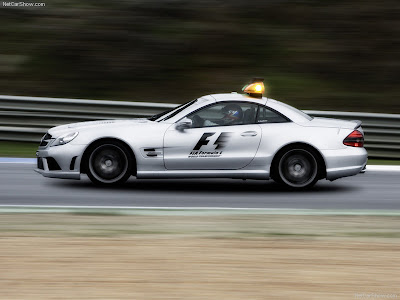
Mercedes-Benz SL63 AMG returns as F1 safety car for 2009

 Mercedes-Benz SL63 AMG F1 Safety Car

AMG has been involved in Formula 1 for well over a decade now, starting with a Mercedes-Benz C36 AMG serving as the safety car back in 1996. Most recently, the SL63 AMG earned the spot last year, and it is returning for 2009 to set the pace at each F1 race this year. To ensure that it's capable of performing its duties in any situation, the car has been fitted with quite a few upgrades, including an upgraded coilover suspension system, a three-stage traction control system, massive composite brakes – 15.4 inches up front and 14.2 inch in the rear – and additional coolers for the oil, transmission, coolant, and power steering. The overall weight of the car has also been reduced by 485 pounds thanks to carbon-fiber-reinforced plastic body components and the removal of the convertible top mechanism.

[Source: Mercedes-Benz]

Audi Q5 commercial


Ads aren’t always very clever, but this one for the Audi Q5 crossoverdefinitely had a few creative minds at work on it. It was made for the South African market, and the slogan is "Everything happens on cue", get it?

Friday, March 27, 2009

Yamaha Mio “Rp40 juta” menang Kontes Modif di Bali


KUTA, SUNDAY - Yamaha Mio property I Made Ambara successfully carry predicate Best of the Best in the event modifications motor matik, Cuzztomatic 2 which was held in the parking lot Central Kuta, Bali, Sunday (30 / 3). Mio color vacillator the full sound system this past champion to successfully carry audio category modification.
Now, after six champion selected to matik modification six categories, motor home modification besutan moto-one (M-1) Denpasar is considered as the best. With the victory, the Mio Ambara that it reserves the right to represent region I (Bali, Nusa Tenggara and East Indonesia) to fight in Cuzztomatic 2 akan national level which was held in Jakarta in mid-year, in Arena Pekan Raya Jakarta.

This event memperebutkan akan melancong the main prize to the land of white elephants, to exchange knowledge with modifikator the powerful in Thailand. Meanwhile, in the contest in Bali, Ambara has mengantongi a number of gifts that is, the money Rp1, 2 million as the top category audio. Then, a unit of Yamaha Mio Soul, and 1 set of Yamaha fashion design Oscar Lawalatta worth Rp 1.7 million as the prize citation for Best of the Best.

So what advantages Mio Ambara other than the champion? One thing that is most surprising, "discotheque walk" has been modified spend more than Rp 30 million, not including the price motornya. Be calculated a number of fantastic considering the price of Yamaha Mio in the range of Rp 12-13 million per unit.

According Ambara, Rp 30 million was spent to install all the audio and completeness vacillator chrome finishing. "To my headunit discussion JVC, with 12 inch subwoofer brands JL, 7 inch screen sentru brands, two JBL speakers, two power brands teklin 2 channel and 4 channel accoustic," said Ambara.

In addition, at the stern of the motor is built for three days this also been a camera, connected to the monitor screen. "So if we are in the way, we can see the situation clearly on the back," said Ambara again.

"And that is also unique, I use an antenna minimoto. As in the car. So if the radio is turned on, antene akan naik is automatically, "said shop owner modifications bermarkas Mulyawan Mountain Road in the East, the Denpasar.

In the peak events in Bali, the Yamaha also watching the events with the Spanish MotoGP racer dijuarai by Repsol Danny Pedrosa Honda, Yamaha and Valentino Rossi are successful finish in second place. After this, the Yamaha motorcycle modification event will be held in Yogyakarta, on 12-13 April, to get the motor matik modif best in the area of Yogyakarta and Central Java.

source: kompas.com

Yamaha Mio Low Rider from Malang


JAKARTA, Wed - Malang Demand was again low rider. See Rohman Fatkhur only works on Yamaha Mio 2004. Skubek the concept dimodif low rider have a new breakthrough. I not only elongate arm swing, but also widen sokbreker front wheel axis so that the long term, "said graduate engineering alumnus Universitas Islam Malang (Unisma) that.
Interestingly, the concept is quite simple elongate wheelbase. only add that arm position as the front wheels so sokbreker. Also followed with a capsize sokbreker front, so that the position of the disc brake was on the right hand side so on the left. This technique takes the risk because the holder kaliper the original on the back tube sokbreker right now so in the future sokbreker left. "Installation of kaliper quite difficult, therefore need to add 50 mm along the plate so that there is room for kaliper holder," said Fatkhur.

Other risks, the standard sokbreker so soft due lengannya sweep. Bakan time in the test road, sepatbor mentok iron triangle. The solution sokbreker add oil. Wrong with the front legs, back and turn a simple garapannya more. To extend the swing arm pivot arm to swing with the help of make a kind of bridge. To be strong, iron box construction made kopong such as stairs.

Once completed, Fatkhur feel his work has not been back sempurna.Konstruksi original monosok not strong. that it is, motorcycle Suspensi too soft and mantul. So change it so sokbreker ganda on the left side. How, under the quasi-holder remains in the original position using the machine, only the holder under shock reducer made new. And look balanced now.

So that the Mio could invite more attention, the color was blue motor changed kunig inspired from the Jazz. Kelhiat not so plain, on the back of the ornament plus airbrush skull thin red lights garapan crow Airbrush.Trus poop on the CCTV camera be placed behind the brake lights. Cool, abis

Thursday, March 26, 2009

2009 Mazda6 s Grand Touring

2009 Mazda6 s Grand Touring

With a tagline like "Zoom Zoom", Mazda has given itself the mandate that every one of its vehicles must be fun to drive. While that standard is more easily met with dedicated sports cars like the RX-8 and MX-5, infusing the essence of Mazda's marketing pitch into CUVs, economy cars and family sedans is easier advertised than done. Mazda runs the risk of damaging its message if each iteration of the CX-7, CX-9, Mazda3, Mazda5 and Mazda6 doesn't measure up.

And so the 2009 Mazda6 arrives with a new design, more room and more power as the brand's all-new offering in the hotly contested mid-size sedan segment. Being a Mazda, the new 6 will be compared just as much to the sedan it replaces as to competitors from Honda, Toyota, Nissan, Ford and Chevrolet. The prior version was the driver's choice among this field of vanilla four-doors, and the 2009 model must scream Mazda's mantra just as loudly while appealing to more customers.

For 2009, the Mazda6 comes in SV, Sport, Touring and Grand Touring trim levels with two available engines. The base mill available in all trims is a 2.5-liter four-cylinder producing 170 hp at 6,000 rpm and 167 lb-ft of torque at 4,000 rpm, while a big 3.7-liter V6 making 272 hp at 6,250 rpm and 269 lb-ft of torque at 4,250 rpm is available in every trim except the base SV. The starting price for a 2009 Mazda6 i SV is just $19,220 including destination charges, while our range-topping s Grand Touring V6 starts at $28,260 and finishes at $32,790 with the optional nav system ($2,000) and Moonroof & Bose Package ($1,760). Surprisingly, the base MSRP of a 2009 Mazda6 i SV is $590 less than the least expensive 2008 model, though our top-shelf tester starts $1,315 higher than last year's.


Just as its price has expanded in both directions, the Mazda6 has grown in every measurable exterior and interior dimension except for rear headroom, which remains the same at 37 inches. The Mazda6 is now one of the largest mid-size sedans on the market, slotting just below the Honda Accord in size, which itself is now classified as a Large Car by the EPA. Those larger dimensions are wrapped in new curves that do things we haven't seen before in this segment.

Dimensions: 2009 Mazda6 vs. 2008 Mazda6

2009 Model
2008 Model
Difference
Length 193.7 inches
186.8 inches +6.9 inches
Width 72.4 inches
70.1 inches +2.3 inches
Height 57.9 inches
56.7 inches
+1.2 inches
Wheelbase 109.8 inches
105.3 inches
+4.5 inches
Curb Weight 3,547 lbs.
3,378 lbs.
+169 lbs.
Headroom F
39 inches
38 inches
+1 inch
Headroom R
37 inches
37 inches Same
Legroom F
42.5 inches
42.3 inches +0.2 inches
Legroom R
38 inches
36.5 inches
+1.5 inches
Trunk Volume
16.6 cubic feet
15.2 cubic feet
+1.4 cubic feet

Take the front fenders, which jut far out from the hood that angles in as they travel down to the leading point of a shield-shaped grille. Those fenders should look familiar – the RX-8 has been wearing them for years. They've been grafted onto other Mazdas like the CX-7, CX-9 and Mazda5 to create an expressive brand identity across the lineup. It's a look that is most at home on the 6 sedan, with its low and wide front clip suspended between 18-inch alloy wheels like an F1 car for the family.


Cat-like headlights with Xenon projector lamps are placed on the forward facing side of the front fenders while a long, thin intake connects a pair of fog lamps at the outer edges of the front end. With a big Mazda badge front and center, the face of the new 6 looks both familiar and more beautiful than before. We suspect it will win Best Dressed compliments from most buyers, especially in the Onyx Black color of our tester which looked like an Armani tux rendered in sheetmetal.


Around back, the Mazda6 is more conventionally shaped, but the designers' avoidance of straight lines continues with a rounded rear trunk lid and tail-lamps shaped to echo the front headlights. The dual exhausts at the bottom of the rear apron spew hydrocarbons through a pair of faux tips embedded in the bumper, a somewhat disturbing trend we've noticed on many new cars that make their dirtier bits appear prettier than they actually are.


While the Mazda6 looks better from any angle than most mid-size sedans, its profile reveals a few wrinkles. Seen from the side, the sedan's larger size cannot be hidden behind sinewy curves and organic shapes. Though its wheelbase has grown by 4.5 inches, the overall length of the Mazda6 now stretches 193.7 inches – a full 6.9 inches longer than before – which means its front and rear overhangs are that much more noticeable. The benefit is a larger trunk that can swallow an extra 1.4 cubic feet of stuff and an engine bay large enough for Ford's 3.7-liter V6. The downside is that while the car's substantially larger dimensions are subdued by its exterior design, the added size and heft can be felt from behind the wheel.


Whereas the exterior is the very definition of designing outside the lines, the interior of the 6 holds no surprises. Though the dash design is all-new, it's similar in most respects to the prior model and again divided in half by a line that sits at the top of your knees. You won't find wood trim here, but the 6 does sport a high-end accent material that looks like smooth piano black lacquer at first, only to reveal a wavy bluish-silver thread element upon closer inspection. It's a good compromise between the organic feel of wood and industrial presentation of aluminum or carbon fiber, and since it's unique, no one can say it looks like faux-anything.


All the controls fall readily to hand and are easy to use, including the three HVAC knobs that sit below the navigation screen, offering a well-oiled, expensive feel when manipulated. Below those, you'll find a chintzier pair of heated seat switches and the car's optional push-button start, though there still remains an ungainly plastic panel covering the hole where the standard ignition would have been on the steering column.

The DVD-based navigation system was unremarkable, which is to say it gets you to Point B no better or worse than the competition. The seven-inch touchscreen also interfaces with the Bose ten-speaker, 333-watt surround sound system. Six CDs can be inserted behind the screen, and it also tilts up a few degrees to reduce glare on sunny days. The large tach and speedo are also easy-to-read and jump out with orange-on-blue backlighting.


There is a small LCD screen that sits atop the center console, but it attempts to convey more information than its real estate can comfortably handle. About the size of a ruler, this display can show the time, inside temperature setting for both zones, fan setting, air flow and audio source information. It also acts as trip computer and show miles per gallon, average mpg, range and average speed. Some of this info can also be displayed on the nav screen, which makes the smaller display seem unnecessarily cluttered and somewhat redundant on higher-spec models.


We do give the new 6 high marks for comfortable seats befitting such a big car, with plenty of thigh support from the long lower cushions up front and loads of legroom in back. The front seats, however, did feature less side bolstering than we expected from a Mazda – they seemed better suited for long haul comfort than holding you steady during a decreasing-radius bend.

So far, we've chronicled everything new about the Mazda6 that doesn't have to do with "Zoom Zoom", so the question remains whether those changes have interfered with what made the last model special. There is one obvious casualty. Mazda canceled the high-performance Mazdaspeed6 model for the last generation's final 2008 model year, and it has not returned. With its lightweight yet extremely potent 2.3-liter, turbocharged, direct-inject four-cylinder producing 270 hp and 280 lb-ft coupled to a torque-splitting all-wheel-drive system, the Mazdaspeed6 had no true peers in the family friendly sports sedan segment.


The new 6 offers a larger V6 producing slightly more horsepower (272) and marginally less torque (269) in a vehicle that weighs about 169 pounds more. All-wheel drive is also off the menu for 2009, which means there's no new 6 that comes close to what the Mazdaspeed6 offered in terms of performance and handling. All is not lost, however, as Mazda engineers have ensured that what remains is still among the sportiest four-door family sedans on the market.

In lieu of all-wheel drive, Mazda asks that you place your faith in its Dynamic Stability Control and Traction Control System. These two electronic nannies should help keep the 6 pointed in your intended direction and aid forward movement on slippery surfaces. While there is no replacement for the grip of all-wheel drive when carving corners, DSC and TCS provide similar levels of sure-footedness during normal driving. However, the DSC is defeatable for those who wish to experience the full force of this front-wheel drive sedan's understeering potential.


That big V6 does provide enough grunt to move the 6 without fuss. S models mate it to a six-speed automatic transmission with manual controls on the shifter – no paddles. Lesser i models get a five-speed auto. Unfortunately, there is no Sport mode for the transmission, which means shifting to manual control gets you gear changes that take just as long as when the computer is in control. The engine already has the extra weight of a larger car working against it, so it's a shame that the transmission doesn't help out by offering a mode with a more aggressive shift pattern. Instead, it generally tries to parse out the engine's power as efficiently as possible, which results in EPA estimated mileage numbers of 17 city and 25 highway. Those aren't bad figures for such a big engine in a large car, but without the payoff of more engaging performance, buyers may gravitate more towards the 2.5-liter four-cylinder that, paired to the five-speed auto, returns 21 city and 30 highway miles per gallon.


What does save the 6's sporting credentials is its suspension. Independent at all four corners with high-mount double wishbones and stabilizer bars front and back, the coil springs and dampers are tuned for a firm ride that returns flat, stable handling when attacking twisties. Grip is prodigious with big 18-inch aluminum alloy wheels wearing P235/45 all-season tires that are intimidated by neither crumbling streets or curvy roads. The speed-sensing power-assisted rack-and-pinion steering, for its part, is excellent, offering just enough resistance at speed to feel the fight between the road and those big radials, only to faithfully dial back up the assistance when you're inching along looking for a parking spot.

For a family sedan, the 6 is remarkably taut and even nimble, certainly more so than most of its competition that compromise in this respect. The tradeoff is a degree of stiffness to which some spouses might protest, but others may not notice this in the face of the car's other attributes. And there's the rub. The 2009 Mazda6 offers more of what most people want in a four-door family sedan, namely interior space. It can haul four people more comfortably than before and accommodate more of their stuff. As such, it should be more appealing to the mainstream that passed on the previous version.


Has Mazda signed a deal with the Devil to sell more units, though? Has sacrificing some of this car's sporty character doomed it to be just one more Toyota Camry competitor? Not quite. Mazda's exterior designers have guaranteed that will never happen. Still, much of the Mazda6 that we loved from before has been gobbled up by a bigger body, and the powerful V6 makes acceleration effortless rather than exhilarating. For the moment, it's enough that we have to amend Mazda's tagline where it applies to the new 6. We're lopping off a "Zoom" from "Zoom Zoom". That still leaves one, which is still more "Zoom" than the other cars in this class.


[Source: Autoblog]

Is Lamborghini preparing a Reventon Roadster?

Lamborghini Reventon

Lamborghini said it was going to make just 20 examples of the Reventon. And it did. But the raging bull didn't say anything about following that run up with some Reventon roadsters. At least, that's the talk coming out of the UK, where "a very reliable source inside Lamborghini" has dropped the news that nine – that's right, nine – Reventon Roadsters will be forthcoming, and they'll be even more powerful than the hardtop.

The roofless Reventons will get the same engine used in the Murcielago LP 670-4 SuperVeloce, with 670 hp and 487 lb-ft. Not that you would expect anything else, but it will also get a price bump: €1,2 million ($1,633,975.25 USD). That means you – or some high-net-worth person you know – will pay a $634,000 premium to add 20 hp and lose a roof. And join a club with only eight other members...

[Source: Cars UK]

Bugatti Veyron replicas starting at under $25K


The details are still a little hazy about this one, but the video does clearly show a replica of a Bugatti Veyron. A company called Supercar Replicas are making these imitation Veyrons using a menu that starts with $23,500 for a C5 Corvette reskin to $50,000 for a 24-cylinder replica car. That’s right 24-cylinders. The company will mate two 12-cylinder BMW engines in series at the output shaft to create an engine with fifty percent more cylinders than a real Veyron.

There are still plenty of questions still left to answer. How many donor parts does the price include? Can two engines tied together at the output shaft be at all reliable? Is it safe, or will I die if I hit a Schwinn?

Then again, there is only one real question for thos interested in buying this car: how many women can I fool into thinking this is really a Veyron?

2010 Jaguar XJ to debut in July, on sale in September

2010 Jaguar XJ

We're in the South of France getting ready to drive Jaguar's new XFR and XKR sports models, and Mike O'Driscoll, Jaguar's managing director, has just confirmed that to us that the long-awaited Jaguar XJ successor will debut this July, with sales beginning in late summer.

Although details about the new XJ are still scarce, expect a thoroughly redesigned exterior that moves away from the current car's evolutionary design (shown above) by taking several cues from the new XF. Similarly, expect an all-new interior that adopts the company's Jaguar Drive transmission (recently ported over to the new XK) and an aluminum architecture that's rumored to keep the curb weight below 4,000 pounds. At launch, look for Jag's all-new naturally aspirated 5.0-liter V8 to makes its way under the hood, with an XJR model following sometime in 2011 packing the XFR's 510-horsepower supercharged bent-eight.

Wednesday, March 25, 2009

First Drive: 2010 Toyota Prius

2010 Toyota Prius

When you sit in the 2010 Toyota Prius, you notice all those little things that provide the "Prius experience" – the shift lever, information screen, center-mounted instrument panel – are all present, but they're slightly different and noticeably improved. The time it takes to adapt to the revised interior is emblematic of the new Prius experience. It's the same oddly shaped hybrid that almost two million buyers love, but it gets better mileage, looks sharper and is packing more technological whiz-bangery than any vehicle this simple to drive has the right to.

We recently tested the 2010 Prius at its North American launch through the vineyard-covered fields and hills surrounding Napa, California. Through it all, the hybrid, officially rated at 50 mpg, performed well and delivered better-than-expected fuel economy. In fact, when we pushed the car's eco prowess by using the EV mode as much as possible and employing a few other tricks, we blew that EPA estimate out of the water by almost 15 mpg.

The Prius' chief engineer, Akihiko Otsuka, drove a 33-mile route in and around Napa and averaged 62.9 mpg. During the drive week, he levied a Beat-The-Chief challenge to anyone who wanted to take him on. AutoblogGreen was able to get the in-dash display to read in the mid- to low-70s for most of the route, but the last ten miles on a busy 55-mph road dropped that to 64.5 mpg. Not bad, but only good for a standing near the absolute bottom of the rankings among other journalists. Overall, the best score was 94.6 mpg, although that involved some less-than-real-world driving behaviors and conditions. The best "honest" score was 75.3 mpg. In all, about half of the journalists were able to get over 70 mpg, while the rest, save two, were able to get more than 66 mpg.


Increased fuel economy is one of many ways the 2010 Prius has evolved, but the driving experience is similar to the last generation. Despite a slightly longer wheelbase, wider track and new low-rolling resistance tires, you don't notice any serious changes from the driver's seat. The front MacPherson struts and improved body rigidity keep the ride smooth around town and on the highway. Overall, it's the same commuter-friendly conveyance you'd expect and, thankfully, rearward visibility is vastly improved over the outgoing model.


However, one small change we did notice was the absence of that infernal beeping when the car is shifted into Reverse that plagued the outgoing model. After asking Otsuka about the change, we were told that the pre-production models we were testing had the feature removed, but when the production model goes on sale, the beep will return. The good news? Otsuka said dealers can turn off the sound at the customer's request.

Speaking of current Prius owners, the automaker is convinced they'll trade up. In fact, Toyota's Bob Carter said the company expects 20-25 percent of third-generation Prius sales will be repeat buyers. So where will the other 75-80 percent come from? It's clear there's a hybrid sales fight brewing between Toyota and Honda, and Toyota needs to convince buyers that paying a few thousand dollars more for the Prius over the new Honda Insight is worth it.


The Insight, which starts at $20,470, is smaller and has fewer features than the Prius, but it's obviously a direct competitor. Based purely on aerodynamics, the Prius beats the Insight (0.25 versus 0.28 Cd). Honda was understandably proud of its "world-leading coefficient" number when the Insight was announced earlier this year, but Toyota has clearly bested its Japanese rival in this department. Does it matter? The Insight is a fun drive that won't attack your wallet at the pump or its point of purchase, while the Prius gets better mileage, is larger and comes with a cache of green cred that would fill the Grand Canyon.


Throw in the new 2010 Ford Fusion Hybrid, which is even larger and starts at $27,270, and 2009 is shaping up to be a good year for potential hybrid owners. With plug-in vehicles supposedly coming in 2010 (and pure electric vehicles not long after) and the poor economy, all bets are off on which hybrid will come out on top. Still, Toyota polled current Prius owners and 90% said their next car will be a Prius. The automaker wanted to offer these repeat buyers some upgraded technology, so it has included two new features on the 2010 Prius: Lane Keep Assist and Intelligent Parking Assist.

Lane Keep Assist (LKA) is triggered by pressing a steering wheel-mounted button that turns on the Lane Departure Warning system. The system looks for yellow and white lines on the pavement and lets the driver know if he or she starts to leave the lane. Lane Keep Assist is used in conjunction with the Prius' Dynamic Cruise Control, but it won't drive for you. The system knows if you let go of the wheel and using a turn signal will disengage LKA entirely.


Another fancy feature is Intelligent Parking Assist (IPA), which makes quick work of parallel parking. When pulling up to an available parking spot, you push a button above the driver's right knee to activate a sensor that can see where parked cars are sitting. When the system finishes its calculations, the rear-view camera turns on and displays a grid that estimates the intended parking position. If the grid is correct, the driver presses "OK" and then the system takes over. From this point, all the driver does is control the speed of the car using the brake pedal. If the driver takes his or her foot off of the brake pedal, IPA will shut down when it reaches its speed threshold. As smart as the new Prius is, however, it's not smart enough to know if a person suddenly appears in the designated parking spot. We were able to test IPA, and it works as advertised. Both LKA and IPA are available as part of the 2010 Prius' Advanced Technology Package (pricing TBD).


2010 Toyota Prius
2009 Toyota Prius
Length 175.6 inches 175 inches
Width 68.7 inches 67.9 inches
Height 58.7 inches
58.7 inches
Wheelbase 106.3 inches
106.3 inches
Gas Engine
1.8L Atkinson 4cyl
1.5L Atkinson 4cyl
Horsepower
Torque
98 @ 5,200 rpm
105 @ 4,000 rpm
76 horsepower
82 lb-ft of torque
Elec. Motor Power
80 horsepower
153 lb-ft of torque
67 horsepower
295 lb-ft of torque
Hybrid Net HP
134
110
EPA Fuel Economy
49 city/50 highway
48 city/45 highway

All new Prius owners will enjoy three new driving modes -- eco, power and EV -- along with a fourth when the other modes are off (you can read an in-depth description of each mode here). While Toyota cites an official EV mode (electric-only) top speed of 25 mph, we discovered that it's easy to get the gas engine, which now checks i at a larger 1.8 liters producing 94 hp, to kick in at a much lower speed if the battery has three or fewer bars. This information is available in the new multi-information display instead of the touch-screen on the current model. Volume and climate controls are redundant with a nifty new feature on the steering wheel called the Touch Tracer Display.


We noticed when cruising in EV mode, with plenty of juice in the battery, that when you go over 25 mph the EV mode does not re-engage when the car dips below the magic mark again. Otsuka didn't have an answer for why they designed the system like this, but it seems like Toyota intends EV mode to be used sparingly, likely to preserve the battery pack's longevity. Turn EV mode on when you're leaving your driveway and, when it clicks off, focus on Eco mode if you're into saving fuel. During the Beat-The-Chief drive, we engaged the EV button every chance we had, and while 65 mpg isn't bad, it does require constant attention to maintain.


In the end, Toyota knows most people drive a Prius because it makes saving fuel super simple. With the outgoing model, owners put up with abysmal rearward visibility because they got 45 mpg. They put up with the reverse beeping and the spaceship look because they can drive by gas stations without stopping more often. Now, with 50 mpg – or better – new Prius owners have even more reasons to quietly deal with any negatives the new car might have to offer. We have to wait until Toyota announces pricing to determine just how good a deal it is, but for the myriad of fuel-conscious consumers, the 2010 Prius could be their best option available.

[Source: Autoblog]

Autocar reviews Tata Nano

Now that Tata's tiny little Nano is officially on sale, a number of media outlets around the world have found themselves behind the wheel, pouring over the positives and negatives associated with driving such an inexpensive vehicle. Interestingly, most of the reviews we've seen have been highly favorable. As it turns out, the World's Cheapest Car is just that – a real car. And it's a surprisingly decent one at that according to a motoring journalist from Autocar India who captured his initial thoughts on video.

We got a good chuckle from the reviewer's assertion that if the Germans had built the Nano, they would have added too much stuff to it and made their version just as expensive as the MINI, while if the Americans were behind the Nano, we would've priced it right below the competition and took away its striking price point.

[Source: Autocar]

Audi to reveal TT-RS Roadster at Leipzig Motor Show

2010 Audi TT-RS

Audi rolled out the fixed-head version of its new TT-RS a couple of weeks ago at the Geneva Motor Show, but a topless version was nowhere in sight. There's a reason for that: this weekend at Germany's Leipzig AMI show, the automaker will be expanded the stylish coupe with a open-top version.

Predictably, the TT-RS Roadster gets the same 340-horsepower, turbocharged 2.5-liter five cylinder as the coupe, which in this case should get the topless TT-RS to 62 mph in just 4.7 sec by putting the power down through all four wheels. The brakes also get a major upgrade with cross-drilled rotors all around, as does the suspension.

[Source: Audi]

Toyota's low-cost hybrid to be based on Yaris

Toyota Yaris

The speculation can finally end. After weeks of hearing rumors regarding an impending low-cost hybrid from Toyota, Automotive News is reporting that the Japanese automaker is working on getting a hybrid drivetrain installed in the Yaris platform. The new car will use the same Hybrid Synergy Drive technology as the Prius but will cost considerably less when it goes on sale, which could take place as early as 2011.

This new development is a direct response to the new Honda Insight, a hybrid five-door that ostensibly competes with the Toyota Prius but costs thousands less due to its slightly smaller size, including a downsized engine and battery pack. When Toyota's Insight-fighter hits the market, we'd expect it to carry an engine that roughly matches the Insight's 1.3 liters, a full half-liter smaller than the powerplant in the 2010 Prius.

[Source: Automotive News]

Hyundai BLUE-WILL concept headed for Seoul

Hyundai BLUE-WILL Concept

Hyundai has just released info on its plug-in hybrid concept for the upcoming Seoul Motor Show. Called the BLUE-WILL, the concept features a direct-inject 1.6-liter gas engine mated to a CVT transmission and 100kw electric motor. The car features a state of the art lithium ion polymer batter pack that's packaged with the fuel tank below the rear seats, as well as a trick panoramic roof that integrates solar cells while still being able to see through. The BLUE-WILL also features eco-friendly plastics, with some components, like the headlamp bezels, made out of recycled plastic bottles and other plastics derived from plant extracts. We're not sure where the plug goes, but Hyundai claims the parallel hybrid can be tethered to a wall socket for extra amps.

The concept's five-door hatchback body style is striking with criss-crossing character lines on the body sides and a high rear deck lid. The thick C-pillars also turn into the center of the roof, leaving a window above each pair of doors. The BLUE-WILL's face has an angry look with its forward canted fascia that bends around on each side to blue-tinted headlights sweeping back up the fender. Koreans will get their first look at the BLUE-WILL when the Seoul Motor Show opens on April 2nd, and Hyundai will begin selling its first hybrid, the Elantra LPI Hybrid, in July in South Korea.

[Source: Hyundai]