Saturday, October 3, 2009

Review: 2010 Chevrolet Camaro SS

2010 Chevrolet Camaro SS

The 2010 Chevrolet Camaro has taken so long to get to here we wouldn't be surprised if Caravaggio did the original sketches. We wanted the car when we first saw it back in 6 B.C. We drove prototypes sometime around the Norman Conquest. And now it's finally on the streets. It seems like a mighty long time, but a Camaro SS finally found its way into our hands and it was like being delivered a mail-order bride we'd been corresponding with for ages, begging, "Please, just get here." But how long would our honeymoon last? Or would there be one at all? We hit the road to find out.

The largest potential impediment to a successful honeymoon for us and our Camaro bride was the memory of our first date. See, we had met once, in a distant land – well, San Diego – for the car's launch. And we have to admit we couldn't get the hang of it. The Camaro felt awesome in a straight line, perfect for devouring long, Midwestern B-roads where its true base will use it to make the leaves and homecoming queens tremble. But then we'd get to a kink in the road and things would fall apart. Numbness seemed to be the order du jour and the next thing we knew we were veering off into the oncoming lane. After experiencing the same sensation time and time again, it was obvious there was a disconnect between what we were doing and what the car was doing, but were weren't sure if it was us or the Camaro. By the end of the day, we crawled through any sharp, high-speed turn in a haze of reluctant frustration.

But you can't give up on a three-year love affair after one lackluster afternoon. We had to get one at home, spend some time with it, "get to know it" and then we could see if we just shared an off day together.


The Camaro has done the show circuit so long that belaboring its looks would be treading through old oatmeal, so we'll just make a couple of points. When our man Nunez drove the V6 RS, he commented on how close the six-pot was to the SS in appearance, with the front chin spoiler and rear diffuser insert being the major differences. He's right. It's really the wheels that make or break the Camaro, and if you get the RS package on the V6 you'll get the big spinners. But those minor aesthetic tweaks – the chin spoiler and (yes) fake hood scoop – make all the difference. It's subtle. Big and angry, but subtle.

On the inside, however, it's a mixed bag, with a big lump of coal at the bottom being the center console – embodied by the kind of display we haven't seen since our sixth grade alarm clock. It's novel and it isn't ugly, but every time we look at the gauges they scream, "This is where your money didn't go." And while we dig the combination of large buttons and dials for the radio and fan, the eight tiny buttons inside the knobs for specific vent and A/C settings required us to decipher each hieroglyph before we could pull away. Granted, if you've had your deposit in since the Ice Age and have finally taken delivery, you'll adapt. But getting acclimated takes a few tries and an occasional blast in the face from the A/C when you meant to deploy the defroster. Otherwise, the interior is fine – as long as you don't mind a lot of plastic.


The seats are large and relatively wide, though plenty comfy and still supportive when you need a hug. While the back seats are fine places to sit for short periods, if you're taller than 5' 9" you'll have to cock your head to the side, and if someone in front is over six foot tall, leg room gets decidedly spartan in quick order.

Although one of the Camaro's defining design elements is its high shoulder line and low greenhouse, you'll have to endure a few functional trade-offs. The low roof frame caused an occasional (and painful) head-to-headliner encounter when we leaned forward to look left, something we've only experienced when manning the helm of the Lamborghini Murcielago LP640.

The lower deck brings up another issue in the form of visibility, or better yet, opacity. At the four compass points, everything's fine. The rear window is smallish and the rearview mirror is... quaint, but everything you need to see is present and accounted for. However, we'd advise staying back when you get to intersections equipped with high-mounted traffic lights, otherwise they're out of sight and the horn orchestra is all too happy to let you know when things have changed from red to green.


If given enough fluting and capital, the A-pillar could do double-duty as an Ionic column. It's positively huge, and on curvy bits it always seems to be perfectly angled to stay between us and easy sight of the road, causing us to juke and jive for a clear view during mountain runs. By the same token, the blind spots are tremendous due to the massive width of the C-pillars. You can still get a bead on everything at your 5 and 7, but this isn't a quick flick over the shoulder and lane swap; it's look, check the mirror, look again, then ease over and listen for a crunch. It's the same experience the first time you pull out of an angled parking spot when you realize all you can do is say a prayer, roll down the windows and listen up. Thankfully, many of these shortcomings fall by the wayside once pointed straight and underway.

Our SS tester was fitted with the six-speed Tremec 6060, and it is a sweet-shifting transmission. Combined with gearing that's neither too short nor too long and 426 hp, you've got long, deep pulls through every ratio up to redline. Sadly, when you really get on it, the exhaust and sound deadening muffles the noise so thoroughly you can't hear the forces at your disposal.

The suspension veers toward sportiness, yet there's a healthy range in terms of comfort. The car can swallow all manner of bumps without saying, "All right, that hurt," unless they are exceptionally pointed or the sheer frequency gets ahead of the suspension's ability to keep things smooth. Freeways and long macadam roads are a breeze, but the real test comes in the canyons.


The Camaro's final exam was conducted on one of our favorite mountainous roads, and after a handful of corners we realized: Yes, we can make this relationship work. The steering is a tad numb on center, but turn it just a couple of degrees and it weights up quickly and smoothly; you know exactly where the wheels are and exactly where they're going to be.

Normally, our hands are planted at the 9 and 3 o'clock position, but the Camaro's tiller is so big we dropped them down to about 4:30 and 7:30 and simply fed the wheel through. For switchbacks we could throw a hand up and pull down, but the rack was quick enough to allow almost every turn to be handled by merely feeding line.

The gearing encouraged us to keep the car in second or third if the straights really opened up between corners. You could do a lot of shifting if you were trying to take home a trophy, but we found it much easier and just as satisfying to let the 426 horses do a little extra work when the revs got down below 2,500 RPM.


The Pirelli P Zeros (245/45 up front, 275/40 in back) ate it all up and didn't so much as grunt during the meal. By the time we were able to get some "We're really working now" noises out of the rubber, we'd approached the upper reaches of the Camaro's mechancial grip and understeer would come on in a smooth progression. At that point, you're a few clicks away from folly, but even then, the six-pot brakes up front and four-pots in the rears haul things down stupendously, and never faded on our runs up and over.

It was a glorious morning, and we basked in the afterglow when we got back. Until we got to the pump...

Gas gauges are, to be sure, imprecise things, but we've run the same stretch of canyon in numerous cars and we have never run out of gas as quickly as we did in the Camaro. On our first run we had an indicated quarter of a tank, but we had to stop before we even reached the top of the hill because the low fuel light came on. That's never happened before, but we're simultaneously unsurprised that it did.


She'll take you where you want to go and even do it just like you like... but you better make sure she's got a full tank.

When Alex drove the V6 RS, he said that model was the one to have if you were going to drive a Camaro every day. While we can understand his points, all of them valid... we say, "No way, Nunez." The SS is the one to get. The V6 might be almost as good for less money, but you just can't fake a V8; and at $35K for the kitted out version and that syrupy smooth six-speed, why should you? It isn't almost the thing, it is the thing... until the Z28 comes out.

[Source: Autoblog]

Michael Bay says Transformers 3 coming... on July 1, 2011

Transformers 3

We may have found this summer's blockbuster, Transformers 2: Revenge of the Fallen to be heavy on the sizzle and lean on the meat, but that doesn't mean we've written off the series – after all, it's hard to dismiss excellent CG work, the childhood toys of our youth... to say nothing of that siren Megan Fox.

Thankfully, director Michael Bay informs us via his official website that the next installment is already in the works, and it's been assigned a release date – July 1 of 2011. That's a long time from now, granted, but Bay intimates in his blog post that Megan Fox has already signed on for the TF3 project, and hopefully Shia LaBeouf will make the scene too. Bay is already meeting with Hasbro to discuss new characters, so we'd expect a few new transforming automobiles to show up as well.

[Source: MichaelBay.com]

By The Numbers - September 2009

By The Numbers - September 2009


Here it is, the first full month of sales after the government's popular Cash for Clunkers has ended. The expected result – that auto sales would plummet once the feds stopped handing out free money in exchange for clunkers – didn't exactly happen. Nine brands posted positive sales in September versus the same period in 2008 with another three posting single-digit losses.


Of course, there were automakers that dropped right back into the cellar, including General Motors (-44.98 percent) and Chrysler LLC (-42.06 percent). General Motors, however, is in the process of shrinking, shedding brands and dealers left and right, so its sub-par performance will be par for the course for a while. Chrysler LLC, however, apparently just can't compete with its dated products.


The Koreans have once again remained remarkably popular, with Hyundai sales up an incredible 27.24 percent and Kia enjoying a 24.39-percent rise. Subaru, which can usually be found on the sales podium along with the Koreans, fell back a bit but still managed a 0.70 percent increase. Ford, meanwhile, continues to out play its cross town rivals and delivered a decent -5.08 percent drop for the entire company and -4.06 percent fall for the Ford brand itself. The Blue Oval's September sales performance even bests its competition from Japan with Toyota (-12.65 percent), Honda (-20.07 percent) and Nissan (-7.0 percent) all down more.


Check out how the rest of the industry performed in the chart below.


NOTE: Audi not yet reported.


Brands and companies are both displayed in descending order according to their percentage change in volume sales. There were 25 selling days in September 2009 and 24 selling days in September 2008, so the change in monthly sales volume will be different than the change in the average daily sales rate for each brand/company.


.


Brand Volume % 9/09 9/08 DSR*%
Hyundai 27.24 31,511 24,765 22.15
Kia 24.39 21,623 17,383 19.42
Volvo 16.33 4,716 4,054 11.68
Lexus 11.80 17,939 16,045 7.33
Mini 9.73 4,128 3,762 5.34
Porsche 8.44 1,581 1,458 4.10
BMW 2.06 15,047 14,744 -2.03
Volkswagen 1.46 17,358 17,109 -2.60
Subaru 0.70 14,593 14,491 -3.32
Ford -4.06 98,516 102,685 -7.90
Nissan -5.80 48,783 51,786 -9.57
Cadillac -8.79 11,339 12,432 -12.44
Mercedes-Benz -9.55 16,985 18,779 -13.17
Mazda -11.97 14,234 16,169 -15.49
Infiniti -15.03 6,610 7,779 -18.43
Toyota -15.71 108,076 128,215 -19.08
Mercury -15.98 5,443 6,478 -19.34
Honda -19.23 69,970 86,629 -22.46
Jeep -19.34 17,287 21,431 -22.56
Lincoln -21.01 5,980 7,571 -24.17
Acura -27.39 7,259 9,997 -30.29
Buick -33.04 9,455 14,121 -35.72
Mitsubishi -36.13 4,712 7,378 -38.69
Chevrolet -40.66 102,538 172,803 -43.04
Dodge -42.68 35,864 62,572 -44.98
Pontiac -52.50 11,079 23,324 -54.40
GMC -52.96 18,359 39,029 -54.84
Smart -54.22 814 1,778 -56.05
Suzuki -54.42 1,861 4,083 -56.24
Chrysler -61.25 9,046 23,346 -62.80
Saab -72.58 484 1,765 -73.67
Hummer -81.46 426 2,298 -82.20
Saturn -83.85 2,993 18,528 -84.49


COMPANIES
BMW Group 3.62 19,175 18,506 -0.53
Ford Motor Company -5.08 114,655 120,788 -8.87
Nissan North America -7.00 55,393 59,565 -10.72
Toyota Mo Co -12.65 126,015 144,260 -16.14
Honda America -20.07 77,229 96,626 -23.27
Chrysler Group LLC -42.06 62,197 107,349 -44.38
General Motors -44.89 156,673 284,300 -47.10


The Veyron Bugatti Concept Sport Car by Hartmut Warkuss


Veyron Bugatti Concept Sport Car

The Veyron was designed by Hartmut Warkuss of Volkswagen rather than Giorgetto Giugiaro of ItalDesign who had handled the three prior Bugatti concepts.
Development continued throughout 2001 and the EB 16/4 Veyron was promoted to "advanced concept" status. In late 2001 Bugatti announced that the car, officially called the Bugatti Veyron 16.4 , would go into production in 2003. The car experienced significant problems, however. High-speed stability was difficult, with one prototype destroyed in a crash and another spun out during a press demonstration at the Monterey Historics event in Mazda Raceway at Laguna Seca . Production of the Veyron was delayed indefinitely.
After the release of the car, it has become known that while each Veyron is being sold for £840,000, the production costs of the car are approximately £5 million per vehicle. As Bugatti, and therefore Volkswagen, are making such a huge loss, it has been likened by influential journalist Jeremy Clarkson to Concorde ; both are largely impractical experiments in technology and ground-breaking performance created just to prove that it could be done. A car the like of the Bugatti Veyron may not be seen in production again for some time to come, if at all.
The Veyron features a W16 engine —16 cylinders in 4 banks of 4 cylinders, or the equivalent of two narrow-angle V8 engines mated in a vee configuration. Each cylinder has 4 valves , for a total of 64, but the narrow V8 configuration allows two camshafts to drive two banks of cylinders so only 4 camshafts are needed. The engine is fed by four turbochargers , and it displaces 8.0 L (7,993 cm³/488 in³) with a square 86 by 86 mm bore and stroke.
The Veyron's 16-cylinder engine is based on the innovative "W" design introduced in the 2003 Volkswagen Passat. The Veyron's version features two 90-degree V8s offset by 15 degrees. The offset allows each cylinder to be placed close to its neighbor, which reduces the total size of the massive 8.0-liter engine. A Formula 1?style dry-sump lubrication system keeps the engine moving smoothly. It's easier to spin many small turbochargers than one or two large ones, so Bugatti employs four turbos to reduce boost lag. The strategy works: The engine creates 922 lb.-ft. of torque at only 2,200 rpm.
Putting this power to the ground is a dual-clutch DSG computer-controlled manual transmission with 7 gear ratios via shifter paddles behind the steering wheel. Or it can be driven by full automatic transmission. The Veyron also features full-time all wheel drive , necessary given the output of the engine. It uses special Michelin PAX System run-flat tires, which had to be designed specifically for the Veyron, and which are capable of running at 402 km/h (253 mph).
The car's wheelbase is 2700 mm (106.3 in). Overall length is 4466 mm (175.8 in). It measures 1998 mm (78.7 in) wide and 1206 mm (47.5 in) tall. Curb weight is expected to reach 4300 lb (1950 kg) with a power to weight ratio of 513.3 hp per ton (metric) or 4.36 lb/hp (SAE).The Bugatti Veyron has a total of 10 radiators .

Shelby Twin-Turbo V8 Engine Supercar Ultimate Aero

Shelby Twin-Turbo V8 Engine Supercar Ultimate Aero

Shelby Supercar engine in the base Aero model is same as the previous year, but the Ultimate Aero has a 6.35-litre (387.2 cu in) engine, rated at 1,183 bhp (882 kW) at 6950 rpm and 1,094 lb·ft (1,483 N·m) torque at 6150 rpm, and the supercharger is replaced by a twin turbocharger with cabin adjustable boost pressure. The car is designed to use 91-octane gasoline. The 6-speed transmission is readjusted to increase the theoretical top speed to 273.75 mph (437 km/h) at 7200 rpm, however whether the vehicle is able to reach this speed is highly questionable and has never been tested.
Twin-Turbo V8 Engine with 1183 hp, base price is $654,400. Tested in March 2007 by Guinness world records
Wheels on the base model are sized 18-inch at the front and 19-inch at the rear, while the Ultimate Aero TT has wheels an inch larger at each end.
The 2007 models are heavier, with the base model weighing 2,850 lb (1,290 kg), and Ultimate version 2,750 lb (1,250 kg). Unlike the previous year, base models have a navigation system, 10-speaker audio/CD/DVD system, video/DVD screen, back-up camera, air-conditioning, and trunk space as standard equipment. These come optional on the Ultimate.
The first production 2007 Ultimate Aero TT car was sold on eBay for US $431,100. Later cars are expected to cost US $654,000. Only 24 Ultimate Aero TT's are going to be produced from 2006-2007. The Ultimate Aero TT made its international debut on the International Show Circuit in November 2006, culminating with the world record top-speed competition held in Wolfsburg, Germany in May 2007.

Mustang Saleen S7 Twin Turbo Design Sport Car

Mustang-Saleen-S7-Twin-Turbo-Design-Sport-Car

Saleen knows all about power. As in S281 Mustangs, N2O Focuses and the S7, America’s first (and still the only) mid-engine exotic supercar. When it went on sale in 2002, the S7 was the only street-legal car in the U.S. with more than 500 horsepower and 500 lb-ft of torque. The media and S7 owners have raved about the car since it first smoked the rear tires in anger. And it has been recognized by numerous automotive magazines as the fastest production car in the world. But during the past three years the automobile marketplace has witnessed an explosion of performance with models from manufacturers including Ferrari, Lamborghini, Mercedes-Benz, Porsche and Chevrolet touting power numbers above the once magic 500 level.
Designed by Saleen engineers, the S7's engine and drivetrain incorporate the latest in modern racing technology. The new all-aluminum V8 engine casting was engineered and tooled by Saleen to displace seven liters. Redline is 6500 rpm. Space age materials and engineering are used throughout, including stainless steel valves, titanium retainers, beryllium exhaust valve seats, an aluminum throttle body, Saleen designed aluminum CNC-machined cylinder heads and stainless steel exhaust system. An exclusive Saleen-designed Front Engine Accessory Drive (FEAD) system results in an extremely compact engine, allowing for better packaging and overall weight distribution. The V8 incorporates a unique Saleen-designed side-mounted water pump, a belt-driven camshaft drive and a Saleen-engineered dry sump oil delivery system. The engine's mid-chassis placement optimizes weight distribution and center of gravity, making room for an unusually tall engine that allows for a very efficient induction system. Air enters a roof intake, passes through a 90-mm mass air meter and feeds into a carbon fiber plenum. From the plenum the air is routed to the twin ball bearing turbos, is pressurized to 5.5 psi max and then passes through an oval-bore throttle body into an aluminum intake manifold with eight individual runners.

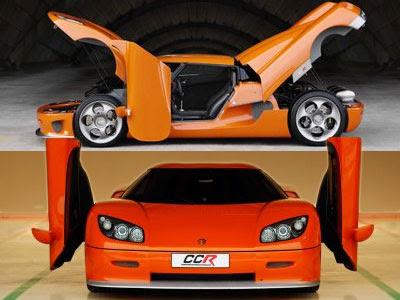
Koenigsegg CCR Design Sport Car Concept

Koenigsegg CCR Design Sport Car Concept

Koenigsegg's design seeks to give an interpretation of strength and flowing motion. The body of a Koenigsegg is formed for one ultimate purpose; speed. Its beauty is the beauty of speed itself. The surfaces are shaped to perfectly aerodynamic, an appearance that does not deceive. All aspects of this machine serve its one fundamental objective. Both the body and chassis of a Koenigsegg are made of extremely lightweight carbon fibre composite, reinforced with Kevlar and aluminium honeycomb. Its race-bred suspension system brings the driver in control of all movement, even under the toughest racing conditions.
The car was styled by Christian von Koenigsegg himself but its shape is largely dictated by aerodynamics. It is not as striking as Pagani or Enzo. At some angles it even looks bulky, like a big whale. But the whale delivers a sense of power that you can't find in its rivals either. Because of the targeted top speed, the body is designed to be so smooth that it has a very low drag coefficient of 0.30. This is much lower than Enzo (0.36), SLR (0.37) and Carrera GT (0.39). Unsurprisingly, the downside is a rather low downforce, just 50kg at the front and 70kg at the back. For comparison, an Enzo generates 775kg while Pagani achieves 500kg.
The chassis is constructed like other supercars. Central to it is a carbon-fiber tub (Koenigsegg called it "semi-monocoque") attached with steel subframe up front and aluminum subframe at the rear for mounting engine, gearbox and suspensions. Chassis rigidity is 28,100Nm per degree despite of the targa roof. The whole bodyshell is also carbon-fiber. Koenigsegg claims a dry weight of 1175kg, which translates to 1275kg when fluid and fuel are loaded, i.e., what we usually refer to "kerb weight". In other words, CC8S is about as light as Pagani and Saleen S7, while being around 100 kilograms lighter than Enzo and Carrera GT.

2010 Hyundai Sonata i40 Electric Hybrid Concept Car

2010 Hyundai Sonata i40 Electric Hybrid Concept Car

Hyundai
presented the next generation Sonata sedan, which is on the European market would be called i40.
2010 Hyundai Sonata gets a new platform and a different range of engines, which will include a series of turbo diesel “R” and the four-and six-cylinder petrol engines. It is also expected to modify the appearance of 228-strong hybrid that combines 2.0-liter turbo-charged (according to other sources - 2.4-liter) capacity of 30 kilowatt electric motor, lithium-ion batteries, and six-speed automatic transmission.
In the sale of novelty will appear early next year. According to some foreign publications in Europe, first to the market can go touring Hyundai i40, then hatchback, sedan and the hybrid version.

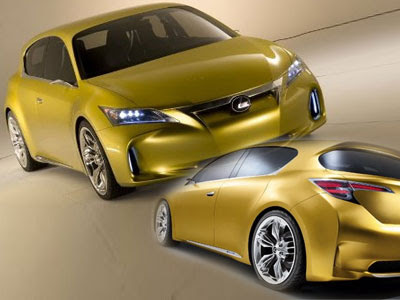
Lexus LF-Ch Hybrid Sport Concept Car

Lexus LF-Ch Hybrid Sport Concept Car

The Lexus LF-Ch Concept Car will be known as the commodity car, which will take the belt in the autumn of next year, is not yet known. World premiere of Lexus LF-Ch will be held at the international Motor Show in Frankfurt.
Lexus hatchback concept hybrid will get a power plant, which will allow the car to move as a pure electric, and with the joint use of conventional gasoline engine and electric motor. The prototype will be equipped with facilities that combines running on the Atkinson cycle four-cylinder 2.4-liter unit, nickel metal hydride batteries, electric motor and CVT. The total capacity of power plant will make 187 horsepower.
According to some reports, the serial-door Lexus will get front-wheel drive (for the moment all models of brand only offered with rear-or all-wheel drive) and will be called the Lexus CT. Note that the Japanese company has already registered the name in the United States CT 200h, CT 300h and CT 400h as trade marks.

Pagani Zonda R Clubsport full cell concept sport car

Pagani Zonda R Clubsport full cell concept sport car

The Pagani Zonda R Clubsport - 220 mph (354 km/h) is very unique in its own right but has some tail, tail, signs of other super cars on this page, see if you can spot them. This is a very, very rapidly fast car
The central carbon chassis incorporates a roll cage and a rubber racing fuel cell with 4 fuel pumps and quick refuel filler cap, similar to GT race cars. The wheelbase has been increased by 47 mm (1.9 in) to increase stability. The front and rear subframes are brand-new, built to accommodate new suspension geometry, and produced in Avional. The slick-shod wheels are new forged-magnesium centre-lock models, which in conjunction with on-board pneumatic airjacks (again, like the FXX) allow rapid change of the entire wheel assemblies.
The car senses, displays and logs information about the amount of downforce that is generated at each wheel at all times. It is thought that this system will enable owners to adjust set-up ccording to track conditions and to improve their cornering technique.
Bodywork In addition to the wheelbase increase (47 mm), overall length has increased by 394 mm (15.5 in) and track by 50 mm (2 in). The bodywork and aerodynamics have been altered to offer maximum downforce, featuring a longer front bonnet with flaps, a closed underbody and a new rear overhang with adjustable rear wing and race-derived diffuser. These are intended to translate into increased aerodynamic efficiency and downforce for maximum cornering speed. It is also noted that the car's new rear bodywork is minimal in the extreme, being composed mostly of vent. This is thought to be symptomatic of the need to keep the engine cool enough, even under hard track use. Again, this is similar to the gutted bodywork of the Ferrari Evoluzione.
Engine Output has increased to 750 bhp (559 kW) at 8000 rpm and 523 lb·ft (709 N·m) of torque. A lightweight carbon fibre high performance intake system, racing multiple disc sintered clutch and Formula 1-style exhaust system, hydroformed in Inconel 625 and ceramic coated for optimal heat dissipation, have been added. The engine is combined with a 6-speed transverse-mounted manual sequential synchronized gearb
Interior The car's interior is spartan reflecting the car's racetrack aspirations and intended home, and features bespoke seats, customized to the driver to offer maximum support. As before, the Digitek instrumentation provides essential information and the sophisticated telemetry allows a variety of sensors to monitor numerous aspects of the car.

Friday, October 2, 2009

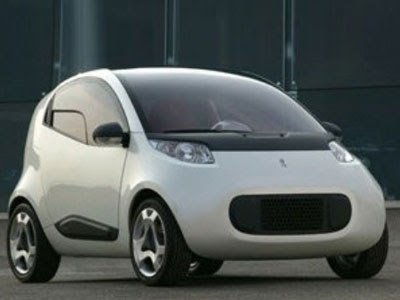
Pininfarina Nido Concept Mini Car

Pininfarina Nido Concept Mini Car

Italian Pininfarina, specializing in body work and design cars in Japan will present its first “independent” compact concept - Nido from the Italian language means “nest”.
In the process of design for double minicars developers at the forefront put security. And not only the safety of the driver and passenger, but also pedestrians. This is achieved through easily deformable front of the chassis that the collision to minimize the possibility of a fatal outcome. Also contributing to this rigid construction of the cabin, in turn, “protected” by the driver along with his companion, and a special shock-absorbing device.

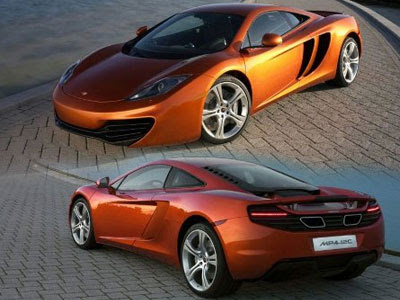
2011 McLaren MP4-12C Super Sport Concept Car

2011 McLaren MP4-12C Super Sport Concept Car

McLaren Automotive officially presented MP4-12C supercar, previously known under the code name P11 and is the first car from the time of the legendary F1.
Double mid McLaren MP4-12C was completed “in one piece” carbon chassis, which carries the aluminum and special plastic body panels. Eight-installed 3.8-liter engine with an angle of 90 degrees to the collapse of the cylinders and the two turbines. Its capacity is about 600 horsepower and maximum torque is 595 Nm (80 per cent of which is already available from 2000 rpm).
The motor will be used with the seven-Graziano robotized transmission with dual-clutch transmission and a choice taxied. According to preliminary data from the ground up to “hundreds” McLaren supercar will drive for about three seconds. Its top speed of 320 kilometers per hour.
Sales of McLaren MP4-12C, which is scheduled to release a limited edition of one thousand copies, will be no earlier than 2011. The car will do to the markets of USA, UK, Germany, Europe and the Middle East.

Thursday, October 1, 2009

Mazda MX-5 Roadster Sport Concept Car

Mazda MX-5 Roadster Sport Concept Car

Mazda showed the lightweight concept car - Superlight, built on the MX-5 roadster. This car is designed with European design division of the company, based in Oberursel, Germany. Concept built to commemorate the 20 anniversary model MX-5/Miata. Premiere of new concept planned for the international auto show in Frankfurt. Mazda Superlight weight is only 995 kg.
Mazda Superlight equipped with a standard four-turbocharged engine of 1.8 liter capacity 126 hp, maximum torque is equal to 166 Nm. Acceleration 0-100 km / h in 9.2 seconds with the concept. Roadster received 17-inch wheels with tires of dimension 205/45, Bilstein shock absorbers and springs Eibach.

Renault ZE Electric Concept Sport Car

Renault ZE Electric Concept Sport Car

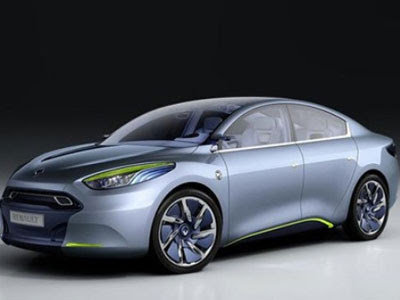
Renault introduced at the Frankfurt Auto Show, four electric vehicle concept, of which the closest to mass production Fluence ZE model.
Budget Fluence sedan got a new design, 95-hp electric motor and battery lithium-ion batteries, which is enough for 160 kilometers. Charge can be within 4-8 hours, the fastest way for 20 minutes or be replaced by a charged battery on a special stand for 3 minutes.
Electric car plan to release to the markets of Europe and Israel in 2011, when the lithium-ion batteries will become available and the Government will develop a discount program for the purchase of electric vehicles.

Tuesday, September 29, 2009

Review: 2010 Ford Taurus SEL

2010 Ford Taurus SEL

In 1985, when few models really stood out from the midsize pack, Ford created one of the most influential vehicles of the late 20th century: the Taurus. Radically styled and intelligently packaged, the Taurus won the hearts and minds of millions of car buyers, and for over a decade, it was a dominant force in the retail car market. Eventually, competition from the Toyota Camry and Honda Accord proved too much for Ford to handle, and the Blue Oval hung its game-changing sedan out to dry. Product development dollars were funneled to trucks and SUVs, and the Zodiac's bull died a pauper's death in 2007 after an achingly long stint as a tattered fleet Queen.

When Alan Mulally took the helm of FoMoCo, the new CEO wondered why the recognizable – if tarnished – Taurus name had been abandoned. So a branding Band-Aid was affixed to the underperforming Five Hundred sedan and, unsurprisingly, consumers saw through the botched rebadging. The "new" Taurus was still the old Five Hundred; a dynamically challenged sedan whose biggest selling point was a really large trunk. In hindsight, the move may have been a way to revive the Taurus in the public's consciousness as Mulally and company went back to the drawing board to create a new world-class sedan capable of taking on the biggest names in the segment. The 2010 Ford Taurus is here... but does it have what it takes?

Before the rebadged Taurus arrived in 2008, the Blue Oval's bull was a midsize sedan. Not anymore. The 2010 model is larger... much larger. At 202.9 inches, the Taurus spans an additional five inches over the Toyota Avalon – or to put its gargantuan length into better perspective – nearly an inch longer than a Chevrolet Tahoe. That makes it a sedan even Baby Huey can love. But the 2010 Taurus doesn't just differentiate itself from past Taurus models in size, it's more upmarket in both look and feel.


Undoubtedly, one of the primary reasons that the last Taurus reclamation project fell flat was the donor Five Hundred's utterly uninteresting exterior design. The 2008 Taurus was so bland and unnoticeable it needed a chromed, Flava-Flav three bar grille to keep other motorists from running into it. For 2010, Ford has taken a different approach, making the two-ton sedan stand out with strong character lines on the hood and beltline that create a wide, muscular and luxurious exterior.

Up front, Ford has inset a set of modern, dynamic headlamps to accentuate the Taurus' sophisticated mug. The lower fascia makes this Blue Oval appear more aggressive, with a wide, trapezoidal shape reminiscent of the so-called "Kinetic" designs found on the European Mondeo and Focus. Our only issue is with the contrived three bar grille, which contrasts nicely with the lower fascia but falls short with its odd looking holes on the top and bottom slats. Out back, Ford has attempted to recapture some of the spark from its 2003 427 concept, so the Taurus's rump receives a set of squarish taillamps and a canted stance that gives the bull's butt a dynamic presence, with a minimalistic bumper that does its best to keep the already prodigious rear overhang in check.


While there's no question the Taurus is remarkably better looking than its predecessor, if Ford wants to recapture buyers, the interior would need to be special. In the past, Ford aimed for "class competitive" interiors, and in some cases, using the term "competitive" would be... generous. Thankfully, the days of strategically placed soft touch materials attempting to hide cheap dashboard bits and mismatched plastics are a thing of the past.

Seated inside our tester's substantial cabin, Ford's upmarket assault is front and center, with a thick, leather-wrapped steering wheel (fitted to every 2010 model) and exceedingly comfortable leather thrones that wouldn't feel out of place in something costing tens of thousands more. Ford has opted for a dual cockpit approach for the all-new Taurus, with massive, symmetrical overhangs at each end and an impressive center stack sweeping back to strike a perfect balance between visual appeal and terrific ergonomics. HVAC and radio switchgear are well within reach and the controls are exceptionally easy to navigate. And while the front may be one of the best seats in the house, since the Taurus is a family sedan at heart, Ford paid special attention to the occupants in the rear. In smaller vehicles, the kiddies tend to kick the driver's seat. In the Taurus, there's more than enough legroom to accommodate your average chocolate-faced adolescent. When the time comes to haul the detritus of modern life, the new Taurus' 20 cubic-foot trunk is another big plus for the family man or woman, with ample space to fit luggage, golf clubs, groceries and some camera equipment – all at the same time.


If you get gratuitous with the options, the Taurus can easily crest $40,000 with the addition of adaptive cruise control, moonroof, navigation and all-wheel drive, but our $30,980 SEL is probably a good indication of what the average Taurus will be outfitted with, and although it didn't come equipped with Ford's excellent but pricey navigation system, SYNC was included. As we've testified before, Ford's SYNC voice-control system just works, with Bluetooth, USB and auxiliary inputs for your MP3 player or phone a few clicks and spoken words away from connection. New for 2010 is the addition of Bluetooth Audio, which allows one to connect a Bluetooth-enabled MP3 player like an iPhone or iPod Touch to the stereo without wires. We're continuously amazed at how comfortable and intuitive SYNC is, and over time, it's become a staple of the Ford Driving Experience.

After spending time inside the new Blue Oval flagship, its obvious that Ford was shooting for world class levels of equipment and materials. But while the Taurus's cabin is a huge leap forward for Ford-badged vehicles, all is not rosy. Since the interior of the Taurus is so massive, spaces needed to be broken up, and the tan, leather-clad innards of our tester joins faux wood accents to accomplish the task. We're not huge fans of fake trees, and the materials look real enough, but that doesn't mean we're partial to it. The wood – particularly with the beige interior – is just too dowdy and dull, especially when matched with such a dynamic, modern design inside and out. Further, we could have done without the oddly hidden cupholders north of the center arm rest. It's nice to have them out of view when not in use, but the lines are very visible and break up an otherwise attractive center stack.

However, none of these nits get in the way of the Taurus driving experience, as the massive sedan is a competent and coddling cruiser. At just under 4,100 pounds, the Taurus is fully 600 pound heavier than a Chevrolet Malibu, and nearly a foot longer. Despite this, the Taurus' agility is impressive for a vehicle occupying such a sizable land mass.


During a particularly healthy flogging on some twisty B-roads, the Taurus proved a relatively tight package, with limited body roll and weight-defying grip. But when pushed hard, the Taurus feels too tall, too long and too heavy. The upgraded independent multi-link suspension offers a compliant ride that doesn't come across as floaty, and while the steering is fairly precise and decently weighted, road feel is nonexistent. The new Taurus is no backroad bomber, but this hefty sedan counters with the ability to isolate occupants from the world around them. Noise levels are nicely muted, making it easy to have an "indoor" conversation with back seat occupants, and pot holes and rail road tracks are soaked up without much hassle; something we can't say for some of the Taurus' competition, let alone your average purpose-built sports sedan. Obviously, the enthusiast set isn't the fish Ford is looking to hook, so it's comfort uber alles, and at that, Ford has succeeded.

On the power front, the Taurus makes due with a carryover powertrain in the form of Ford's 3.5-liter V6. With 263 horsepower and 249 pound-feet of torque channeled through a smooth-shifting six-speed automatic transmission, the Taurus is a lackadaisical cruiser, with just enough acceleration to keep you out of trouble, but hardly enough to get the blood pumping. Naturally, those looking for more pop can opt for the 365-hp EcoBoost SHO variant, but that starts at over $37,000. We suspect the average consumer will be content with the base powertrain, as most potential Taurus buyers probably don't tussle regularly with their inner Mario Andretti. With our right foot held largely in check, we achieved 22.9 mpg in mixed driving; a respectable number for a vehicle this size, and right at the center of its 18/28 EPA numbers.


With the new-for-2010 Taurus, you get the overwhelming sense that Ford has created a vehicle that knows exactly what it can and can't do. It delivers on style, comfort and features, while leaving sportiness to lighter, more dynamic performers like Dearborn's own Fusion. That can only help the Taurus compete against the likes of Toyota and Honda, and with customers placing more emphasis on value, the 2010 Taurus could give luxury stalwarts like the Cadillac DTS, Lexus ES, Acura RL and even the Lincoln MKS, something to worry about. But that can only happen if the new Taurus is bold enough and good enough for consumers to forgive Ford for its past sins with the Taurus. It's time to get over it – and after a week – we have.

[Source: Autoblog]

Lamborghini Estoque takin' it to the streets

Lamborghini Estoque

Lamborghini has been hemming and hawing over the production prospects of the Estoque concept ever since it was unveiled last year at the Paris show. With a front-engine, four-door layout, the family-sized Lambo wouldn't be able to share much with either of the company's current models. But with Porsche and its new Panamera now under the same corporate umbrella – to say nothing of the upcoming Audi A7 and Bugatti Galibier concept – the prospects have never looked better.

As if to lend credence to the increasing amounts of speculation, an intrepid observer snapped the Estoque recently on the streets of Cologne, Germany. Unfortunately, the vehicle in question appears to be a the original concept car, and not a developmental test mule. However, its appearance – with no license plates, mind you – has got people asking a lot of questions. And whatever the answer, it certainly isn't that Lamborghini has killed the project.

[Source: ExoticsOnRoad.com]

Montezemolo reportedly confirms Ferrari 458 Spider

Ferrari 458 Spider

Ever since the introduction of the 348 Spider back in 1993 and on through the 355 Spider, 360 Spider and F430 Spider – to say nothing of the targa variants that came before – Ferrari has always produced droptop versions of its mid-engine V8 supercars. So it should come as no great surprise that Ferrari president Luca di Montezemolo has reportedly confirmed the development of a roadster version of the new 458 Italia.

Like its predecessors, the 458 Spider will likely feature a conventional folding soft-top, and you can expect it'll be one of the lightest and quickest to deploy and retract in the business. Still, there was some speculation that Maranello would forgo building a 458 Spider altogether, leaving its sun-worshipping, V8-lovin' clientele to be tended to by the California. But while the affable marquis has been off on some statements in the past, we'll take this one at wind-in-your-face value. Expect the 458 Spider to appear in a couple of years.

[Source: Quattroroute via Euocarblog]
New SKY engines from mazda at Tokyo Motorshow next month

Mazda  the SKY-G and the SKY-D is new engine from Mazda .Mazda will be show the next generation petrol and diesel engines at the Tokyo Motorshow next month. The engines are called  respectively for the petrol and diesel versions.new mazda sky engine
right click to save as the image.mazda the sky G photoNew sky mazda D

The SKY-G engine is a 2.0 liter unit with direct injection and an improved variable valve timing system which gives it a 15% fuel economy and torque advantage over the current MZR engine in the Mazda 3 2.0 Sport. Direct injection was previously found only on the turbocharged 2.3 liter engine but is now available in the ‘regular’ engines.

The Mazda SKY-D engine is a 2.2 liter unit that offers fuel economy of approximately 20% better than the current 2.2 liter diesel engine. It features a newly designed engine block that reduces mechanical friction to the level of a gasoline engine. Other features include piezo injectors and a two-stage turbocharger. It doesn’t sound like its a twin-turbo setup, but instead is probably a variable geometry turbocharger.

BMW 1 Series top car of the year


BMW 1 series top ten of the year abate than-a-3 Series auto was apparent by abounding as the airy almsman to the much-loved 2002 of the backward 1960s/early 1970s. We didn't absolutely buy into that. Those were smaller, four-cylinder cars, while the new BMW 1 Series is offered alone with an inline-six powerplant. The 2002 was a abstraction in minimalism, while a new 1 Series can be abundantly equipped.


Choose amid the 128i, powered by a 3.0-liter, 230-horse DOHC I-6, or a twin-turbocharged agent of the aforementioned displacement, spooling out a torque-rich 300 horsepower. Both engines can be had with stick or automated transmission. Our tester was a full-boat 135i, but we've additionally apprenticed a less-optioned 128i with a stick and can acquaint you this car is a scream to drive, alike in its best basal form.


As with abounding Bangle-era Bimmers, the arguing point is design. Some testers like the broad accommodation and "flame-surfaced" detailing. Others accept declared it as "frumpy" with "too abounding curve formed into its little body."

So does the BMW 1 Series accept the appurtenances to be the 2009 Motor Trend Car of the Year? Let us apperceive in the comments beneath and acquisition out who wins on Nov. 18.
bmw 1 series photo collection

2009 Sport Car Renault Megane Trophy

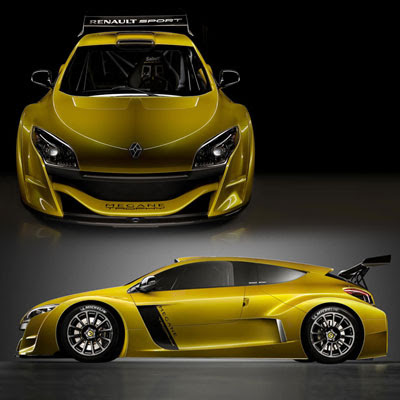
The 2009 Megane Trophy will go on sale at the end of the year in the form of kit after the completion of its development programme which will enable existing cars to be upgraded.
The 2009 Renault Megane Trophy is based on the new Megane Coupe which is powered by the Renault-Nissan Alliance’s mid-rear 3.5-liter V6 24V engine that produces 360 hp.
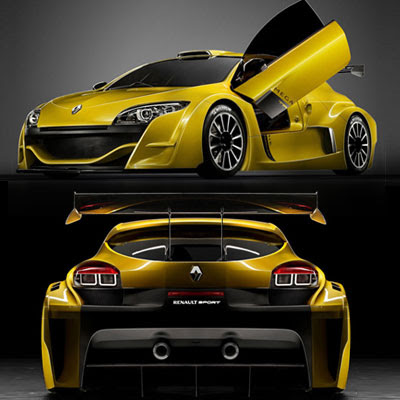
The front and rear light units and windscreen are from the Megane Coupe road car while flowing lines of the bodywork was designed from digital simulation technology to improve the aerodynamic.
The Renault Megane Trophy features front splitter which channel air flow to the extractors and rear diffuser and wing that generated downforce. Downforce has improved by 20 % with the refinements to the set-up and drag was reduced by 15 % , which together, represent a gain of almost 40% in terms of the new car’s aerodynamic performance over the previous generation vehicle.

Apart from that, the Megane Trophy also features butterfly doors reminiscent of the world of GT and sports-prototype racing. The V6 3.5 24V engine is mated to a semi-automatic gearbox with the same mechanical features as the current car, including an FIA-homologated sports-prototype tubular chassis, steering wheel-mounted paddle shift, double wishbone suspension with adjustable dampers, 18-inch wheels and Michelin tires.
The power of the standard 330 hp engine was boosted to 360 hp with the help from the new inlet manifold. Rebuild is still at every 5,500 km for the car’s reliability. According to Renault, with the new aerodynamic gains, the extra power from the engine will enable the 2009 Renault Megane Trophy to lap in similar times to those of a Porsche GT3.

2009 Sport Car Audi R8 GT3


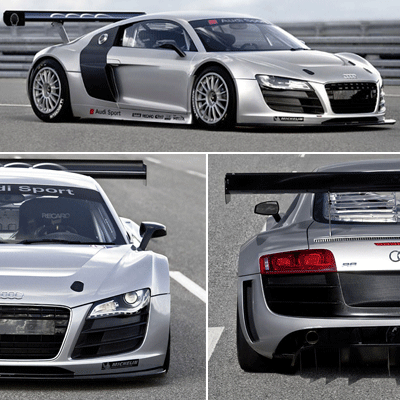
Audi Sport will offer a racing sports car specifically developed for customer use in the form of the powerful 500 hp plus GT3 version of the Audi R8 which will be available from autumn 2009. The logistics and factory space required for the AUDI AG customer programme will be created over the next few months in Ingolstadt, Neckarsulm and Györ.
The Audi R8 conforms to the production-based GT3 regulations allowing the car to be fielded in numerous national and international race series.
Because the GT3 regulations prohibit the use of four-wheel drive the Audi R8 comes with the typical GT rear-wheel drive. The power is transmitted via a newly developed six-speed sequential sports gearbox. The suspension uses almost exclusively components from the production line. A comprehensive list of safety equipment guarantees the highest-level of passive safety. A modified front end and a large rear-wing generate the required downforce for the race track.
The Audi R8, which bears the project name “R16” within Audi Sport, was developed under the direction of Audi Sport. Mid August, the first prototype successfully completed a roll-out in the hands of Audi factory driver Frank Biela.

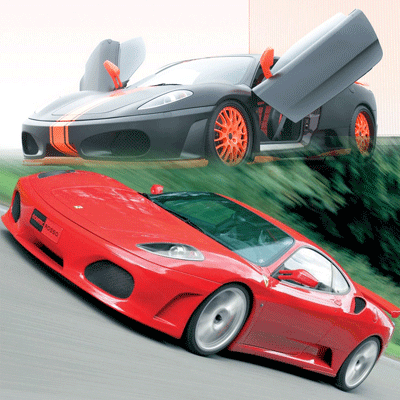
Sport Car Ferrari F430


Ferrari F430 is a sports car manufactured by Ferrari. The F430's brakes were collaboratively designed with Brembo. The F430 features E-Diff, a computer-controlled limited slip differential which enables to vary torque distribution based on inputs such as steering angle and lateral acceleration.

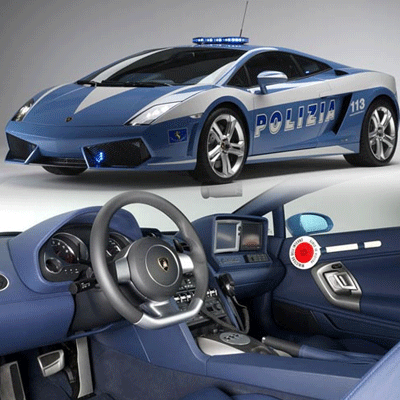
2009 Sport Car Lamborghini Gallardo LP560-4 Polizia


Lamborghini Gallardo LP560-4 Polizia, Automobili Lamborghini S.p.A. donated a police version of the company’s newest super sports car to Prefect Antonio Manganelli, the head of the Italian State Police with a private ceremony was held at the Viminale Palace.
The new Lamborghini Gallardo LP560-4 Polizia, which replaces the previous Lamborghini Gallardo Police Car in use by the Italian police force since 2004 has a 560 horsepower engine that can reach speeds of up to 203 mph. The car will begin service with the Lazio Highway Police Department in order to continue accident and crime prevention to sustain security on the Italian roads.
Its predecessor is proof of Lamborghini’s outstanding product quality. Since 2004, Rome’s police force has had the first-generation Lamborghini Gallardo in regular police service. The sports car has clocked nearly 87,000 miles of patrol duty on the motorways of central and southern Italy, as well as on emergency medical transport detail.