Friday, January 8, 2010

Capstone Supercar CMT-380 the high performance hybrid electric microturbine vehicle Debut at LA Auto Show

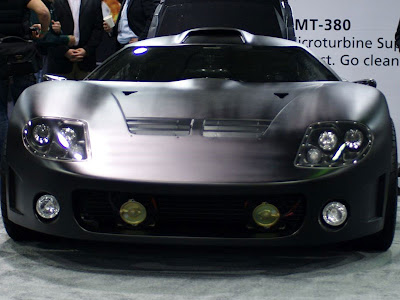
Capstone Supercar CMT-380

The Capstone CMT-380 was the surprise basement find of the LA Auto Show.The Capstone CMT-380 is essentially a prototype show car designed to highlight the technology and products available from Capstone Turbine Corporation. The concept for the high performance hybrid electric microturbine vehicle was developed by Electronic Arts (EA) Chief Creative Director Richard Hilleman.
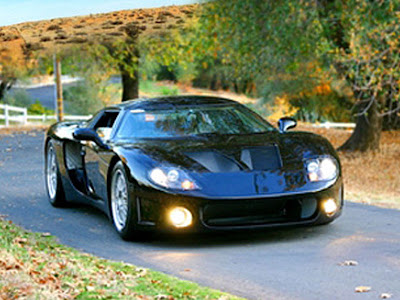
Capstone Supercar CMT-380

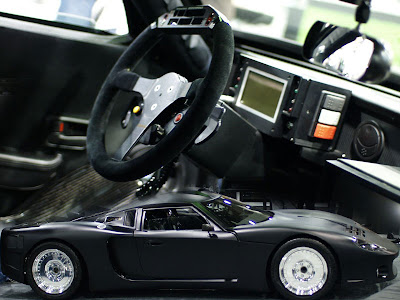
After working on the car for four years, inventor Richard Hilleman was the man of the hour as he fielded questions about his unusual microturbine-lithium-ion hybrid powertrain fitted to a GTM Supercar kit body. It may still be in the test phase, but Capstone claims that the car can reach a top speed of 150mph, and is able to sprint from zero to 60mph in just 3.9 seconds.
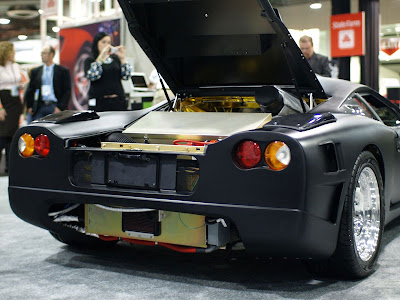
The CMT-380 features an unusual hybrid drivetrain which uses one of Capstone's new C30 (30-kilowatt) microturbine engines to extend the range of the primarily electric powered vehicle. The turbine can be run on either diesel or biodiesel.
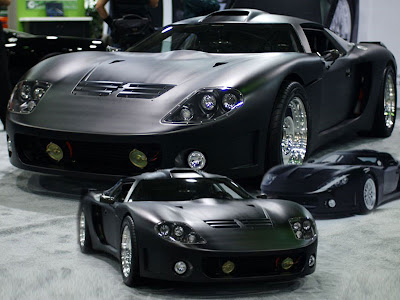
Capstone Supercar CMT-380

The CMT-380 features lithium-polymer battery cells that can be charged at home or at a public recharging station. While driving, the CMT-380 can operate on 100 percent battery power in zero emissions mode for a range of up to 80 miles. When the batteries reach a predetermined state of discharge, the Capstone C30 microturbine quietly fires up and recharges the batteries on the fly to extend the driving range up to 500 miles. The diesel fueled C30 microturbine requires less maintenance than traditional combustion engines and produces ultra-low exhaust emissions. Hilleman has owned an electric vehicle – a converted Porsche 550 Spyder – for at 15 years and has constantly upgraded it. The EV used to have just 30 hp with lead acids but now uses lithium ferrous batteries and has 200 hp. The 100-mile range hasn't changed, though, and so he knew it was time to build a hybrid. He decided on Capstone's diesel microturbines as the range extender.
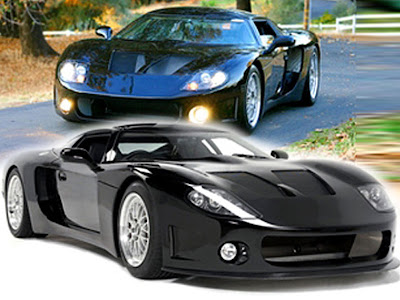
Capstone Supercar CMT-380

He knew he could rely on them – they've been used in buses for years – but there was still the challenge of fitting the unit into a car like this. Hilleman built the CMT-380 just for himself, but Capstone is happy to show it off as a proof of concept vehicle. It would be too pricey to put into mass production (Hilleman estimated he put in about $375,000 hours of work), but it's not impossible that a high-end, expensive, limited production run could be made some day.
Capstone Supercar CMT-380

Right now, Hilleman is really happy with his creation. He especially loves the sound of the vehicle. Three feet to the side of the car, the microturbine puts out about 87 dB, but in the cabin, it's nearly silent. California law might require him to add a muffler, but it's already quiet enough without one. He's got a solution for that problem, should he need it.
The chassis and bodywork of the Capstone CMT-380 are borrowed from the Factory Five GTM kit sports car, and modified to accept the hybrid drivetrain.
Capstone Supercar CMT-380

"Capstone's CMT-380 is just now finishing up the conceptual design and first article testing stage," said Darren Jamison, Capstone President and CEO. "We plan to finalize very soon a limited production plan, in part, based on interest received at the [2009] LA Auto Show. We anticipate customers will be a select group of individuals who appreciate its many innovative high-performance and high-technology driving characteristics, long driving range and ultra-low emissions," added Jamison.
Thursday, January 7, 2010

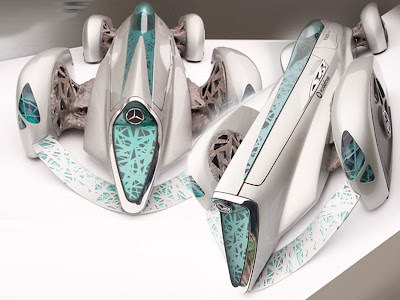
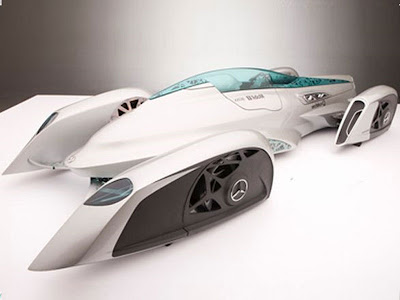
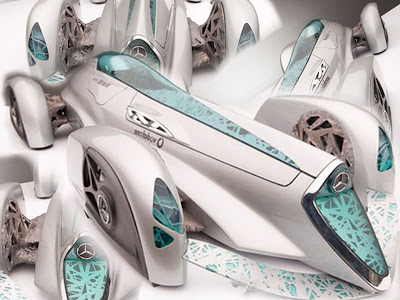
Mercedes-Benz BlitzenBenz Concept Car Production year theoretical 2025

Mercedes-Benz BlitzenBenz concept car

Mercedes-Benz BlitzenBenz concept car Production year theoretical 2025. Brilliant and outstanding is what every car lover will exclaim when will see this BlitzenBenz concept car. The Mercedes-Benz BlitzenBenz concept was created by George Yoo, a designer at Mercedes-Benz Research and Development in Carlsbad, California. The BlitzenBenz was developed during his final year at the Art Center College of Design in Pasadena.
Mercedes-Benz BlitzenBenz concept car

Created by George Yoo as a futuristic racing vehicle, BlitzenBenz concept is derived from two different sources. And let me tell you the roots of its design are in the past. The main inspiration behind the idea is from original Blitzen-Benz from 1909 that had a long tubular shape and rear cab positioning. On the other, Alex Erlandson work of creating sculptures from trees that were grown into certain shapes/patterns influenced Yoo considerably to contemplate what if automotive parts were to be grown and tamed to hold certain shapes.
Mercedes-Benz BlitzenBenz concept car

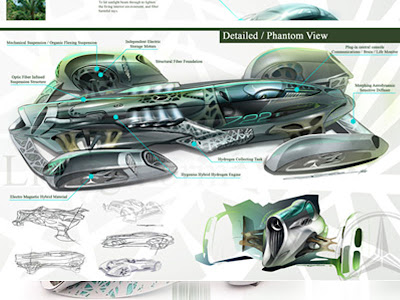
Obviously the technology is not quite there yet to create such a vehicle, but the current research into nanotechnology is paving the way for intelligent and adaptable components which can be grown instead of manufactured. It's an incredibly interesting prospect which would completely alter the way cars are built, maintained, upgraded and recycled.
Mercedes-Benz BlitzenBenz concept car

The exterior design is a base for the organic structure and the individual wheel pods are there to sense as to when the inside electric motors need to be cooled down. When the cooling will be required, these structures will open up in the same way as the plants do to receive the vital sunlight.
Mercedes-Benz BlitzenBenz concept car

To run this Mercedes-Benz BlitzenBenz, there is an advanced next-generation Hygenius hybrid hydrogen engine and four in-wheel electric motors. The inspiration for the blue lightening system came from bioluminescent capabilities of deep sea creatures. Also, a hydrogen storage tank is just below the cockpit and the fuel level is shown in a small window.
Mercedes-Benz BlitzenBenz concept car

Though, woefully, there is no technology to make this vehicle as such, but the progressing research into nanotechnology will surely open the way for components that can be grown than manufactured, changing the way cars will be built or maintained in future.

Wednesday, January 6, 2010

Top 20 Best-Selling Vehicles of 2009

Top 20 Best-Selling Vehicles of 2009

Mouse over the clock in the lower right-hand corner of your PC. Alternatively, if you're a Mac user, look at the little iCal widget down at the bottom of your screen. Whoa, look at that! It's 2010. January 6th, to be exact. And that means the final sales tallies of all automakers for the year-that-was are in. As you may have noticed yesterday, none but Subaru, Kia and Hyundai are likely to be entirely pleased with their YTD performances, falling as they did compared to sales in 2008.

Wouldn't you know, though, that not one of those three upwardly trending automakers earned a single spot on the Top 10 Best Selling Vehicles chart? To see a Korean automobile on the list, you need to expand the search to the Top 17. This fact reminds us yet again that by and large the American population tends to be a rather predictable bunch.

Think you can guess what the best-selling vehicle of 2009 was? We won't lie... you probably can. In fact, it's been the same vehicle for the past 28 years straight

[Source: Examiner.com]

Top 20 Best-Selling Vehicles of 2009


First, let's get numbers 20–11 out of the way. There are a couple of interesting highlights, such as the Chevrolet Impala, which drops four spots from 2008 down to number 12 as its Bowtie sedan stablemate, the Malibu, jumps in at number 13. We also see the Toyota Prius at number 16, falling just shy of 150,000 units sold in 2009. Finally, note the GMC Sierra at number 18. Interestingly, when the Sierra's 111,842 sales are added to its Silverado sibling from Chevrolet, that platform outsells the Ford F-150 rather handily. As you'll soon see, though, Ford does indeed have the last laugh once all full-size truck sales are counted.

  • Chevrolet Cobalt: 104,724
  • Toyota Tacoma: 111,824
  • GMC Sierra: 111,842
  • Hyundai Sonata: 120,028
  • Toyota Prius: 139,682
  • Toyota RAV4: 149,088
  • Ford Focus: 160,433
  • Chevrolet Malibu: 161,568
  • Chevrolet Impala: 165,565
  • Ford Escape: 173,044
Number 10 – Dodge Ram: 177,268


Number 9 – Ford Fusion: 180,671


Number 8 – Honda CR-V: 191,214


Number 7 – Nissan Altima: 203,568


Number 6 – Honda Civic: 259,722


Number 5 – Honda Accord: 290,056


Number 4 – Toyota Corolla: 296,874


Number 3 – Chevrolet Silverado: 316,544


Number 2 – Toyota Camry: 356,824


Number 1 – Ford F-Series: 413,625

By the Numbers - 2009

By the Numbers - 2009

Most automakers giving themselves a pat on the back for a strong sales performance in December should take a second look at the books. A good month of sales to finish off a crappy year still equals a crappy year of sales. The chart below makes this perfectly evident, as only three individual brands and no multi-brand automakers managed to make it through 2009 selling more vehicles than they did in 2008. Not surprisingly, Subaru, Kia and Hyundai (in that order) were the three brands to post an overall sales increase in 2009, with Subaru posting a double-digit rise of 15 percent. With 216,652 sales overall, Subaru now sells more vehicles in the U.S. than Volkswagen and Mazda, two direct competitors with larger lineups.

Though no multi-brand automaker can claim a sales victory in 2009, you might be surprised to learn that Ford Motor Company with its Ford, Lincoln, Mercury and Volvo brands performed the best. FoMoCo sales in 2009 fell 15 percent, a smaller drop than any of its competitors. Toyota Motor Company sales (Toyota and Lexus combined) fell over 20 percent, but the Japanese juggernaut still managed to beat Ford in number of vehicles sold (1.77 million to 1.68 million).

The rest of the industry's performance can be viewed in the chart below. Note that there were 308 selling days in both 2008 and 2009, so the percent change in volume sold will equal the percent change in the daily average sales rate.

.

Brand/Company Volume % Dec. '09 Dec. '08 DSR* % DSR Dec. '09 DSR Dec. '08
Subaru 15.43 216,652 187,699 15.43 703 609
Kia 9.75 300,063 273,397 9.75 974 888
Hyundai 8.29 435,064 401,742 8.29 1,413 1,304
Volkswagen -4.34 213,454 223,128 -4.34 693 724
Audi -5.75 82,716 87,760 -5.75 269 285
Ford -14.34 1,445,742 1,687,731 -14.34 4,694 5,480
Mercedes-Benz -15.34 190,604 225,128 -15.34 619 731
Volvo -15.96 61,435 73,102 -15.96 199 237
Mini -16.37 45,225 54,077 -16.37 147 176
Lexus -16.96 215,975 260,087 -16.96 701 844
Nissan -17.81 689,014 838,361 -17.81 2,237 2,722
Honda -18.63 1,045,061 1,284,261 -18.63 3,393 4,170
Toyota -20.61 1,554,174 1,957,575 -20.61 5,046 6,356
BMW -21.12 196,502 249,113 -21.12 638 809
Mazda -21.29 207,767 263,949 -21.29 675 857
Lincoln -22.79 82,847 107,295 -22.79 269 348
Mercury -23.24 92,299 120,248 -23.24 300 390
Porsche -24.35 19,696 26,035 -24.35 64 85
Chevrolet -25.35 1,344,629 1,801,131 -25.35 4,366 5,848
Buick -25.43 102,306 137,197 -25.43 332 445
Acura -26.84 105,723 144,504 -26.84 343 469
Infiniti -28.23 81,089 112,989 -28.23 263 367
Jeep -30.61 231,701 333,901 -30.61 752 1,084
GMC -31.09 259,779 376,996 -31.09 843 1,224
Cadillac -32.31 109,092 161,159 -32.31 354 523
Pontiac -33.31 178,300 267,348 -33.31 579 868
Dodge -33.34 522,686 784,113 -33.34 1,697 2,546
Smart -40.72 14,595 24,622 -40.72 47 80
Mitsubishi -44.85 53,636 97,257 -44.85 174 316
Chrysler -47.18 177,015 335,108 -47.18 575 1,088
Saab -59.38 8,680 21,368 -59.38 28 69
Saturn -61.35 72,660 188,004 -61.35 236 610
Hummer -67.09 9,046 27,485 -67.09 29 89
COMPANIES
Ford Mo Co -15.39 1,682,323 1,988,376 -15.39 5,462 6,456
Nissan NA -19.05 770,103 951,350 -19.05 2,500 3,089
American Honda -19.46 1,150,784 1,428,765 -19.46 3,736 4,639
Toyota Mo Co -20.18 1,770,149 2,217,662 -20.18 5,747 7,200
BMW Group -20.27 241,727 303,190 -20.27 785 984
General Motors -30.07 2,084,492 2,980,688 -30.07 6,768 9,678
Chrysler Group
-35.90 931,402 1,453,122 -35.90 3,024 4,718

Lamborghini Gallardo LP570-4 Super Veloce rendered ahead of Geneva debut

Lamborghini Gallardo LP570-4 Super Veloce

Let's make one thing very clear from the onset. The images you see above are not official shots of the Lamborghini Gallardo LP570-4 Super Veloce. They're renderings. Good renderings, mind you, but nothing more than photoshopped speculation. So with that out of the way...

It's been assumed for months that Lamborghini would unveil a final special edition Gallardo at the Geneva Motor Show this March. If the most recent reports are to be believed, the V10 will be tweaked and tuned to put out 570 horsepower through all four wheels – just as it's LP570-4 designation would imply. However, there's still no word on whether the Super Veloce moniker will be applied and what kind of weight savings will be exacted. If it's anything like the Murciélago LP670-4 SV, expect the curb weight to drop by around 200 pounds and the 0-60 time to speed by in under 3.5 seconds. And if the folks in Sant'Agata really want to bring the noise, the Gallardo SV will drop the "-4" and go rear-wheel drive like its Valentino Balboni sibling.

[Source: Lambocars via Insideline]

Aston Martin could build hybrid Lagonda, all-electric Cygnet

Aston Martin Lagonda Concept

Are hybrid drivetrains befitting of a premium luxury and performance brand? Well, that depends on who you ask. According to such diverse automakers as BMW, Mercedes-Benz, Jaguar, Rolls-Royce and even Ferrari and Lamborghini, the answer is 'yes'. Aston Martin CEO Dr. Ulrich Bez, though, reportedly believes otherwise. "The current hybrid technologies are not suited to the character of Aston Martin sports cars," explains Bez.

We're not so sure we agree, especially since Aston's long-planned Lagonda revival – which may or may not come wrapped in an ungainly SUV package – is rumored to be equipped with a hybrid powertrain. After all, the torque-rich nature of electric motors certainly wouldn't be a bad thing for a luxury tourer.

A few branches up on the green tree, Aston Martin's tiny Toyota iQ-based Cygnet minicar could quite possibly get a fully electric drivetrain, which would seem to make sense given that car's stated mission as an urban runabout for those times when a V12 Vanquish could be considered overkill. Beautiful, sonorous, splendid overkill...

Monday, January 4, 2010

Ford Rescue X Concept created at Ford of Europe design studio By Robert Engelmann

Ford Rescue X Concept By Robert Engelmann

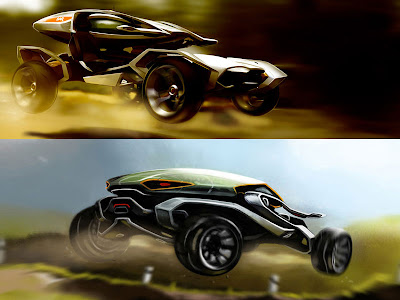
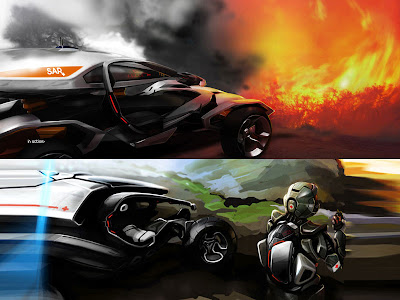
The Ford Rescue X design proposal from Robert Engelmann is a tough vehicle designed for rescue operations in treacherous terrains. The futuristic search and rescue vehicle is designed to reduce time consumption in medical emergencies. The Ford Rescue X Concept is a study of a futuristic search and rescue vehicle designed for rough terrains that features a dedicated medical module and Computer Aided Surgery equipment. It was designed by German product design graduate Robert Engelmann.

Ford Rescue X Concept By Robert Engelmann

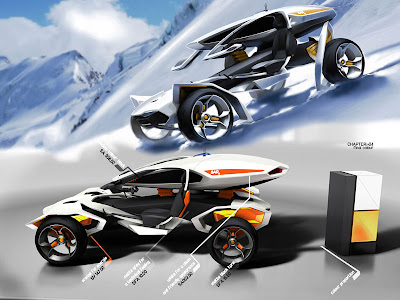
Ford Rescue X Concept Rendering Ford Rescue X Concept Rendering The car has an original layout, with an open structure that integrates two seats for the driver and another operator, and a dedicated closed medical module, which is connected to the chassis by means of a mechanical balancing system. The medical module floats above the main structure and protects the passenger like an egg. A display window shows the passenger's health conditions.
Ford Rescue X Concept By Robert Engelmann

One of the seats has an integrated first aid pack that can be quickly released, while the rotating wheel arches on the concept allow it to move through snow covered/ icy terrains. The medical module has a system to allow remote Computer Aided Surgery (CAS). The concept has an electric drivetrain utilizing four suspension-mounted motors.
Ford Rescue X Concept By Robert Engelmann

Ford Rescue X Concept Ford Rescue X ConceptThis contributes to the safety of the injured person and allows a specialist to remotely operate the integrated medical equipment in order to do an emergency surgery anywhere. Ford Rescue X Concept - Design Panel The rotating wheelarches can be turned into special breaks for extreme conditions such as on the snow or icy terrains. A backpack with first aid tools is integrated in the seat and can be quickly released. The integrated medical equipment also includes a computer tomograph and a CAS system (Computer Aided Surgery).

Ford Rescue X Concept By Robert Engelmann

The project was created at Ford of Europe design studio by Robert Engelmann for his product design diploma at HBK Saar, Germany.

Sunday, January 3, 2010

2020 Aston Martin Twenty Twenty Sports Car concept designed by Giorgetto and Fabrizio Giugiaro of ItalDesign (2001)

2020 Aston Martin Twenty Twenty Sports Car concept

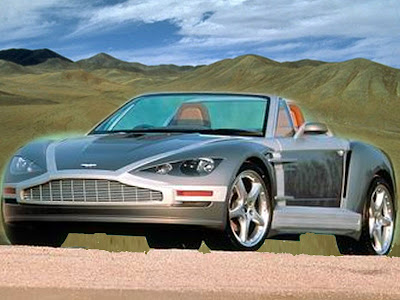
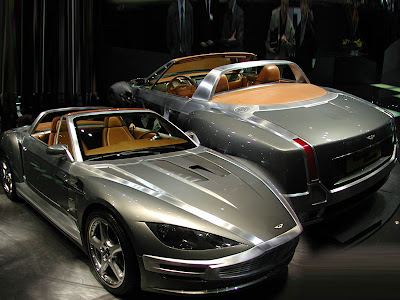
Geneva is one of the world's great auto shows, if for no other reason than it's the place where Italy's design houses and coachbuilders -carrozzerie- annually roll out their latest concept cars. This year, Aston Martin previewed the production version its voluptuous Vanquish (covered elsewhere in this issue). But that wasn't the only Aston on the show floor. The Aston Martin Twenty Twenty concept from 2001 was designed by Giorgetto and Fabrizio Giugiaro of ItalDesign.
2020 Aston Martin Twenty Twenty Sports Car concept

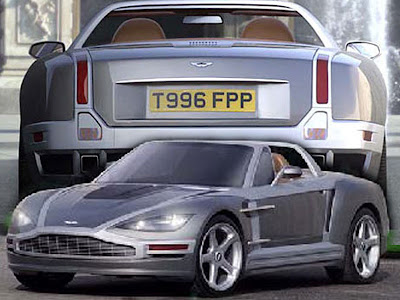
The fully-functioning concept car was intended as a vision for a convertible Aston Martin sports car for the year 2020. Italdesign sprung this amazing car on the unsuspecting visitors to the 2001 Geneva Salon L'Auto. This startling car, based on an early production DB7 Vantage, has a body shape made of exposed extruded aluminium structural elements; body panels made from plastic and carbon fibre are fitted onto it. Thankfully Aston Martin’s current styling trend is headed in a completely different direction to the Twenty Twenty concept.
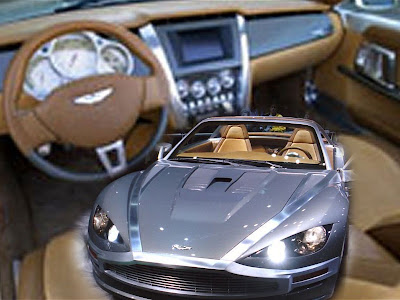
The brushed aluminium highlighting lines which adorn the Aston Martin Twenty Twenty are an original design feature. However their overuse (especially around the front) gives the concept an unusual, almost comical appearance from some angles. The grille surround almost looks like lipstick.
2020 Aston Martin Twenty Twenty Sports Car concept

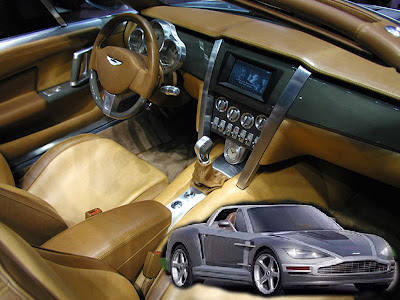
The Twenty Twenty is powered by front mounted, uprated version of the 6 litre V12 from the DB7 Vantage, said to produce 500bhp - visible through a grilled fairing on the bonnet. Initially it appears to be a strict 2 seater, although the rear bulkhead can be removed to provide seating for two children. The rear of the Aston Martin Twenty Twenty (from the doors back) is more appealing with more conservative use of bare aluminium. The soft top is stored in its own special housing that can be slotted into position between the roll-bar and the windscreen, 'Targa' fashion. Notice the fantastic door hinges - derived from the classic Aston wing vent, are both decorative and functional elements.
2020 Aston Martin Twenty Twenty Sports Car concept

Giorgetto Giugiaro and Aston Martin previously co-operated in 1961, when Carrozzeria Bertone worked on the two-seater DB4GT Jet coupe prototype. And like the original 'Jet' car, the 2020 is destined to remain unique. Aston Martin are believed to have thought the 2020 'interesting', but no plans were ever made even for limited production. As the Twenty Twenty isn't an official Aston Martin design project, don't look for any sort of production version. What about the name? Simple: It's the term commonly used to describe perfect vision. And the Giugiaros clearly have good eyes.
2020 Aston Martin Twenty Twenty Sports Car concept

In March 2004, I received an e-mail claiming the 2020 was for sale, but I have been unable to find any reference to this anywhere. But the car was seen for the first time in the UK at the Goodwood Festival of Speed, June 2005.